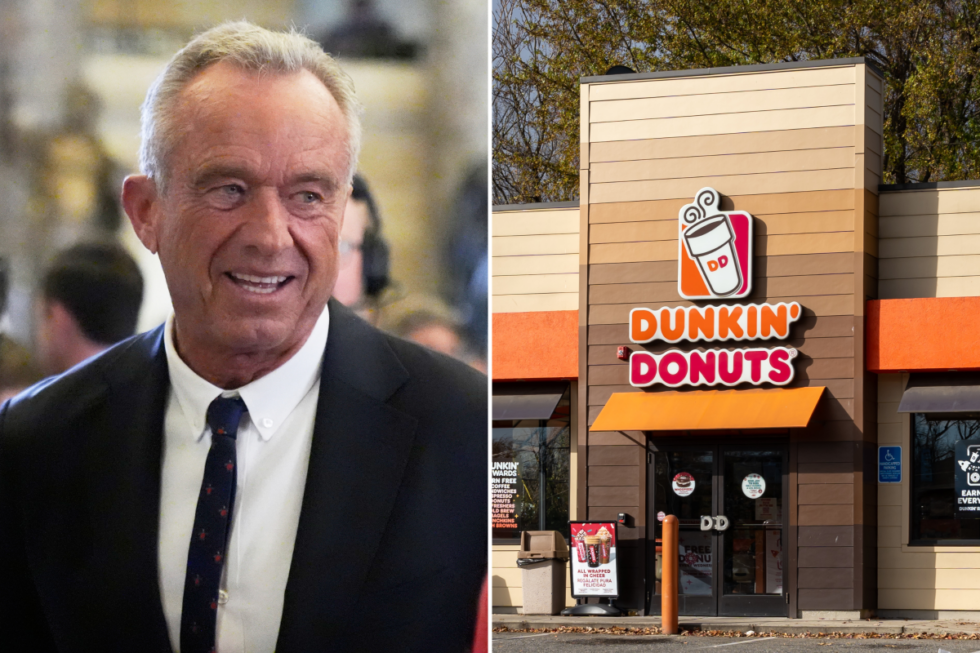
Robert F. Kennedy Jr. has taken on powerful food industry targets before, but his public challenge to Dunkin’ and Starbucks over high‑sugar drinks has sparked a sharper political and cultural backlash than many of his earlier health initiatives.
The health and human services (HHS) secretary has faced relatively limited resistance while pushing to phase out synthetic food dyes, promote beef tallow over seed oils, and reframe federal dietary guidelines under his “Make America Healthy Again” agenda. But by questioning the safety of sugary beverages sold by two of America’s most popular consumer brands, he has stepped into more politically sensitive terrain—raising questions about how far the MAHA agenda can go before it collides with consumer habits, corporate power, and cultural attachment to familiar foods.
“We’re going to ask Dunkin’ Donuts and Starbucks, ‘Show us the safety data that show that it’s OK for a teenage girl to drink an iced coffee with 115 grams of sugar in it,” Kennedy said at a rally in Austin, Texas last week, according to The Boston Globe. “I don’t think they’re going to be able to do it.”
The reaction was swift. Kennedy’s comments drew backlash on social media and from elected officials, including Massachusetts Democratic Governor Maura Healey, underscoring how differently Americans have responded to his challenge of Dunkin’ and Starbucks compared with earlier MAHA initiatives.
Kennedy moved quickly to downplay concerns that the government was coming for Americans’ coffee. “No one is taking away your Dunkin’,” he wrote on X Thursday in response to Healey’s post daring him to “come and take it,” alongside a picture of a Dunkin’ cup. “But isn’t it reasonable to ask whether a drink loaded with 180 grams of sugar is safe?”
An HHS spokesperson told Newsweek that Kennedy is pushing Americans to reduce added sugar, pointing to federal dietary guidance that discourages sugar‑sweetened beverages and urges limits on added sugar.

MAHA’s Push for ‘Real Food’
A significant part of Kennedy’s MAHA campaign has been about getting Americans to eat “real food.” He recently released new dietary guidelines as part of this bid that focus on reducing Americans’ intake of highly processed foods, getting them to prioritize protein, making sure they eat the right number of calories and nudging them toward whole-milk dairy products, among other things.
This came following Kennedy’s victory in removing eight synthetic food dyes last year, a move that was widely supported by health advocates. Some states even took it a step further and began to regulate other food additives in meals served to children in schools.
Another focus Kennedy has in regard to Americans’ diet is reducing the widespread use of “seed oils.” This move has been less supported by nutrition scientists, who say research indicates benefits rather than harms of using the oils, although a number of American influencers were quick to support Kennedy’s objective.
Unlike food dyes or obscure additives, sugary coffee drinks are woven into daily routines, regional identity, and consumer loyalty—particularly at chains like Dunkin’, whose brand is culturally embedded in the Northeast and among working‑class voters Kennedy needs to persuade.
The Numbers Behind the Backlash
Starbucks and Dunkin’ Donuts make up the highest proportion of America’s coffee shops. Based on data up to 2024 gathered by coffeedasher.com, Starbucks has a 40 percent market share in coffee shops in the U.S., followed by Dunkin’ at 26 percent. It is estimated that Starbucks sells about 5 million cups of coffee a day in the U.S., while Dunkin’ sells 60 cups a second globally.
However, while both chains are widely popular across the country—and the world—some of their beverages have high levels of sugar.
For example, some of Starbucks’ Frappuccino drinks, like the Caramel Ribbon Crunch, Pumpkin Spice and White Chocolate Mocha Frappuccinos, have 60 or more grams of sugar. It’s Caramel Apple Spice drink has 77 grams.
Meanwhile, on Dunkin’ Donuts’ menu, some frozen coffee options exceed 100 grams of sugar per drink—with the large-sized Triple Mocha Frozen Coffee containing 165 grams of sugar and 1,100 calories. A number of its iced Lattes also exceed 70 grams of sugar, such as the Banana Puddin’ Cloud Latte, the Hazelnut Cloud Dunkalatte and the Vanilla Chai Latte.
According to the American Heart Association, sugar-sweetened beverages make up 24 percent of where Americans are getting their high sugar levels from. The association says many Americans consume more than two to three times the recommended daily allowance of added sugar, which is 36 grams for men and 25 for women.
Experts Agree on the Problem, Split on the Approach
Jerold Mande, a former FDA senior adviser, CEO of Nourish Science and a Harvard professor, told Newsweek that “the coffee is great and good for our health,” but that the “extensive use and marketing of highly processed refined carbohydrates are killing us.”
“Americans have the shortest lifespans among wealthy nations,” he said. “Thirty to forty percent of our children have a food‑caused chronic disease.”
Marion Nestle, a professor of nutrition and public health at New York University, said drinks with such high sugar levels are “hard for bodies to metabolize.”
“Over time, diets with a lot of such things will predispose to obesity, type 2 diabetes and other chronic conditions,” she said.
Dr. Dariush Mozaffarian, director of the Food is Medicine Institute at Tufts University, told Newsweek that “the administration here is exactly right,” calling diet‑related disease a national crisis.
But Nestle cautioned that it is unrealistic to expect every food company or restaurant to conduct clinical trials for individual menu items. “The scientific question is to ask at what dose sugar becomes harmful,” she said.
Susan Mayne, former director of the FDA’s Center for Food Safety and Applied Nutrition, was more critical, calling Kennedy’s approach “bullying” when the same ingredients are widely used across the food supply.
“If FDA has concerns about the safety of any ingredient, they should lay out those concerns and use a regulatory process to address them broadly,” she said, adding that clearer labeling and consumer education would be more effective.
What This Reveals About the Limits of MAHA
One of Kennedy’s most enthusiastic constituencies, the “MAHA Moms,” welcomed the move. Zen Honeycutt, founder of Moms Across America, said supporters were glad the health secretary was holding food companies accountable.
But the backlash to his Dunkin’ and Starbucks comments highlights a broader political reality: MAHA’s easiest victories come when reform can be framed as protecting consumers from hidden dangers. Its hardest battles emerge when reform feels like a judgment on consumer behavior itself.
Many Dunkin’ fans have responded with jokes and memes online, signaling how quickly public health messaging can turn into cultural pushback when it touches beloved brands.
Whether MAHA can move beyond ingredient reform and sustain momentum when it challenges daily habits may determine how far Kennedy’s food agenda ultimately goes.
Update 3/6/26, 3:18 a.m. ET: This article has been updated with a comment from HHS.
Update 3/6/26, 9:21 a.m. ET: This article was updated with additional information.
In a polarized era, the center is dismissed as bland. At Newsweek, ours is different: The Courageous Center—it’s not “both sides,” it’s sharp, challenging and alive with ideas. We follow facts, not factions. If that sounds like the kind of journalism you want to see thrive, we need you.
When you become a Newsweek Member, you support a mission to keep the center strong and vibrant. Members enjoy: Ad-free browsing, exclusive content and editor conversations. Help keep the center courageous. Join today.