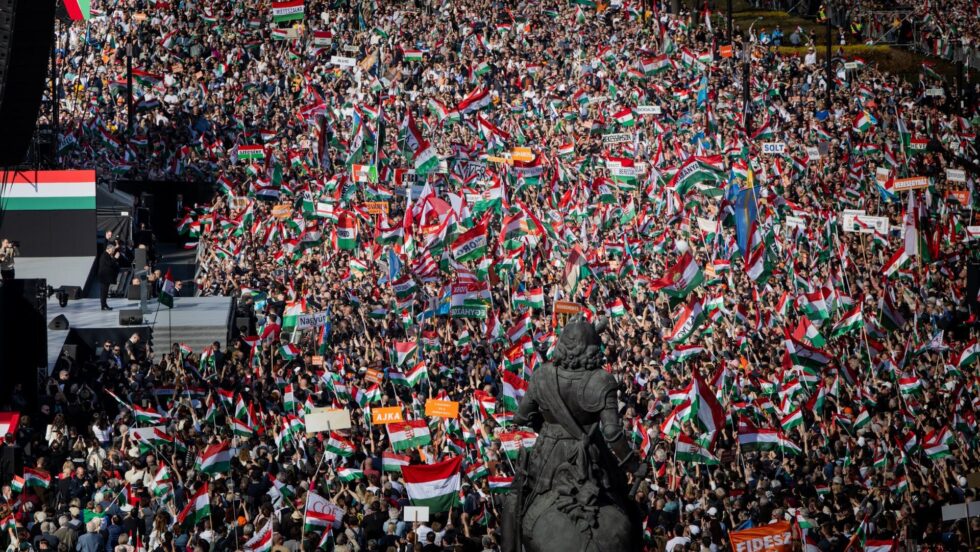
The whole of Europe is watching as Hungarians head to the polls on Sunday, April 12, to elect 199 MPs to the National Assembly. The vote is seen as a pivotal election not just in the 10-million-strong Central European nation of Hungary but also throughout Europe.
Prime Minister Viktor Orbán’s conservative Fidesz party has been in power for the last sixteen years, implementing policies that have drawn the ire of the European Union’s institutions, as well as of liberal governments in Western Europe.
Viktor Orbán has pursued anti-immigration, pro-family, anti-LGBT, and anti-woke policies. His government has espoused conservative, Christian values. His foreign policy has been built on a common-sense approach, trying to establish pragmatic relationships with not only Hungary’s traditional Western allies within the EU and NATO but also with powers like China and Russia.
The EU has lambasted the Budapest government for diverging from the mainstream EU approach and refusing military aid to Ukraine, opposing Ukraine’s EU accession, and rejecting sanctions on Russia, which Orbán’s government says harms the European economy more than Russia itself.
Brussels, left-wing forces and NGOs in Europe have constantly battled and threatened Hungary for the past decade and a half to try and alter the Central European nation’s course: they have frozen EU funds to Hungary, excluded Hungarian students from participating in the EU’s Erasmus exchange programme, imposed a daily fine of €1 million on Hungary for protecting its borders against the invasion of illegal migrants, and taken Hungary to court for the Hungarian ban on promoting gender ideology in schools. Hungary has even been threatened by Brussels that its voting rights in the EU will be taken away if it does not comply.
Hungary stands in the way of everything that is wrong with the EU, and Brussels knows this very well. That’s why the liberal elites are hoping for the victory of Fidesz’s main rival, the Tisza party, which belongs to the centrist European People’s Party (EPP).
Fidesz and Tisza campaign-closing rallies on Saturday
The campaign-closing rally of Fidesz was held in the Buda Castle in Budapest, while that of the Tisza Party in Hungary’s second largest city, Debrecen last night.
At the Fidesz rally that attracted a sizeable crowd that included families with young children, Orbán declared “We, as a civic, patriotic, and Christian community, are capable of defending Hungary’s interests and staying out of wars.” The prime minister said Fidesz needs 3 million votes for a comfortable majority and exhorted all to go and vote “and convince three other people to do so too.” He reminded Hungarians that in a democracy, national unity can be achieved through election results, therefore, if the 3 million votes are secured, then “not even the gates of hell will be able to prevail against us in the next four years.“
Péter Magyar pledged Tisza would not change the Hungarian Basic Law on its own even if it achieves a two-thirds majority in parliament, but would involve “all political forces” in the drafting of the new constitution and would then hold a referendum on the amended Basic Law. He also committed to introducing a wealth tax for “billionaires,” to releasing the so-called “informants files” from Communist times “and beyond,” and to launching an inquiry into “Russian interference” in Hungary.
Follow europeanconservative.com’s live coverage from Hungary throughout the day as events unfold on April 12. Our timestamps indicate Central European Time (CET). Polling stations open on Sunday at 6 a.m. CET and close at 7 p.m. CET. The results should become clear by late Sunday evening.
10:19 p.m.—European Leaders Respond to Hungary’s Election Result
Several European leaders reacted quickly to the outcome of the elections, offering congratulations to Péter Magyar, the leader of the Tisza Party.
European Commission President Ursula von der Leyen welcomed the result, while French president Emmanuel Macron congratulated Péter Magyar on his victory.
German chancellor Friedrich Merz also expressed his support, saying he looks forward to working together and calling for cooperation toward “a strong, secure and united Europe” in a post on X.
10:14 p.m.—Tisza on Course for Two-thirds Majority
With more than 80% of the votes counted, the opposition Tisza Party seems to have secured 137 seats in the 199-seat National Assembly.
The ruling conservative Fidesz party has 55 seats, and the only other party to enter parliament is the right-wing Our Homeland Movement with 7 MPs.
10:08 p.m.—Despite Leftist Attacks, Election Proves Hungary is a Thriving Democracy
Hungarian Prime Minister Viktor Orbán has conceded defeat and congratulated Péter Magyar, the leader of the opposition Tisza Party.
This is in complete contrast to how the leaders of the Hungarian left-wing parties behaved after their losses in previous elections, unwilling to acknowledge Orbán’s victories, and instead criticising him for “tilting” the playing field of the Hungarian election system in his favour.
Today’s elections in Hungary showcased the exact opposite: all a party has to do is collect more votes than the other parties to win.
Despite the globalist forces’ and the mainstream media’s negative portrayal of Orbán’s Hungary as a quasi-autocracy, Sunday’s election proved once again that democracy is thriving in this small Central European nation.
Orbán’s speech showed that it is possible to concede defeat in a humble and dignified way.
The prime minister said that “we don’t yet know” what the election result means “for the fate of our country and the nation,” but, he added, “no matter how it turns out, even in opposition, we will serve our country and the Hungarian nation.”
9:30 p.m.—Orbán Concedes Election
At the Bálna events centre the crowd that gathered to celebrate a victory–however slim–seemed dejected to learn that not only has Fidesz not won, but Tisza will most likely obtain a two-thirds majority in the national assembly. Some were clearly in tears, but most shellshocked.
Viktor Orbán, however, was received with thunderous ovation, cheers and clapping, and rythmic chanting of “Viktor” when he arrived. The prime minister spoke with calm and dignity, conceding the election and announcing he has congratulated the winner. He reassured those present that Fidesz will never let the 2.5 million people who voted for it down, and thanking in particular the ethnic Hungarian voters living in the neighbouring countries for their massive, over 90% support.
Orbán said Fidesz now needs to further strengthen its tight community, and recalled that it has survived hard times before, and will do so now too.
9:11 p.m.—Tisza Ahead of Fidesz Both Regarding Party List and Individual Constituencies
According to partial results released after 31% of all votes counted, published by the Hungarian National Election Office, opposition party Tisza is in the lead with close to 52% of the votes cast on national party lists, while Fidesz is second with just over 39%.
Mi Hazánk has obtained just over 6% of the votes. The Democratic Coalition obtained 1.18% of the party list ballots, while the Two-Tailed Dog Party got 0.75%.
In terms of individual candidates, close to 61% of all votes have been counted, with Tisza having obtained the majority of votes in the overwhelming majority of the constituencies. As things stand now, Tisza is set to win the elections, most probably obtaining a two-thirds majority in the Hungarian parliament.
8:15 p.m.—Rodrigo Ballester: “There’s so much at stake today, especially regarding Ukraine”
What can we expect, as preliminary election numbers are about to start coming in? Rodrigo Ballester, head of the Center for European Studies at the Mathias Corvinus Collegium (MCC) in Budapest, spoke with our reporters:
Soon preliminary results will start coming in and Brussels hopes it goes favorable for their candidate Peter Magyar. But will the Hungarian voters choose the person backed by the EU over Prime Minister Orban, standing for national interests.Here is what @rodballester said👇 pic.twitter.com/gy1l5DZL49— The European Conservative (@EuroConOfficial) April 12, 2026
8:04 p.m.—Observer Mission Says Hungary Election Was Free and Fair
The Liberty Coalition for Free and Fair Elections released a statement on X assessing the conduct of Hungary’s parliamentary election.
The observer mission said Hungarian voters were able to participate in a “democratic and free elections for the members of the next National Assembly” and highlighted the high turnout as a sign of confidence in the electoral system.
According to the statement, more than 80 observers were deployed across the country, covering 45 constituencies and visiting around 60 polling stations.
The group reported no major irregularities affecting the integrity of the vote, adding that “none of the identified irregularities, whether considered individually or cumulatively, resulted in a breach of European electoral standards.”
It also noted that polling stations were properly prepared, including support for voters with disabilities and the use of mobile ballot boxes for those unable to attend in person.
7:55 p.m.—President Tamás Sulyok Says the 2026 Election Went Smoothly
Tamás Sulyok said that Hungary’s 2026 parliamentary election was conducted smoothly after receiving a briefing from the National Election Office.
Speaking on Sunday evening, he noted that turnout had reached 77.8% based on preliminary data. He said the high participation demonstrates the effective functioning of democracy in Hungary.
The president added that the final results are still pending, with only preliminary figures available on election night. According to constitutional rules, he will begin consultations with party leaders after the official results are announced and later make a proposal for the next prime minister.
7:47 p.m.—Gladden Pappin: “Clear Testament to Hungarian Democracy“
Gladden Pappin, president of the Hungarian Institute of International Affairs, spoke to our reporters at the MCC Budapest election night event:
Why is Hungary important for the future of Europe? Hungarian voters chose today: conservative policies or lucrative Brussels business. We talked with @gjpappin pic.twitter.com/Jc9X0NQDK2— The European Conservative (@EuroConOfficial) April 12, 2026
7:38 p.m.—Pollsters Paint Different Pictures of Who Won
According to an opinion poll by right-wing pollster Alapjogokért Központ, Prime Minister Viktor Orbán’s conservative Fidesz party will receive 44.5% of the votes, while the opposition Tisza Party is expected to gain 40-42%. The only other party projected to enter parliament is the right-wing Mi Hazánk (Our Homeland) party with 7%.
Meanwhile, left-wing think tanks project a huge victory for Tisza, with one pollster predicting a two-thirds majority for the centrist party.
7:26 p.m.—Polls Closed After Record Turnout
By 6:30 p.m., turnout had reached 77.80%, with 5,856,515 of 7,527,742 registered voters casting their ballots. Polling stations closed at 7:00 p.m., though those already in line were still allowed to vote.
The figures indicate the highest voter participation ever recorded in Hungarian elections.
7:08 p.m.—French Political Scientist Thibaud Gibelin:
Our reporters at the MCC Budapest election night event spoke with French political scientist, historian, author, and commentator Thibaud Gibelin, who specializes in Central European politics:
We are on the scene of the Election Night event of @MCC_Budapest with @ThibaudGibelin talking about the importance of the Hungarian election happening today pic.twitter.com/0BvE2jGLxE— The European Conservative (@EuroConOfficial) April 12, 2026
6:05 p.m.—Fidesz Alleges Hundreds of Election Violations Linked to Tisza Party
Hungary’s ruling party has accused the opposition Tisza Party of widespread electoral abuses, citing hundreds of alleged violations on the day of the national vote.
In a post on X, Balázs Orbán, the political director of Prime Minister Viktor Orbán, claimed that “one report after another” pointed to vote-buying, intimidation, and aggressive behaviour at polling stations linked to Péter Magyar’s Tisza Party.
‼️WAVE OF REPORTS ON ELECTION FRAUD AND AGGRESSIVE ACTIONS LINKED TO THE TISZA PARTY‼️One report after another is emerging: attempted vote-buying, intimidation, and aggressive behavior at polling stations linked to the Brussels- and Kyiv-backed Tisza Party of Péter Magyar.… pic.twitter.com/LkjQgAjYXS— Balázs Orbán (@BalazsOrban_HU) April 12, 2026
Earlier, Csaba Dömötör, an MEP for the governing Fidesz, said 639 cases of electoral violations had been identified based on party submissions, with 74 police reports currently underway. He claimed most cases were linked to Tisza affiliates, including alleged vote-buying and instances of employers pressuring staff to support the opposition.
5:45 p.m.—Turnout Level at 5 p.m. Likely To Be Historical
According to the figures released by the National Election Office (NVI), by 5 p.m. today 74.23% of eligible voters went to the polls in Hungary, making it more and more likely that the final turnout will be historical.
The highest comparable turnout recorded so far during parliamentary elections since the system change was in 2018, when 63.21% had cast their ballots by the same time on election day.
The below chart, published on the website of NVI, shows the change in turnout from 7 a.m. to 5 p.m.
4:35 p.m.—Ukrainian-Plated Car Blocks Entrance to Fidesz Politician’s Home
Balázs Németh, spokesperson of the Fidesz-KDNP parliamentary group and Fidesz individual candidate running in Budapest’s 15th district, shared a video on social media showing a luxury car with Ukrainian license plates blocking the entrance to his home.
He also stated that similar vehicles had appeared across the entire constituency.
In his post, he wrote: “Let’s stop them! You can go and vote until 7 p.m.!”
3:55 p.m.—Voter Turnout at 3 p.m.
According to the latest data released by the National Election Office, turnout by 3 p.m. was 66.01%.
In Budapest, 69.23% of eligible voters have turned out at the polls so far. In the countryside, Pest County has recorded the largest turnout, 69.67%, followed by Győr-Moson-Sopron, with 68.38%. These are the two economically most prosperous counties in Hungary.
This is record-high participation, as illustrated by Europe Elects’ chart:
Hungary: National parliament electionTurnout at 3:00 PM CEST2010: 46.78%2014: 45.02%2018: 53.64%2022: 52.75%2026: 66.01%Source: Nemzeti Választási Iroda➤ https://t.co/nONdLs4JDG#Hungary pic.twitter.com/K3xzwH5zTY— Europe Elects (@EuropeElects) April 12, 2026
3.45 p.m.—If “they take down” Viktor Orbán, it will be “the ultimate scalp” for Brussels, as he is the only conservative politician who is not just in office in Europe, but actually executes conservative policies, says Ralph Schoellhammer in our Europe Unmasked podcast. Watch:
3:15 p.m.—National Election Office Says First Results May Be Announced at 8 p.m.
Depending on the processing of the ballots, the National Election Office (NVI) is expected to start announcing the preliminary results of the elections at 8 p.m. today, MTI reports. The vote-counting committees will first count the ballots of individual candidates.
The preliminary results of the vote will be published on the www.valasztas.hu website after polls close at 7 p.m., with updates every 10 minutes.
The vote counting committees will first count the votes cast for individual candidates, followed by the national party list votes, and then the votes cast for the so-called nationality lists fielded by Hungary’s national and ethnic minorities.
3:00 p.m.—Commentators Say Record-High Turnout May Push Small Parties Out of Parliament
Commentators including a former politician and an elections analyst say the record-high turnout will likely result in smaller parties, in particular the Two-Tailed Dog Party, the Democratic Coalition, but possibly also the radical right-wing party Mi Hazánk not passing the 5% parliamentary threshold.
This means that for the first time since the first democratic elections held after the Communist rule in 1990, Hungary’s national assembly would only have MPs of the two large parties, potentially marking the start of a two-party era.
2:48 p.m.—Support from Conservative Europe
Conservative leaders from across Europe took to social media to offer their support for the Orbán government.
Geert Wilders (Dutch PVV) said Orban’s “brave and fierce resistance to illegal immigration and woke nonsense is an example for the rest of Europe!”
Slovakian PM Robert Fico said, “During my long political career, I have never encountered such a strong advocate for sovereignty and the national interests of his own country as Hungarian Prime Minister Viktor Orbán.”
Serbian PM Aleksandar Vučić said on Facebook, “ I don’t know whether Viktor Orbán will lose or win. I only know that I am endlessly grateful to him for the friendship between Serbs and Hungarians. Without him, that friendship wouldn’t exist.”
Tom Van Grieken (Belgian Vlaams Belang): “Today the Hungarians are deciding not only the future of Hungary, but also that of the EU.”
🇭🇺🗳️ Vandaag een moderne versie van David tegen Goliath. @PM_ViktorOrban tegen Peter Magyar.Een premier die aan de kant van zijn volk staat en die tegen oorlog en open grenzen is.Aan de andere kant een opportunist die gesteund wordt door de ganse EU-propagandamachine, door… pic.twitter.com/oVQ1UQqP4p— Tom Van Grieken (@tomvangrieken) April 12, 2026
Czech prime minister and co-founder of the Patriots for Europe EP group Andrej Babiš praised Orbán as a leader who has always protected Hungary’s citizens and Hungarian interests, stating: “In turbulent times, choosing stability and proven leadership matters more than ever.”
2:25 p.m.—In our Europe Unmasked podcast, Rodrigo Ballester places the Hungarian elections in the context of “the arrogance of the old member states” of the European Union towards “the new members states:”
1:55 p.m.—Voter Turnout at 1 p.m.
54.14% of those eligible to vote, 4,075,272 voters, went to the polls by 1 p.m. today, according to data from the National Election Office (NVI).
Voter turnout was the highest in Pest County at 1 p.m., 58.01%, which means 609,511 voters. The lowest turnout was in Szabolcs-Szatmár-Bereg County, 47.62%, equaling 198,192 voters.
In Budapest, 56.77% of voters, 721,838 people, cast their votes by 1 p.m.
12:16 p.m.—Leaked Memo Claims Tisza Is Plotting Major Demonstrations in Case of Defeat
A leaked document shared by Balázs Csercsa, a former Tisza Party official, alleges that the opposition party is planning to prematurely declare election victory, claim fraud by the ruling party Fidesz, and mobilise street protests to influence the outcome.
The English-language “Election Day Action Plan”, posted on social media, was reportedly obtained from internal sources on the morning of the vote.
According to the text, party leader Péter Magyar would be encouraged to announce victory before final results are known in order to secure recognition from international actors, including the European Commission and the German government. The plan also calls for presenting alleged evidence of electoral fraud during the day and urging official investigations.
The document proposes rapidly organising demonstrations in major urban locations and directing crowds towards key government buildings. It references the 2020 actions of Donald Trump and the 2014 Maidan protests in Ukraine as strategic precedents.
12:00 p.m.—Ralph Schoellhammer in our Europe Unmasked podcast on how, should Tisza win, Western European leaders would no longer be able to “hide behind Orbán’s back” when it comes to difficult decisions:
11:54 a.m.—Early Turnout Reaches Record Level at 37.98%
Voter turnout in Hungary remains at record levels, with more than 2.8 million people having cast their ballots by 11:00 a.m., according to the National Election Office.
At 11:00 a.m., turnout stood at 37.98%. For comparison, the highest turnout recorded in previous elections was in 2018, when it reached 29.93% by the same time of day.
Hungary: National parliament electionTurnout at 11:00 AM CEST2010: 24.78%2014: 23.23%2018: 29.93%2022: 25.77%2026: 37.98%Source: Nemzeti Választási Iroda➤ https://t.co/nONdLs4JDG#Hungary pic.twitter.com/wcQC1uQIr5— Europe Elects (@EuropeElects) April 12, 2026
11:35 a.m.—Former German Intelligence Chief Expresses Support for Orbán
Hans-Georg Maaßen, the former head of Germany’s Federal Office for the Protection of the Constitution, commented on Hungary’s election in a post on X.
He wrote: “Today, Hungary decides on its future.”
Heute entscheidet Ungarn über seine Zukunft.Geht es um ein souveränes Land, das seine Grenzen schützt, seine christlich-abendländische Kultur bewahrt und sich nicht von Brüssel und der woken Ideologie bevormunden lässt? Oder um den Weg in die nächste EU-Abhängigkeit?Viktor… pic.twitter.com/WgD5cqcF3z— Hans-Georg Maaßen (@HGMaassen) April 12, 2026
Maaßen framed the election as a choice between a sovereign, border-protecting country preserving its Christian-Western culture and a path toward increased EU dependency.
He also expressed support for Prime Minister Viktor Orbán and the ruling party, which “made Hungary a model for years.”
He concluded his post by saying: “May the voice of reason and national sovereignty prevail!”
11:10 a.m.—Magyar Confident of Victory
Péter Magyar, leader of the opposition Tisza Party, cast his vote in Budapest, urging citizens to participate in what he described as a “decisive” election.
Speaking briefly to the press afterwards, Magyar said he expected record turnout, and stressed that “every vote counts,” noting that some races could be decided by only a handful of ballots. He said his party is confident of victory.
Tisza Party leader Péter Magyar after casting his vote in Budapest on April 12, 2026. Photo: Ferenc Isza / AFP
11:00 a.m.—Balázs Orbán: High Turnout Favors Ruling Parties
Balázs Orbán, the political director of rime Minister Viktor Orbán, said high voter turnout has always favored the ruling parties, commenting on the latest participation data in a Facebook post.
He noted that opposition supporters had been highly active throughout the campaign, while the level of engagement among government supporters had been uncertain. According to him, recent developments suggest that right-wing voters have also become more mobilized.
“Now it seems that right-wing voters have also moved. Now it’s our turn,” he wrote.
10:48 a.m.—Watch Rodrigo Ballester in the latest episode of our Europe Unmasked podcast describe the unprecedented level of “interest” shown by foreign actors in Hungary’s 2026 elections:
10:20 a.m.—Fidesz to File Complaint Over Alleged Tisza Party Vote-Buying
Fidesz has announced it will file a complaint over alleged vote-buying linked to the Tisza Party. The move follows the publication of an audio recording on Saturday evening.
According to Fidesz, the recording suggests that individuals connected to the opposition discussed distributing packages disguised as donations in exchange for votes. The party stated it considers this a violation of election law and will take legal action.
9:41 a.m.—Voter Participation Rises Sharply As Day Progresses
Voter turnout in Hungary is progressing at a rapid pace, with early data suggesting strong participation. By 9:00 a.m., 16.89% of eligible voters—1,271,768 people out of 8,115,484—had cast their ballots, according to the National Election Office.
The early momentum seen at 7:00 a.m., when turnout reached 3.46%, has continued steadily. Compared to the 2022 parliamentary elections, when turnout stood at 10.31% by 9:00 AM, participation is notably higher this year.
8:53 a.m.—Orbán: I’ve come to win
Speaking to domestic and foreign reporters this morning after casting his ballot, Prime Minister Viktor Orbán was asked to comment on the early morning record-high turnout numbers. He said “Good, the more, the better.” When asked how big a defeat would be necessary for him to resign, he said “A big one,” adding: “I’ve come to win.”
Prime Minister Viktor Orbán and his wife, Anikó Lévai drop their ballots in the ballot box in Budapest on April 12, 2026 Photo: Attila Kisbenedek / AFP
You can follow his live presser here:
Prime Minister Viktor Orbán talks with journalists after he voted in Budapest on April 12, 2026. Photo: Attila Kisbenedek / AFP
8:43 a.m.—Foreign Interference Fears Loom Over Hungary’s Election Campaign
The Hungarian election campaign has been dominated by interference from:
the EU, which launched its so-called Rapid Response System to monitor the elections;
a Ukrainian-linked disinformation network coordinating online activity and media messaging aimed at boosting the opposition Tisza Party;
social media platforms, with Facebook tilting the playing field against Prime Minister Viktor Orbán;
Western mainstream media and European intelligence services that are generating fake news and leaking phone calls made by Hungarian government officials.
Máté Kocsis, the parliamentary leader of the ruling Fidesz party, accused Kyiv, Brussels, and parts of Germany’s political class of trying to force a change of power in Budapest.
Viktor Orbán has warned that foreign-backed actors are preparing “chaos and protests,” accusing the opposition of working with secret services to undermine the vote.
8:30 a.m.— Early morning voter turnout figures released
By 7:30 a.m. local time this morning, almost 3.5% of eligible voters already cast their votes, according to the National Election Office (NVI). This is a record-high figure, analysts note.
Source: National Election Office of Hungary (NVI)
7:26 a.m.—Conflicting Surveys Fuel Election Uncertainty
Opinion polls before elections in Hungary have never been so far apart from each other. Left-wing pollsters predict a comfortable victory for the opposition Tisza party, right-wing pollsters say Prime Minister Viktor Orbán’s conservative Fidesz will prevail.
According to trusted U.S. pollster McLaughlin & Associates, Fidesz has a five-point advantage over Tisza. Close-to-Fidesz pollsters Nézőpont, Századvég and Társadalomkutató have also measured a lead for the governing parties, but all or most of these polls are by default not included in the projections of international pollsters and think tanks. Europe Elects for instance relies heavily on the numbers published by close-to-the-opposition pollsters:
Hungary 🇭🇺: Seat projections ahead of Sunday’s parliamentary elections indicate divergent outcomes. Three out of four show that Viktor Orbán’s right-wing Fidesz–KDNP alliance could be defeated for the first time after 15 years in power.We’ll be covering all results live on our… pic.twitter.com/meGTM2GfiH— Europe Elects (@EuropeElects) April 10, 2026
For our analysis on why inflated polls are being used to portray Péter Magyar and his Tisza Party as inevitable winners, while simultaneously laying the groundwork to explain away a potential defeat, click here:
7:15 a.m.—Voting Abroad
In-person voting abroad began yesterday at the Hungarian missions in several locations across the globe due to the time differences, and has even ended in some places. The first polling stations opened in the Americas on Saturday, April 11, at 6 a.m. local time, 11 a.m. CET, the National Election Office told MTI on Sunday.
Voting is taking place in almost all locations between 6 a.m. and 7 p.m. local time.
Voting in the first embassies to open, including Argentina (Buenos Aires), Brazil (Brasília and Sao Paulo), and Uruguay (Montevideo), closed at midnight CET on Saturday, but at 4 a.m. on Sunday across the entire American continent. The greatest interest in the American continent this year was again in New York, where more than 1,400 voters applied to be added to the embassy’s list of voters.
The first outside the Americas to open voting was in Wellington, New Zealand, at 8 p.m. CET on Saturday evening, followed by the Hungarian embassies in Canberra, Melbourne, and Sydney in Australia at 10 p.m.
Voting began at 6 a.m. CET on Sunday at numerous foreign missions in Europe and Africa..
At the 149 available foreign missions, Hungarian citizens who have a Hungarian address, are abroad on election day, and have requested to be included in the foreign mission register by 4 p.m. on April 2, 2026, indicating the location of the vote, can cast their votes. Just under 91,000 voters have registered, the National Election Office said.
After the voting closes, the votes cast at the foreign missions will be delivered to the National Election Office by the staff of the foreign mission election offices, as the votes will be counted in Hungary.
6:59 a.m.—From Romania to Hungary: A Repeated Election Playbook?
In his commentary for europeanconservative.com, Mădălin Sârbu draws a parallel between the cancelled elections in Romania in 2024 and the upcoming elections in Hungary, saying that the same playbook is being used:
From the perspective of Brussels, the answer is increasingly uncomfortable. With Viktor Orbán, compromise is out of the question. Compliance is unreliable. Control is not an option. So, an alternative becomes necessary. Not through tanks or treaties, but through pressure. Narratives. Signals. Through influence that shapes outcomes before votes are even counted. An experiment that already was tested.
Read the article here:
6:40 a.m.—How Hungary Shaped Policies It Was Punished For
In his op-ed for europeanconservative.com, Doug Stokes argues how Hungary has shaped European policy with its resistance against the mainstream way of thinking:
Hungary was sanctioned for migration policies the EU has since adopted, criticised for energy dependencies the continent still shares, and subjected to an enforcement mechanism applied to no other member state with comparable alleged governance deficits.
Read the op-ed here:
6:30 a.m.—Brussels Wants a Compliant Hungary, Not a Sovereign One
In his commentary for europeanconservative.com, Rafael Pinto Borges writes that if Hungarian opposition leader Péter Magyar were to prevail, “he would not be a Hungarian prime minister, but a European satrap in Budapest.”
Brussels dreams of a weak, compliant Hungary. They could never quite understand how a tiny country of nine million, landlocked, still recovering from decades of communist oppression, might have the audacity to resist them. It doesn’t help that, time and again, the Hungarians showed themselves to be the last bastion of European common sense.
Read the commentary here:
6:23 a.m.—Polls opened in Hungary at 6 a.m.
Some 7.5 million people are eligible to vote in Hungary. According to Hungarian state news agency MTI, approximately 293 thousand young people can vote for the first time in this election.
In all electoral districts first votes cast on individual candidates will be counted, then the votes for the national party lists.
The first preliminary results are expected to start coming out shortly after the polls close at 7 p.m., and by 11 p.m. around 94-97% of votes cast on individual candidates and 92-95% of votes for national party lists are expected to be counted.
06:00 a.m.—Political Analyst Says EU Wants Hungary’s Alternative Gone
In an interview for europeanconservative.com, Hungarian political analyst Zoltán Kiszelly says:
The question is whether the alternative that Prime Minister Viktor Orbán has presented so far can continue to exist, or whether the EU will move forward without it. In Brussels, it is clear that everything is being done to ensure that this alternative fails.
Read the interview here: