This article may contain commentary
which reflects the author’s opinion.
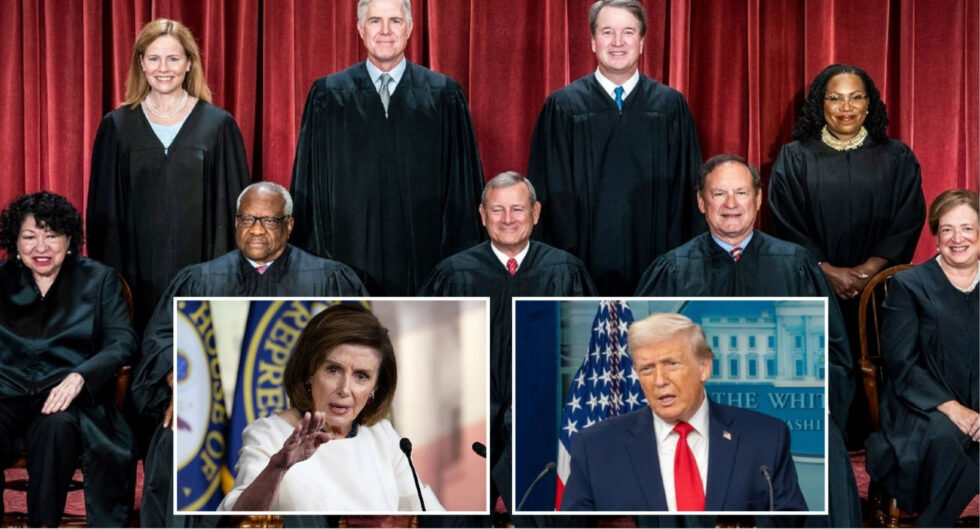
The Supreme Court struck down Louisiana’s congressional map on Wednesday and sharply limited the use of race in drawing district boundaries in a major ruling that could carry significant consequences for future House elections.
Louisiana had been ordered by lower courts to create a second majority-Black congressional district in 2024 to comply with Section 2 of the 1965 Voting Rights Act, which bars states from diluting minority voting strength.
The Trump administration and state officials challenged the revised map, arguing it amounted to an unconstitutional racial gerrymander in violation of the 14th Amendment, which guarantees equal protection under the law, reports said on Wednesday.
Advertisement
“If these were white Democrats, there’s no reason to think they would have a second district, none,” principal deputy solicitor general Hashim Mooppan told the high court during oral arguments in October.
“And so what is happening here is, their argument is, ‘Because these Democrats happen to be black, they get a second district.’ If they were all white, we all agree they wouldn’t get the same,” he added.
About one-third of Louisiana’s residents are African-American, and the state’s only two Democratic lawmakers in Congress (compared to four House Republicans) were elected from majority-black districts.
Advertisement
The justices initially addressed the Louisiana map case during the 2024-25 term. In an unusual move, they ordered both sides to restate their arguments to consider the implications of both the 14th and 15th Amendments. The 15th Amendment, in particular, prohibits states from denying citizens equal protection under the law or restricting their rights based on race.
The decision was widely interpreted as a signal that the Supreme Court was preparing to weaken Section 2 of the Voting Rights Act.
Advertisement
The ruling carries immense weight, with two prominent voting rights organizations noting earlier that the removal or restriction of Section 2 will likely empower Republican-led legislatures to change the boundaries of as many as 19 congressional districts to their advantage, in order to comply with the court.
“However, it’s not clear if red states will be able to seize on the Supreme Court’s decision in time to significantly impact the 2026 midterms, in which Democrats are favored to retake the House of Representatives,” the New York Post reported.
This would enable mapmakers to emphasize Republican strengths.
Chief Justice John Roberts, the author of the 2023 Allen v. Milligan ruling that requires the establishment of a second majority-Black district in Alabama, examined whether this framework is consistent with Allen and the Court’s Thornburg v. Gingles criteria.
The test mandates that plaintiffs demonstrate a minority group is not only sizable and cohesive but also experiences majority bloc voting that undermines their electoral candidates. Roberts appeared focused on aligning the proposal with established norms, steering clear of a complete transformation.
Justice Brett Kavanaugh, an influential voice in the Allen case alongside Roberts and the liberal justices, raised the possibility of a “sunset” clause for Section 2 remedies, referencing precedents that restrict race-based policies to temporary solutions.
Voting rights organizations aligned with the Democratic Party already warned that the removal or restriction of Section 2 could empower Republican-led legislatures to change the boundaries of as many as 19 congressional districts to their advantage.
Fair Fight Action and the Black Voters Matter Fund argue that if Section 2 of the Voting Rights Act is invalidated, it could significantly increase the likelihood of Republicans maintaining control over the House of Representatives for years.
Research has identified 27 congressional seats nationwide that could be redrawn to benefit Republicans, contingent on the current legal and political landscape remaining unchanged.
Nineteen of these changes are directly tied to the potential loss of Section 2 protections.
The SCOTUS ruling will set off a firestorm in many states to redraw maps ahead of November’s elections.