US forces Monday sank six small Iranian boats deployed to harass vessels stuck in the Strait of Hormuz, shortly before President Trump warned that the Islamic Republic will be “blown off the face of the Earth” if it interferes with efforts to reopen the crucial waterway.
Adm. Brad Cooper, head of US Central Command (CENTCOM), told reporters in a press call that while Iran historically has deployed “between 20 and 40 small boats” to threaten commercial shipping in the strait, “Today, we saw just six and eliminated them quickly.”
“We have an enormous amount of capability and firepower concentrated in and around the strait, including AH-64 Apache and MH 60 Seahawk helicopters,” said Cooper, emphasizing that Iran’s military capability has been “dramatically degraded.”
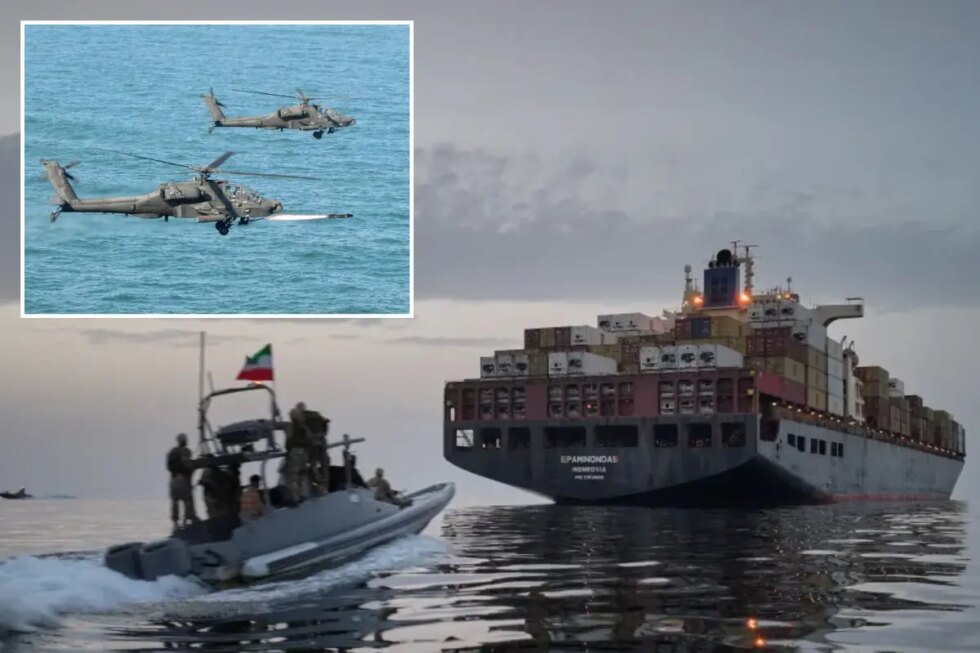
U.S. Navy AH-64 Apache helicopters are actively operating in the Strait of Hormuz. 8th Fighter Wing Public Affairs
Map shows Monday’s marine traffic in and around the strait. Marinetraffic.com
Monday’s strikes occurred after Trump’s announcement Sunday evening of “Project Freedom,” a US initiative to move maritime traffic through the Strait of Hormuz since it has been backed up for months from the start of Operation Epic Fury Feb. 28.
Iran has warned it would resist any effort to force open the strait and insisted that any ships attempting to move through the waterway must coordinate with Tehran first, prompting Trump to tell Fox News that the Middle Eastern regime would be “blown off the face of the Earth” if it attacks US-flagged vessels.
MH-60 Seahawk helicopters are assisting operations. Commander Task Force 56
“We have more weapons and ammunition at a much higher grade than we had before,” Trump told Fox News chief foreign correspondent Trey Yingst. “We have the best equipment. We have stuff all over the world. We have these bases all over the world. They’re all stocked up with equipment. We can use all of that stuff, and we will, if we need it.”
The president claimed that Iran has become “much more malleable” regarding peace talks that have stagnated since mid-April.
Cooper did not say whether America’s strikes on Iran’s fast-attack boats and Tehran’s claims that it fired at US warships constitute a collapse of the fragile cease-fire secured last month.
The Iranian Revolutionary Guard approaches the cargo ship Epaminondas in the Strait of Hormuz in April. AP
“I think the key thing for us is we’re merely there as a defensive force and to give a very thick layer of defense to commercial shipping to allow them to proceed out of the [Persian Gulf],” Cooper said.
There are hundreds of ships from about 87 countries stuck in the Persian Gulf, with CENTCOM reaching out to neutral ships to help offer them safe passage.
At least two US ships crossed the Strait of Hormuz on Monday, according to CENTCOM, a claim that Iran slammed as “baseless.”
Iranian Revolutionary Guards drive speedboats near the port of Bandar Abbas in 2012. AFP via Getty Images
It remains to be seen how many foreign ships take up CENTCOM’s offer to move through the strait, after a South Korean-used carrier reported an explosion and fire onboard when it attempted to cross the waterway.
The HMM Namu suffered a blast early Monday, with fire breaking out in the engine room of the Panama-flagged cargo ship, South Korea’s foreign ministry said.
Trump said the attack on the Namu should push Seoul, which has 26 ships trapped in the Gulf, to join the US in military operations to secure the strait.
“Perhaps it’s time for South Korea to come and join the mission!” Trump wrote on Truth Social.
“Other than the South Korean Ship, there has been, at this moment, no damage going through the Strait,” he wrote, noting that military commanders will speak to reporters Tuesday about the operations.
Along with the South Korean ship, a United Arab Emirates oil tanker was targeted by an Iranian drone as it tried to cross the strait and caught fire, Abu Dhabi officials said.