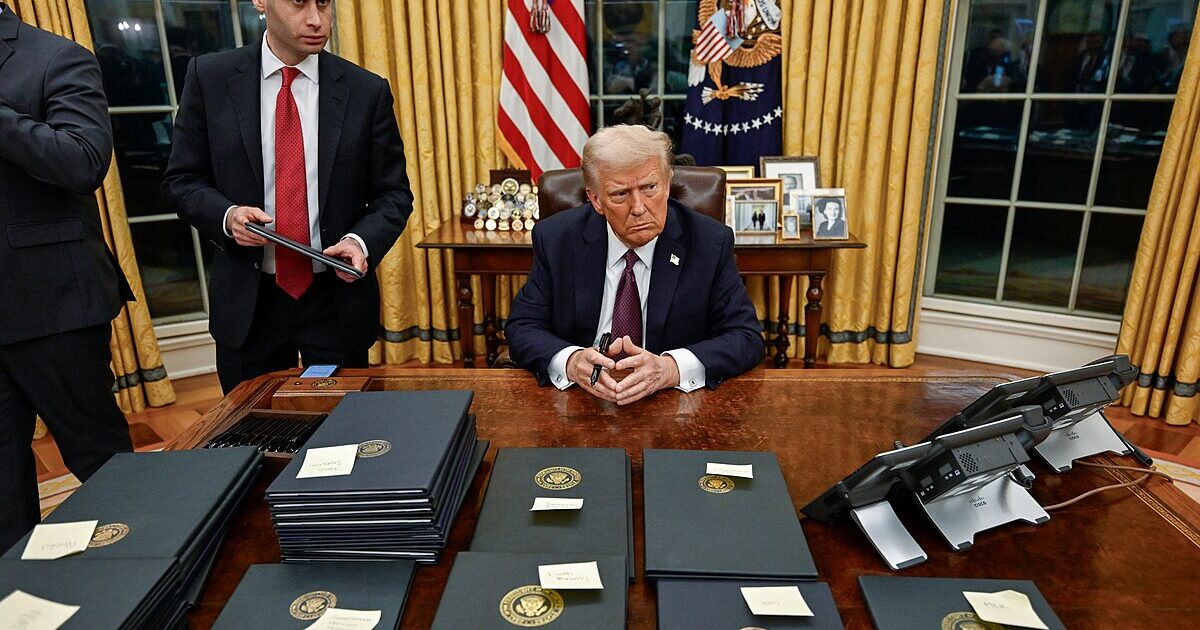
A Republican bill proposing $1 billion for the Secret Service to help finance President Donald Trump’s White House ballroom is at risk due to opposition from a senior Senate official.
Senate Parliamentarian Elizabeth MacDonough stated on Saturday that the budget bill,
Advertisement
The bill seeks funding for ICE and Border Patrol in addition to the $1 billion for the ballroom and must be revised to address jurisdictional concerns, according to multiple reports.
“A project as complex and large in scale as Trump’s proposed ballroom necessarily involves the coordination of many government agencies which span the jurisdiction of many Senate committees,” Senate Democrats said after their meeting with the parliamentarian.
“As drafted, the provision inappropriately funds activities outside the jurisdiction of the Judiciary Committee,” they added.
The Senate parliamentarian determined that the bill would be subject to the chamber’s 60-vote threshold, meaning it cannot pass with a simple majority, as some legislation can under the budget reconciliation process.
Budget reconciliation is a parliamentary procedure that allows certain fiscal legislation to bypass the Senate filibuster and pass with a simple majority, though strict rules limit what policy provisions may be included, NBC News noted.
The ruling represents a setback for the Republican proposal, but GOP lawmakers are continuing efforts to preserve the ballroom funding provision.
Advertisement
According to a Republican leadership aide cited by NBC News, Senate Republicans had already begun revising the language before Saturday’s ruling based on guidance from Senate officials.
A spokesperson for Judiciary Committee Republicans also told NBC News that “conversations and revisions are continuing, as they have been for days.”
It remains unclear whether Republicans can revise the provision in a way that fully satisfies the Senate parliamentarian’s concerns.
The budget resolution governing the legislation permits provisions only from the jurisdiction of the Senate Judiciary Committee and the Senate Homeland Security and Governmental Affairs Committee.
If Senate officials again determine that the ballroom project falls under the authority of another committee, Republicans may ultimately have to remove the funding from the bill altogether, since they are unlikely to secure the 60 votes required to override the parliamentarian’s ruling, said the outlet.
Advertisement
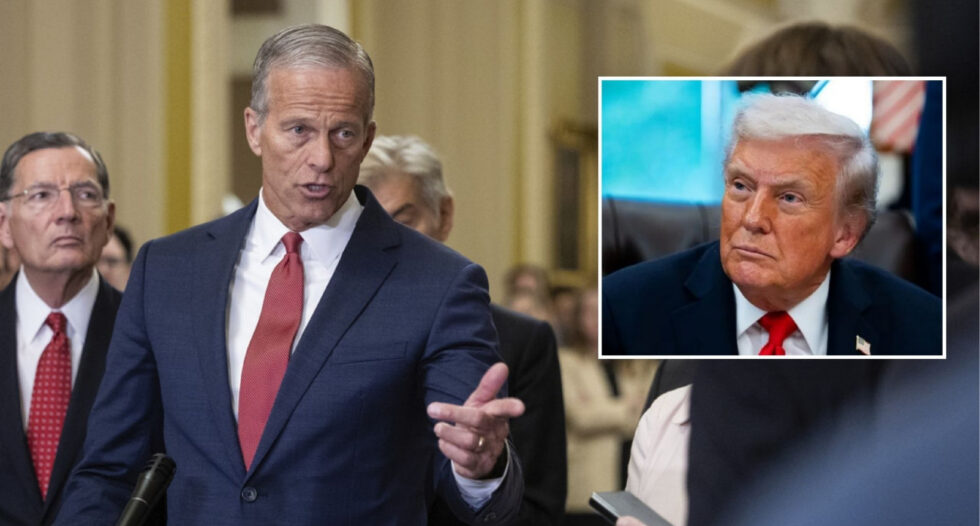
Ryan Wrasse, a spokesman for Senate Majority Leader John Thune (R-S.D.), brushed off the setback for the GOP bill Saturday.
“Redraft. Refine. Resubmit. None of this is abnormal during a Byrd process,” Wrasse wrote in a post on X.
🚨 NOW: The Senate Parliamentarian has just unilaterally STRUCK DOWN President Trump’s ballroom Secret Service security funding from the GOP reconciliation bill
By decree, Elizabeth MacDonough is requiring 60 votes for the upgrades, not 50+1.
ABSOLUTELY UNREAL!!
Thune can… pic.twitter.com/eWVwGvwJUD
— Eric Daugherty (@EricLDaugh) May 17, 2026
The “Byrd process” refers to the informal review conducted by the Senate parliamentarian to determine whether provisions in a budget reconciliation bill comply with the Byrd Rule.
The Byrd Rule is designed to ensure that measures included in reconciliation legislation are directly related to federal spending, revenue, or the national debt, while preventing unrelated policy provisions from being added to bills that can pass the Senate with a simple majority.
Advertisement
Some Senate Republicans had already expressed reservations about the GOP proposal to use $1 billion in taxpayer funding for the ballroom project, despite Donald Trump previously stating that the project would require “no government funds.”
According to a memo obtained by NBC News, Republican senators were presented earlier this week with a breakdown of the proposed funding that included $220 million to strengthen security around the White House complex, $180 million for a visitor screening facility, $175 million for training initiatives, and another $175 million for enhanced protection measures for United States Secret Service protectees.
“I still got some more questions, and they’re going to send us more information,” Sen. Roger Marshall, R-Kan., said after the meeting. “I’m undecided.”
Two more Republican senators, Rand Paul of Kentucky and Susan Collins of Maine, said the entire project should be done with private funds, as Trump initially said it would be.
It’s not clear what Thune will do if he can’t secure the 60 votes to satisfy the parliamentarian.
This article may contain commentary
which reflects the author’s opinion.