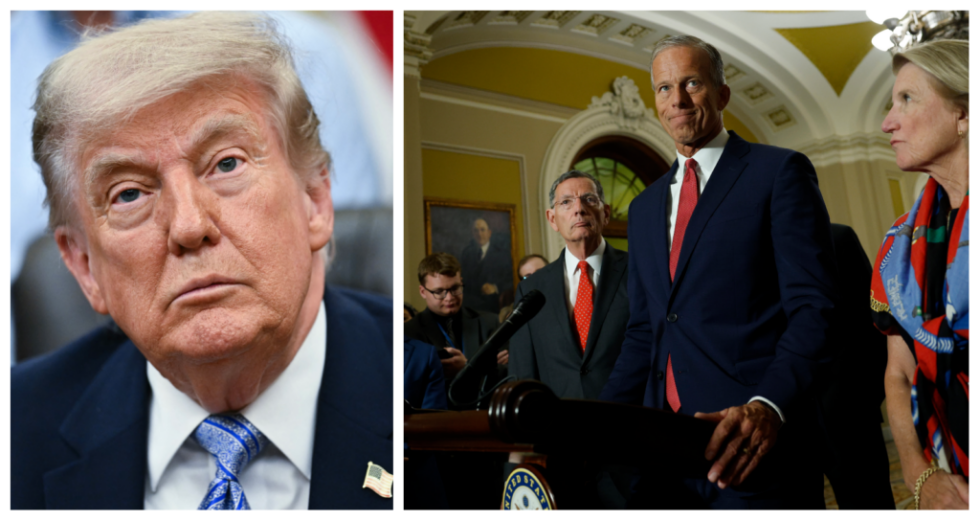
President Donald Trump is facing mounting criticism from members of his own party after a planned White House meeting with senior Republican leaders reportedly fell apart amid internal backlash over a controversial $1.8 billion compensation fund linked to Jan. 6 defendants.
According to reports, tensions boiled over Thursday as Republicans clashed over the proposed fund, which critics inside the GOP have derided as a potential “slush fund” tied to allegations of political targeting and prosecutorial abuse during the administration of Joe Biden.
Advertisement
Democrats, of course, have attacked the fund as well, which the president says is aimed at providing relief for Jan. 6 defendants whose rights were abused during the Biden administation, not for those who were rightfully convicted of violence.
The controversy reportedly blew up a high-stakes White House strategy session involving Trump, House Speaker Mike Johnson (R-La.), and top Republican leadership.
The meeting had been intended to rescue a stalled $70 billion immigration enforcement package viewed as central to Trump’s long-term deportation and border security agenda through 2029.
Instead, lawmakers reportedly left the closed-door session frustrated after a tense confrontation with acting Attorney General Todd Blanche, with several Republicans signaling the legislation was effectively dead for the week.
What made the backlash especially significant was that some of Trump’s usual allies were reportedly among the loudest critics.
Advertisement
Sens. Katie Britt and Tommy Tuberville, both from Alabama, were reportedly among the Republicans who confronted Blanche over fears that taxpayer money from the proposed compensation fund could ultimately go to individuals convicted in connection with the Jan. 6 Capitol riot, including defendants accused of assaulting police officers.
Senate Majority Leader John Thune (R-SD) canceled scheduled votes and sent lawmakers home until June 1, surpassing Trump’s preferred deadline.
“The White House needs to help with this issue, because we have a lot of members who are concerned,” Thune told reporters afterward.
Alaska Sen. Lisa Murkowski (R) described the proposal as “a bomb in the middle of a pretty well planned out reconciliation bill.”
“I don’t like the fund at all,” added Sen. John Curtis (R-Utah).
The fund comes from a settlement with the Justice Dept. after Trump filed a $10 billion lawsuit.
According to reports, the settlement established a $1.8 billion compensation fund designed to provide financial restitution and formal apologies to individuals who claim they were unfairly targeted through politically motivated prosecutions and alleged “lawfare” during the Biden administration.
The reports further stated that more than 1,600 individuals connected to the Jan. 6 Capitol riot who later received pardons from Trump could potentially be eligible to apply for compensation through the program.
The dispute intensified further after reports surfaced that the agreement also included provisions that would reportedly shield Donald Trump and his sons from certain Internal Revenue Service audit actions.
Rep. Brian Fitzpatrick said he had “never heard” of protections like those being proposed and pledged to oppose the provisions through legislation.
Reports also noted increasing tensions between Trump and Thune after Trump endorsed Texas Attorney General Ken Paxton over incumbent Sen. John Cornyn in Texas’s upcoming Republican Senate primary.
When asked on Thursday whether he was losing control over Senate Republicans, Trump replied, “I really don’t know. I can tell you I only do what’s right.”
The backlash marks one of the clearest public breaks between Donald Trump and portions of the Republican Party since his return to office, exposing growing tensions within the GOP over Jan. 6, federal spending, and Trump’s continued influence over the party ahead of the 2026 midterm elections.
It’s possible that before the Senate returns in June that a deal could be worked out for the reconciliation package that is must-pass.
That said, Trump may have to either give up on the Jan. 6 fund or make significant concessions elsewhere to bridge the divide.
This article may contain commentary which reflects the author’s opinion.