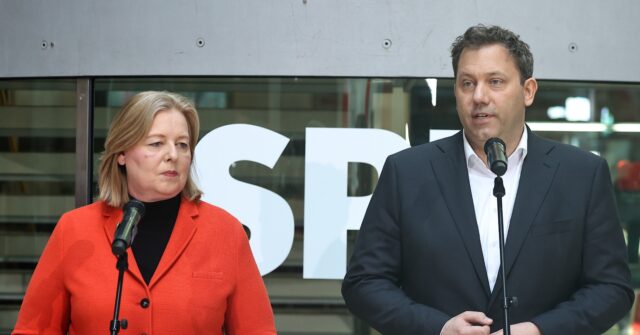
Germany’s Social Democrats have fallen to a record low support as voters continue to abandon the establishment in favour of outsider parties like the Alternative für Deutschland (AfD), which continues to maintain its lead in the polls.
This week’s RTL/ntv political support barometer has found that the Social Democrats (SPD), the oldest survivng major political party in Germany, has had its poorest showing since the Forsa Institute began the survey, falling to just 11 per cent support among voters. This is down from 16.4 per cent at the last federal election in 2025.
The establishment left-wing party, which remained in government as a coalition partner of the supposed centre-right CDU despite having lost the last election, has lost ground to father left parties, such as the Greens, which have climbed from 11.6 per cent at the last election to 15 per cent this week and Die Linke (The Left) which has jumped from 8.8 per cent to 11 per cent during the same time.
Meanwhile, the Christian Democratic Union of Chancellor Merz now stands at 22 per cent after also seeing a precipitous decline in support, falling from 28.5 per cent at the last election.
Conversely, the populist anti-mass migration Alternative for Germany (AfD) has continued to maintain its lead at 27 per cent, an increase from 20.8 per cent in 2025.
While the AfD is characterised in the legacy media as being a so-called “far-right” party, like other populist parties in Europe and the Trump movement in the United States, it has drawn significant support from working-class voters who traditionally supported the Social Democrats.
Indeed, following last year’s elections, an Infratest-Dimap exit poll found that 38 per cent of voters cast their ballots for the Alternative for Germany, compared to just 12 per cent for the SPD.
The declining support for the SPD among the working class comes in the wake of the former Social Democrat government of Chancellor Olaf Scholz presiding over record levels of immigration and widespread economic stagnation.
Like Labour in the United Kingdom and the Democrats in the United States, the SPD has refused to reckon with its voters rejecting mass migration policies, with government Labour Minister Bärbel Bas sparking controversy last month after claiming that mass migration was not only essential economically, but also critical for its “cultural enrichment” as opposed to the “uniform grey” society that would be without millions of foreigners
With this attitude, despite the well documented deleterious impacts of mass migration, it is perhaps therefore unsurprising that nearly eight in ten voters do not believe that the government has adequately addressed the immigration crisis.
SPD party leader Lars Klingbeil, who has also doubled down on mass migration as an economic panacea, has seen his approval ratings collapse from 37 per cent in December to just 28 per cent this week.
Follow Kurt Zindulka on X: Follow @KurtZindulka or e-mail to: kzindulka@breitbart.com