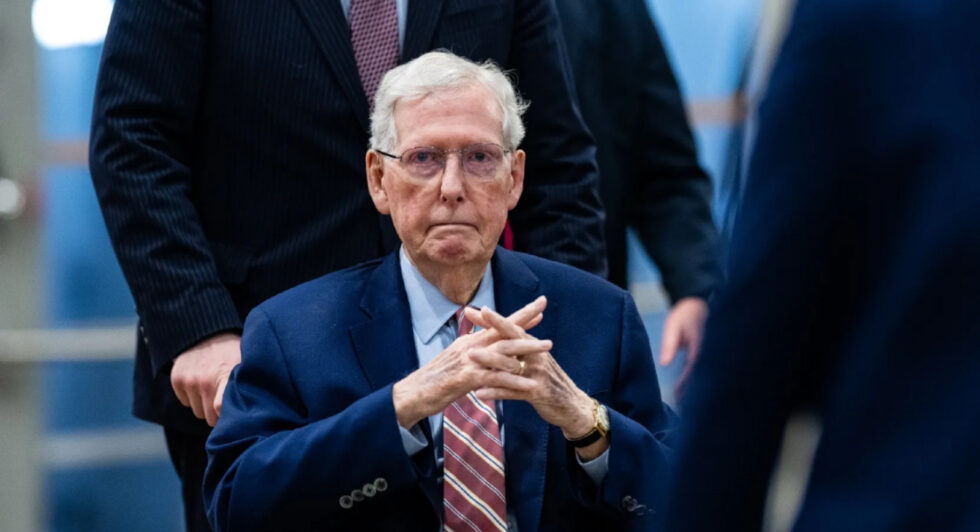
Sen. Mitch McConnell (R-Ky.) was admitted to a hospital Sunday afternoon after suffering a ‘mystery’ illness, according to multiple reports.
Shortly after his admission, a spokesman for the former Senate majority leader provided an update about his condition.
Advertisement
“Senator McConnell was admitted to the hospital this morning. He is receiving excellent care,” spokesperson David Popp said, per CNN.
McConnell, 84, has experienced several health-related incidents in recent years that have prompted increased public scrutiny of his future in office.
In 2023, he suffered a concussion and fractured ribs after a fall that required hospitalization and a lengthy recovery.
Later that year, the longtime Kentucky senator drew national attention when he briefly froze while speaking during a news conference, raising fresh questions about his health.
Advertisement
Additional reports indicated that he had experienced multiple falls during the same period, adding to concerns about the physical toll of serving in high office at an advanced age.
McConnell was first elected to the Senate in 1984 and rose to become Senate majority leader in 2015, a position he held for years as the longest-serving Republican leader in the chamber’s history.
During President Donald Trump’s first term, McConnell played a central role in advancing the administration’s agenda, most notably by helping confirm hundreds of federal judges and three Supreme Court justices who reshaped the federal judiciary for a generation.
In recent years, however, McConnell has increasingly found himself at odds with both Trump and the direction of the modern Republican Party.
No longer serving in Senate leadership, he broke with the administration on several high-profile issues and voted against some of Trump’s Cabinet nominees, including Health and Human Services Secretary Robert F. Kennedy Jr..
Explaining his opposition, McConnell, who survived polio as a child, argued that Kennedy had not demonstrated he was the right person to lead the nation’s top health agency.
McConnell has also remained one of the Republican Party’s strongest advocates for a robust American role abroad, particularly in supporting Ukraine against Russian aggression and strengthening deterrence against China in the Taiwan Strait.
Those positions have increasingly placed him at odds with a growing segment of the GOP base, which has embraced Trump’s more restrained and America First approach to foreign policy.
He chairs the Senate Appropriations Subcommittee on Defense.
Recently, he expressed concerns about the Trump administration’s plan to increase defense spending through the reconciliation process, cautioning that there is no guarantee Republicans can achieve this.
“He announced last year he would not run for reelection in 2026. Republican Rep. Andy Barr, endorsed by Trump, will take on Democratic former state lawmaker Charles Booker in the November election to replace McConnell,” CNN reported.
McConnell said last year that when his term ends, he will leave the chamber “with great hope for the endurance of the Senate as an institution. There are any number of reasons for pessimism, but the strength of the Senate is not one of them.”
Barr easily bested a slew of other candidates to replace McConnell.
Though it’s a race overshadowed by another contest, where Trump is the driving factor in the state, it’s still significant, given that Barr and his Democratic opponent will be at the forefront of change in the political status quo of the Bluegrass state.
Barr’s bid for the upper chamber after serving seven terms in the House was spurred by a late endorsement from Trump in May.
“We did have a lead before the endorsement,” Barr said during a campaign event on Monday. “Our lead has skyrocketed since then in the polling that we’re looking at, but we don’t take anything for granted.”
The endorsement helped Barr best his nearest competitor, former Kentucky Attorney General Daniel Cameron, who remained confident that he could still win without Trump’s backing.
This article may contain commentary which reflects the author’s opinion.