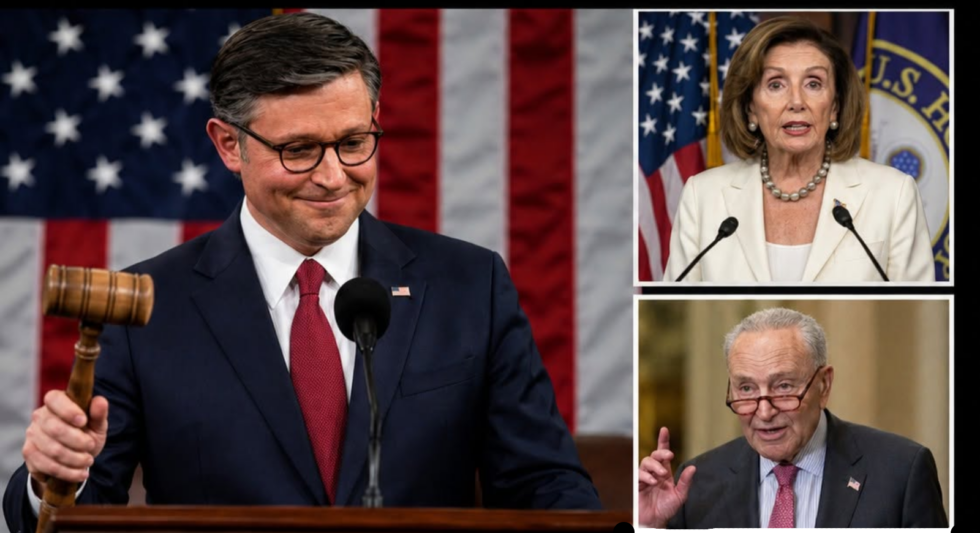
The U.S. House of Representatives has voted 213 to 184 to pass legislation aimed at speeding up federal permitting for interstate natural gas pipelines.
The bill would designate the Federal Energy Regulatory Commission as the lead agency for pipeline permitting reviews.
Advertisement
Under the legislation, FERC would be allowed to consider water quality assessments as part of its environmental review, rather than waiting for separate Clean Water Act certifications from states.
Supporters say state-level certifications have often delayed pipeline approvals for years.
The bill is titled the Improving Interagency Coordination for Pipeline Reviews Act.
It is one of several measures in Congress that aim to accelerate federal permitting processes.
Another bill, the Promoting Efficient Review for Modern Infrastructure Today Act, also passed the House with bipartisan support.
Advertisement
Lawmakers have made broad permitting reform a priority as they seek to expand energy infrastructure to meet rising electricity demand.
That demand has grown in part due to the rapid expansion of data centers across the country.
Supporters of the legislation also argue that faster permitting could help reduce household energy costs, particularly by enabling quicker construction of energy projects that can increase supply and competition in the market.
The agency has recently approved most natural gas pipeline proposals that have come before it.
This announcement comes as President Donald Trump secured a historic U.S.-Iran peace deal.
With critics hyperbolizing the negatives of making peace with Iran and those same critics rebuking war with Iran, Trump boldly sent them a “you’re welcome” message.
Trump declared victory on energy, national security, and the economy in a Truth Social post, saying oil is flowing, Iran “can never have a nuclear weapon,” and U.S. markets are surging.
President Trump and many of his administration officials have made it clear that no frozen Iranian assets have been released.
Vice President JD Vance provided another big update on Thursday surrounding the recently signed deal.
Vance spent much of the week pushing back against widespread reports claiming the deal contains a massive reconstruction fund worth hundreds of billions of dollars.
Vance explained that Iran would need to permanently abandon efforts to obtain nuclear weapons, eliminate enriched nuclear stockpiles, and submit to extensive verification measures before meaningful sanctions relief could occur.
Officials have also indicated that Gulf nations could potentially invest in Iranian reconstruction projects in the future, but only if Tehran fully complies with the agreement.
One of the most significant outcomes of the agreement involves the Strait of Hormuz.
During a White House press briefing, the vice president fielded several questions from reporters after President Donald Trump signed the US-Iran Memorandum of Understanding (MOU).
Kicking off the briefing, a reporter asked Vance, “Do you think that the current Iranian leadership recognizes the leverage that the U.S. holds over itself economically and militarily enough to actually go forth with fundamentally changing their behavior over the long-term and going about things differently?”
“So, I certainly think they recognize the leverage that the United States has over them. We’ve seen that in a number of our conversations,” Vance said.
“We’ve seen that just in their behavior over the last couple of days. They certainly recognize that the United States has great leverage. Will that ultimately lead to a change in behavior? I don’t know,” Vance said.
“You know, I’ve seen skeptics of the deal. People say the Iranians will never change their behavior. Well, maybe that’s true, and if so, they don’t get any of the benefits of the bargain. But isn’t it worth trying? Isn’t it worth seeing whether this incredibly weakened position that the president of the United States has put the Iranians under, whether that motivates them to change their behavior, not just vis-a-vis the West, but vis-a-vis the Middle East?” Vance asked.
This article may contain commentary which reflects the author’s opinion.