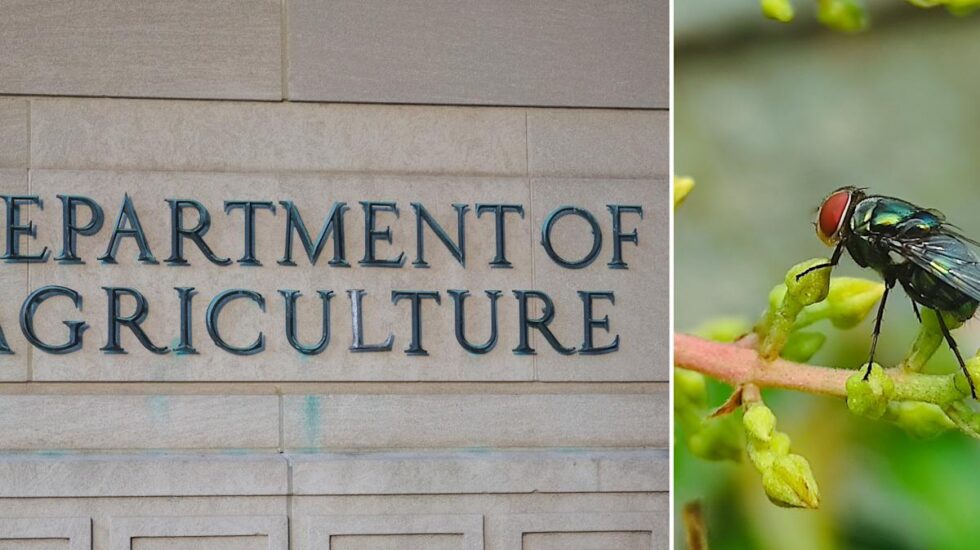
When the Elon Musk-affiliated Department of Government Efficiency (DOGE) swept through Washington in 2025, slashing the workforce of federal agencies, the ramifications were far-reaching.
Those decisions are now drawing renewed scrutiny as the New World screwworm, a parasitic threat to livestock and other animals, resurfaces in Texas, and questions emerge about whether federal agencies have enough resources to contain it.
Must Read
Critics of DOGE and the Trump administration say those cuts have impacted response efforts. chThe Department of Agriculture (USDA), however, says it is ready to fight the parasite.
How dangerous is the New World screwworm?
The New World screwworm (NWS) is a parasitic fly that was previously eradicated in the U.S., in the 1960s (1). An outbreak in Florida in 2017 was also contained.
On June 3, the NWS reappeared in the U.S. (2), with the first case reported in cattle in Zavala County, Texas. As of June 16, the USDA was reporting 12 domestic cases; 11 cases in Texas were in cattle, sheep and goats, and one case in New Mexico was reported in a dog.
The NWS can have serious impacts on livestock. Its larvae burrow into open wounds or body openings and feed on living flesh. According to the USDA (1), it can infest “livestock, pets, wildlife, occasionally birds, and in rare cases, people.”
On June 12, the CDC said in a release (3) that “Currently, there are no reported human cases in the United States, and the risk to the public remains low.” As it is a parasitic infestation, it can’t spread “from animal to animal, animal to people, or person to person.”
Read More: About 1 in 5 Americans over 50 has zero retirement savings. Here’s why it’s not too late
Government response to the screwworm reappearance
Efforts to eradicate the NWS began in 1957, with a biological control method where sterilized male flies are released. It saw the eradication of the pest in the U.S. by 1966. According to the USDA (4), since the 1980s, Mexico and several Central American countries were declared free of the NWS.
But the pest began moving back northward, and in 2024 it was detected in southern Mexico (5).
With recent reports of the screwworm appearing in Texas, USDA officials say they are prepared to fight the NWS.
“These developments obviously represent a serious threat to our livestock and wildlife, but they haven’t caught us off guard,” Department of Agriculture (USDA) Secretary Brooke Rollins said at a recent press conference, according to a report from The Hill (6).
According to The Hill, Rollins said that more than $1 billion has been invested by the administration in combatting the NWS.
The Food and Drug Administration (7) has fast-tracked reviews for animal drugs to treat NWS infestation, including three conditional approvals and 10 emergency use authorizations. One of those drugmakers is Elanco. Rajeev Modi, Elanco’s executive vice president of U.S. pet health, told The Hill that coordinating with several federal agencies, including the FDA, the USDA and the Environmental Protection Agency, has been smooth.
But some are sounding the alarm that the shrunken workforce of the USDA could pose problems.
Did DOGE cuts affect the government’s screwworm response?
According to the National Sustainable Agriculture Coalition (NSAC) (8), the USDA lost approximately 20,000 employees from January 2025 to January 2026. During that time period, the USDA’s Animal Plant and Health Inspection Service (APHIS) lost 2,009 employees, which was 23% of the service.
A group of 11 Democratic senators sent Rollins a letter (9) on June 9 outlining concerns over the reduction of USDA staff, specifically at the APHIS, along with the Food Safety Inspection Service and the Agricultural Marketing Service.
“APHIS’s veterinarians and scientists — most of which are located in the field — rapidly respond to crises such as the recent hantavirus outbreak or resurgence of new world screwworm,” the letter says.
The Hill reported that Rollins denied that DOGE and the Trump administration were responsible.
“The idea that DOGE caused this could not be further from the truth,” Rollins said, according to The Hill. “What we did was reallocate resources and prioritize what matters, ensuring taxpayer dollars are used effectively while leaning in aggressively on preparedness.”
A June 10 report from The Hill stated that the Trump administration “cut funding at USDA for programs that were specifically targeted to monitoring and responding to New World screwworm (10).”
Some reports and social media posts circulated recently claiming that DOGE had cut funding from the U.S. Agency for International Development (USAID) to the United Nations Food and Agriculture Organization (FAO), and its Global Health Security Programme. (The program includes the design and implementation of “effective detection, prevention and control measures against zoonoses and antimicrobial [resistance (11)].”)
Fact-checking website Snopes could not independently verify claims that DOGE cuts to USAID, and in turn FAO, directly impacted programs that were specifically for monitoring NWS. However, Snopes did find that a USAID grant to FAO appeared to have been cancelled (12).
An outbreak of NSW infestations could be devastating to the Texas cattle industry. A USDA report from 2025 stated that an outbreak of NSW in Texas could cost the state’s economy $1.8 billion (13).
You May Also Like
Join 250,000+ readers and get Moneywise’s best stories and exclusive interviews first — clear insights curated and delivered weekly. Subscribe now.
Article Sources
We rely only on vetted sources and credible third-party reporting. For details, see our ethics and guidelines.
Animal and Plant Health Inspection Service (1), (2), (4), (5), (13); Centers for Disease Control (3); The Hill (6), (10); U.S. Food and Drug Administration (7); Sustainable Agriculture (8); Merkley for Oregon (9); Food and Agriculture Organization of the United Nations (11); Snopes (12)
This article originally appeared on Moneywise.com under the title: The USDA lost 20,000 workers to DOGE cuts. Then a flesh-eating parasite showed up in Texas
This article provides information only and should not be construed as advice. It is provided without warranty of any kind.