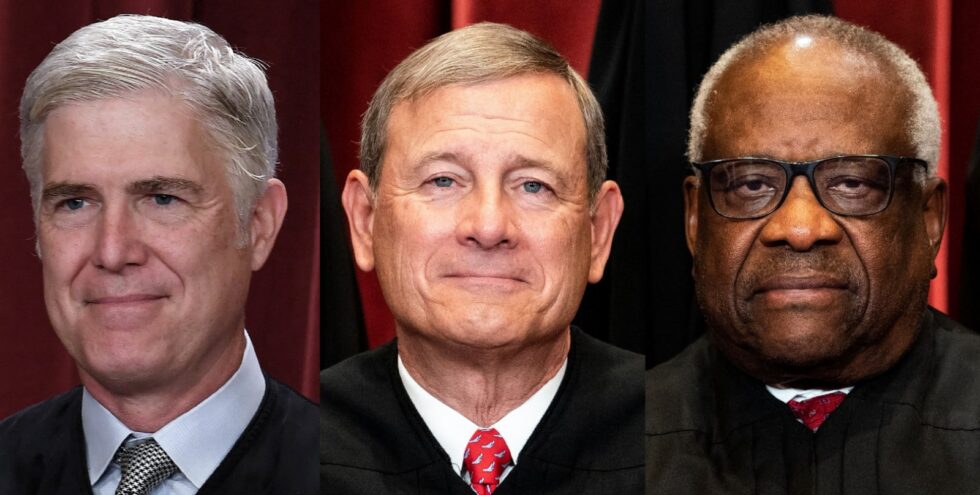
The U.S. Supreme Court on Monday refused to hear an appeal from the National Shooting Sports Foundation (NSSF), leaving intact an appeals court ruling that supported Democratic New York Attorney General Letitia James.
In 2021, then-Democratic New York Gov. Andrew Cuomo signed a law aimed at permitting “public nuisance” lawsuits against firearms manufacturers as a means of circumventing the Protection of Lawful Commerce in Arms Act of 2005 (PLCAA).
Advertisement
The NSSF said it was disappointed by the news that the Supreme Court will not hear the case it brought in December 2021 in a pre-enforcement challenge, court documents show.
“NSSF respects the decision of the U.S. Supreme Court but is disappointed it declined to grant certiorari in this case,” the firearms industry trade group said in a statement provided to the Daily Caller News Foundation.
Advertisement
“NSSF sincerely believes that those criminals who illegally misuse lawful products should be held responsible for the harms they cause when they commit their crimes,” the group added.
“Holding the firearm industry responsible for the criminal misuse of a firearm is akin to holding Anheuser-Busch and Ford Motor Company responsible for damages from drunk driving crimes or baseball bat and knife makers responsible for criminal assault with their lawfully made and lawfully sold products,” NSSF continued.
Advertisement
As attorney general, James defended the law in the courts. James had vowed in a July 2018 statement released by her campaign to “target the NRA” and investigate “the legitimacy of the NRA as a charitable institution.”
She filed a suit for the dissolution of the NRA in August 2020.
“The NRA is an organ of deadly propaganda masquerading as a charity for public good,” James claimed in the release.
James also sued President Donald Trump in September 2022, alleging he overstated the value of real estate holdings in order to obtain loans.
She also promised to investigate Trump during her 2018 campaign for attorney general, during which she labeled him an “illegitimate president.”
NSSF initially appealed to the Supreme Court in February, after the United States Court of Appeals for the Second Circuit held that the law did not conflict with the PLCAA or the Commerce Clause.
“Here, in the absence of any evidence or specific findings regarding the economic benefits and burdens of Section 898, we find no undue burden,” the court said in its ruling.
New Jersey filed suit against Glock in December 2024 over so-called “Glock switches,” devices that allow the popular semiautomatic pistols to fire like machine guns.
In the litigation, New Jersey claimed that the company created a “public nuisance” under a 2022 law similar to the one enacted in New York due to its firearms being easily convertible.
Such conversions are illegal without paying a tax and receiving permission from the Bureau of Alcohol, Tobacco, Firearms, and Explosives (ATF), according to 26 USC Chapter 53, and can result in a sentence of up to ten years in federal prison if convicted.
NSSF sued to block the law, but a three-judge panel of the United States Court of Appeals for the Third Circuit dismissed the case, claiming the group had “jumped the gun.”
The trade group re-filed the suit seeking to block New Jersey’s law in February 2025, following the state’s litigation against Glock.
Last week, the Supreme Court made headlines with another key ruling.
The Supreme Court on Thursday delivered a landmark ruling that bolsters Second Amendment rights and issued a sharp rebuke to federal overreach.
The nation’s highest court unanimously held that the government cannot automatically disarm Americans simply for using marijuana, even if the drug remains illegal under federal law.
The case, United States v. Hemani, centered on Ali Danial Hemani, a Texas man who admitted to using marijuana a few times a week.
Federal agents found a legally owned Glock pistol in his home during a search, along with marijuana.
Prosecutors charged him under 18 U.S.C. §922(g)(3), which bans firearm possession by anyone who is an “unlawful user” of a controlled substance.
This article may contain commentary which reflects the author’s opinion.