Iranian President Masoud Pezeshkian said Wednesday that communicating with Iran’s unseen Supreme Leader Mojtaba Khamenei is currently “very difficult,” as Tehran and Oman appeared close to finalizing an agreement over navigation through the Strait of Hormuz.
“It is very difficult to communicate with him at the moment, but in any case, his presence is a very great source of strength for us so that we can continue,” Pezeshkian said in an interview aired on Iranian state television.
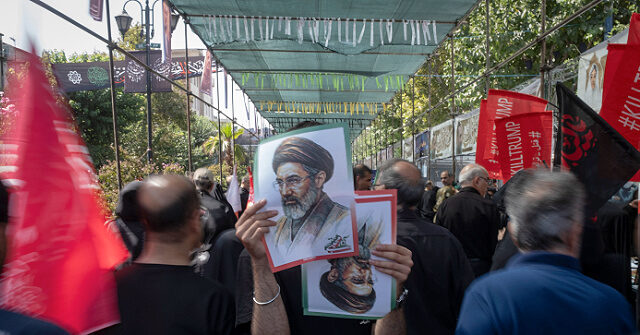
Khamenei has not appeared publicly since succeeding his father, Ayatollah Ali Khamenei, who was killed in the opening U.S.-Israeli strikes that launched Operation Epic Fury in February. Mojtaba was reportedly wounded in the same attack, with accounts differing significantly over the extent of his injuries, and has remained completely out of public view since.
No video or audio of Khamenei has been released since he became supreme leader. His communications with the Iranian public have instead come through written statements attributed to him, and he notably did not appear at his father’s funeral ceremonies last month.
Earlier this week, the Tehran Municipality-affiliated Iranian newspaper Al-Mashhari reported that authorities were withholding audio recordings of Khamenei because of concerns that foreign intelligence agencies could use them to determine his location — an explanation offered for why even his voice has not been publicly released.
The newspaper outlined several ways such a recording could potentially be exploited, including acoustic signatures, background equipment noise and other characteristics that could disclose information about Khamenei’s surroundings or condition.
Pezeshkian nevertheless defended the supreme leader Wednesday, describing his interactions with Khamenei as productive and saying he had encountered “kindness and very sound logic.”
“Unfortunately, the current situation allows some malicious people to describe him differently and to present a different image of him,” Pezeshkian said, without specifying to whom he was referring.
His remarks came as Iranian officials announced significant progress in negotiations with Oman over a framework for commercial shipping through the Strait of Hormuz, potentially setting the stage for a renewed ceasefire with the United States and a return to negotiations over Iran’s nuclear program.
Iranian Foreign Ministry spokesman Esmaeil Baghaei said Wednesday that Tehran and Muscat had agreed on the geographical coordinates of proposed shipping routes and were in the final stages of preparing a joint statement.
“The geographical coordinates of the route envisaged by the two sides have been agreed upon and, if certain third parties do not obstruct the process, the joint statement of the two countries, containing the main considerations and points of agreement, is also in the final review and drafting stage,” Baghaei said, according to Iran’s state-run IRNA news agency.
Iranian Deputy Foreign Minister Kazem Gharibabadi separately said the two countries had reached understandings on nearly all of the outstanding issues and described a final agreement as being “on the verge of being finalized.”
Reports have differed over some of the framework’s details, but the emerging arrangement would establish new routes for vessels entering and exiting the Persian Gulf, giving Iran a greater role in managing commercial traffic through the strategic waterway than it held before the war.
Israel’s Channel 12 reported that the agreement would initially remain in effect for 60 days, with ships entering the Persian Gulf traveling along the Iranian side of the strait and outbound vessels traveling through the Omani side. No tolls would be charged during that period, while the parties would work to clear mines from the strait’s main shipping lane within the first 30 days.
Once cleared, the central lane would again be used for inbound and outbound traffic while Iran and Oman negotiate a permanent arrangement, according to the report.
Iranian officials, however, have cautioned that an agreement with Oman would not by itself mean the strait will fully reopen.
Baghaei said the U.S. naval blockade and what Tehran describes as other American “aggressive and threatening actions” remain obstacles to restoring safe commercial passage. Gharibabadi similarly said a U.S. return to commitments Tehran says Washington made under the June memorandum of understanding would be necessary — though not sufficient — for reopening the waterway.
The disagreement leaves important questions unresolved even as President Donald Trump has repeatedly indicated that a deal could be imminent.
Trump said Tuesday night that the United States would know more within “48 hours,” telling reporters that negotiations were “moving along very nicely.” He had earlier said a deal could come Wednesday or Thursday.
Speaking Wednesday evening in Las Vegas, Trump reiterated that Iran had sought negotiations after the United States prepared what he has described as the largest military attack since World War II.
“They called me and they said, ‘Please don’t do it, let’s talk,’” Trump said.
“I’d rather make a deal because I don’t want to kill people,” he added. “But Iran cannot have a nuclear weapon.”
Trump has made clear that the immediate negotiations over Hormuz are intended to lead into a broader diplomatic track addressing Iran’s nuclear program, while threatening overwhelming military action if Tehran again abandons the process.
“The Strait is going to be open very soon, or they’re going to get hit very hard, and then the Strait is going to be open,” Trump told Fox News in an interview aired Tuesday night.
“If they back out again, they’re going to get hit really hard,” he added. “They know that; they understand that. I have no choice. They can’t have a nuclear weapon. It’s very simple.”
Despite Trump’s insistence that Washington and Tehran are engaged in discussions, Iranian officials continued Wednesday to publicly deny that direct negotiations with the United States are underway, characterizing the current talks as bilateral negotiations between Iran and Oman.
For now, those negotiations appear close to producing a framework, although Tehran continues to condition the actual reopening of Hormuz on further U.S. action. Whether the emerging arrangement will satisfy Trump’s demands and avert the military action he has threatened also remains unclear, as does the extent to which Pezeshkian’s acknowledged difficulty communicating with Khamenei could affect the final approval or implementation of any agreement.
Joshua Klein is a reporter for Breitbart News. Email him at jklein@breitbart.com. Follow him on Twitter @JoshuaKlein