With fewer than 90 days remaining before voters head to the polls in the midterm elections, pressure is building within the Republican Party to advance more of President Donald Trump’s legislative agenda.
One Republican senator is now publicly urging Senate leadership to act more quickly, arguing that there is little time left to deliver on several key priorities before lawmakers leave Washington for the campaign season.
Advertisement
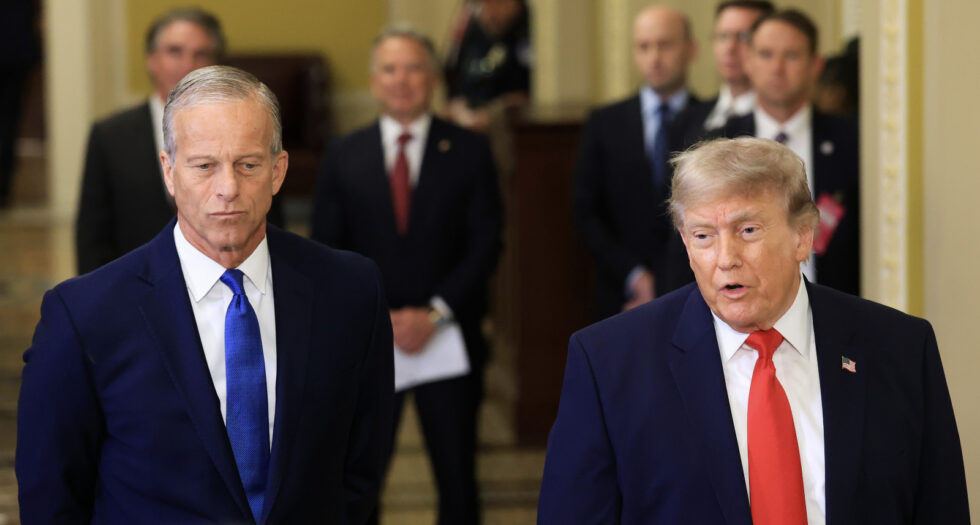
Sen. John Kennedy of Louisiana called on Senate Majority Leader John Thune to move more aggressively in advancing President Trump’s agenda, saying he believes Republicans should stop waiting for Democratic cooperation and begin bringing major legislation to the Senate floor.
Speaking on CBS News’ Face the Nation, Kennedy praised Thune personally but argued the Senate leader has been too cautious.
“Look, I mean no disrespect. I love John Thune. He’s my leader. He’s got a big brain. He’s better looking than me, but I think he’s just being too cautious,” Kennedy said.
Advertisement
The Senate is now on a five-week recess and will not return until mid-September.
Kennedy said Republicans need to advance more major pieces of legislation supported by President Trump.
Advertisement
Among those priorities, Kennedy listed the House budget resolution, additional defense funding, assistance for farmers, the cryptocurrency market structure bill and legislation imposing tougher sanctions on Russia.
Perhaps Kennedy’s strongest push centered on the SAVE America Act, legislation backed by President Trump that would require documentary proof of U.S. citizenship when registering to vote for federal elections and would establish additional voter identification requirements.
Republicans have repeatedly attempted to bring the bill up for consideration in the Senate, but Democrats have blocked those efforts.
Kennedy argued the proposal is important for maintaining confidence in federal elections.
“In my opinion, for both sides to have credibility in our elections, we need to do two things and only two things,” Kennedy said.
He said voters should prove they are eligible before registering and that election results should generally be known on Election Day or shortly afterward.
“I think we can pass it … but we’re not going to know if we don’t try,” Kennedy added.
In mid-July, President Donald Trump revealed stunning, newly declassified intelligence detailing how China worked to compromise the 2020 election in favor of Joe Biden.
Advertisement
During his address to the nation, Trump said that an initial investigation into voting rolls across just four states found that nearly a quarter of a million non-citizens were registered to vote.
After telling Americans the declassified documents were being posted to the White House website, he went on to say the intelligence was known by the CIA ahead of the 2020 election.
However, he added, officials within the agency worked to keep the information secret instead of providing it to him as required by the agency’s mandate.
Trump urged Congress to pass the SAVE Act, legislation that would, among other provisions, require individuals to provide proof of U.S. citizenship when registering to vote in federal elections.
Advertisement
Republicans began to immediately echo his call in online posts.
“It is more important than ever to crush foreign election interference. It is more important than ever to pass the SAVE AMERICA ACT,” Sen. Mike Lee, R-Utah, said in a post to X.
Hans Von Spakovsky, an election expert with Advancing American Freedom, a conservative think tank, agreed.
“The president is absolutely correct that the SAVE Act needs to be passed to implement universal voter ID and proof of citizenship,” Spakovsky said.
Advertisement
“He is also correct that the only reason an elected official would oppose this is because that official wants to make it easy to cheat and ensure that aliens who register and vote are not caught,” Spakovsky noted further.
The SAVE Act has passed the House of Representatives multiple times but has stalled in the Senate, where Democratic opposition has prevented it from advancing.
Under current Senate rules, most legislation requires 60 votes to overcome a filibuster, while Republicans currently hold 53 seats.
This article may contain commentary which reflects the author’s opinion.