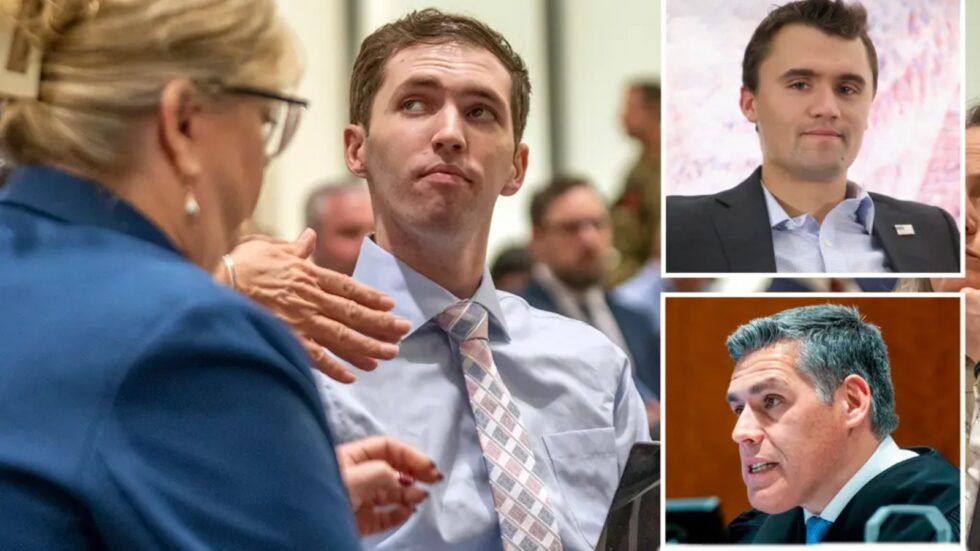
A Utah judge is expected to deliver a consequential ruling Tuesday on whether prosecutors have presented enough evidence to send Tyler Robinson to trial for the alleged assassination of conservative activist Charlie Kirk.
The decision could also determine whether the 23-year-old defendant remains eligible for the death penalty.
Advertisement
Fourth District Judge Tony Graf will hear final arguments in Provo after an unusually lengthy preliminary hearing in July, when prosecutors spent five days laying out what they described as “overwhelming” evidence connecting Robinson to the Sept. 10, 2025, shooting at Utah Valley University.
Kirk, 31, the co-founder of Turning Point USA and one of President Donald Trump’s most influential allies among young conservative voters, was fatally struck by a single rifle round while speaking before thousands of students and supporters at the outdoor campus event.
Advertisement
Robinson turned himself in one day after the killing and has not yet entered a plea, while his attorneys have concentrated on challenging the prosecution’s evidence, preventing the case from advancing on an aggravated-murder charge and removing capital punishment as a possible sentence.
Graf is expected to rule from the bench after closing arguments that could last as long as four hours, and an arraignment could follow if the judge determines prosecutors have established probable cause for the case to proceed.
Advertisement
Prosecutors say DNA testing links Robinson to the bolt-action rifle authorities identify as the murder weapon and to a tool investigators allege was used to engrave messages onto ammunition associated with the shooting.
One cartridge displayed during the preliminary hearing carried the message “Hey Facist! CATCH!”, which prosecutors have characterized as an “overt political reference” supporting their allegation that Kirk was targeted because of his conservative political views.
Investigators also introduced a handwritten note that prosecutors allege Robinson left for his romantic partner, Lance Twiggs, which stated in part, “I had the opportunity to take out Charlie Kirk, and I took it.”
Prosecutors say Robinson subsequently wrote about Kirk in a text message, “I had enough of his hatred. Some hate can’t be negotiated out.”
Twiggs told investigators during a recorded interview that Robinson expressed regret the day after the shooting and said “he wishes he hadn’t done it,” according to evidence presented during the preliminary proceedings.
Investigators also testified that roughly one hour before surrendering, Robinson posted “it was me at UVU yesterday” in an online chat room, another statement prosecutors have presented as evidence connecting him to the killing.
Advertisement
The defense has attacked the reliability of the government’s DNA analysis and argued that investigators failed to sufficiently pursue evidence that could point toward somebody else, although Robinson’s lawyers have not presented an alternative theory explaining Kirk’s death.
Robinson’s attorneys have also disputed the prosecution’s political-motive theory, noting that Twiggs said he had never heard Robinson discuss Kirk before the shooting and arguing investigators found insufficient evidence establishing that Robinson personally disagreed with Kirk’s political positions.
The political-motive dispute could carry enormous consequences because prosecutors allege Robinson targeted Kirk over his positions on issues including gay marriage and transgender rights, an allegation that could strengthen the state’s effort to pursue enhanced punishment.
Advertisement
Another major battle concerns whether the shooting endangered other people in the massive crowd, because prosecutors argue numerous spectators were placed within a potential “zone of danger” when the rifle was fired from a rooftop toward Kirk.
Defense attorneys counter that the gunman fired one round, struck the “intended target” and did not endanger anyone else, arguing that “the only evidence presented supports that the bullet traveled above, not through, the crowd.”
That issue matters because Robinson is charged with aggravated murder based partly on allegations that the killing endangered others, and Utah law allows prosecutors to seek the death penalty if the necessary aggravating circumstances are established.
Advertisement
Graf does not have to determine Robinson’s guilt Tuesday, but rather whether prosecutors have shown enough probable cause for the charges to proceed toward a full criminal trial, where the state would face the much higher burden of proving its case beyond a reasonable doubt.
The judge could allow the aggravated-murder case to advance, send Robinson forward on a lesser charge or reject portions of the prosecution’s case, making Tuesday’s ruling one of the most consequential developments since Robinson’s arrest nearly a year ago.
This article may contain commentary which reflects the author’s opinion.