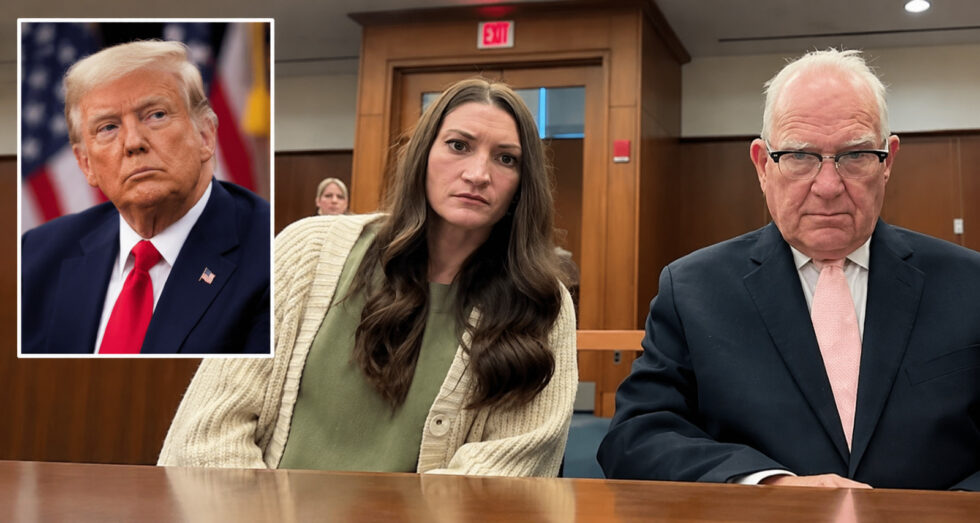
Lindsay Clancy’s defense attorney has made an extraordinary public appeal to President Donald Trump following the mistrial in her Massachusetts murder case.
Kevin Reddington asked Trump to consider pardoning Clancy, even though the Constitution gives presidents no authority to pardon state offenses.
Advertisement
The request came only days after Trump publicly commented on the case and said Clancy would ultimately face “a price” through prison, a mental institution or another legal outcome.
Reddington is now urging the president to consider Clancy’s mental-health history and personal background as prosecutors decide whether to put her on trial again.
“Mr. President, I would hope that you would consider this young lady, the type of person she is, what she has been through, and consider a pardon,” Reddington said during a television interview Tuesday.
Advertisement
There is, however, a fundamental legal obstacle to the request.
Article II of the Constitution gives presidents authority to grant pardons only for “Offenses against the United States,” meaning federal crimes rather than violations of state law.
The Justice Department similarly states that a president cannot grant clemency for a state conviction and that anyone seeking relief from a state offense must turn to the appropriate state authorities.
Clancy’s prosecution is being handled under Massachusetts law, leaving Trump without constitutional authority to pardon her or dismiss the charges.
Reddington has acknowledged that limitation while suggesting Trump could still use his public influence as the defense seeks another resolution to the case.
Clancy, 36, is charged in the January 2023 deaths of her three children, Cora, 5, Dawson, 3, and Callan, 8 months, inside their Duxbury home.
Her attorneys do not dispute that she killed the children but argued at trial that she lacked criminal responsibility because she was suffering from severe mental illness, including postpartum psychosis.
Advertisement
Prosecutors maintained that Clancy remained aware of her actions and deliberately carried out the killings.
The six-week trial ended Friday when jurors reported that they could not unanimously resolve the question of Clancy’s criminal responsibility after approximately 38 hours of deliberations.
Defense attorneys have said the jury was divided 11-1 in favor of finding Clancy not criminally responsible, although the individual jurors have not publicly confirmed their votes.
The mistrial did not amount to either an acquittal or conviction and leaves prosecutors free to seek another trial.
Advertisement
Plymouth County District Attorney Timothy Cruz has not announced whether his office will retry Clancy, negotiate another resolution or take a different course.
Reddington has made clear that he hopes prosecutors will avoid another full trial and reach an agreement with the defense instead.
He has also said he would oppose any agreement requiring Clancy to serve prison time, maintaining that psychiatric treatment rather than incarceration is appropriate.
Reddington used his television appearance to again emphasize evidence the defense says demonstrated Clancy’s deteriorating mental condition before the killings.
He cited messages, medical treatment and attempts to obtain help that he argues showed Clancy was struggling with serious psychiatric problems long before January 2023.
Advertisement
Those claims remain part of the defense case, while prosecutors have argued that the evidence showed planning and awareness inconsistent with Clancy’s claim that she lacked criminal responsibility.
Trump weighed in on the case after the mistrial, describing the deaths as a “horrible tragedy” and saying he expected the legal process to continue.
Reddington’s unusual appeal now adds a presidential dimension to a case that has already generated national attention, although it does not change the legal authority governing Clancy’s prosecution.
Any decision about retrying her remains with Massachusetts prosecutors, and any state clemency process would have to proceed through Massachusetts rather than the White House.
Clancy is scheduled to return to court September 29, when attorneys are expected to discuss the next stage of the case, The New York Times reported.
Until then, Reddington’s appeal may generate political and public attention, but it cannot give Trump a power the Constitution does not provide.
This article may contain commentary which reflects the author’s opinion.