Millions of Americans may now have indirect exposure to Elon Musk’s SpaceX through retirement accounts after the rocket and satellite company joined the Nasdaq-100 following its blockbuster public offering earlier this year.
But for some, that’s unacceptable—including Congress’ undeclared communist senator, Bernie Sanders.
Advertisement
The Vermont “independent” introduced legislation in June that would establish an American AI Sovereign Wealth Fund.
Under Sanders’ proposal, the largest artificial-intelligence companies would face a one-time tax equal to 50% of their equity, paid in stock rather than cash.
The shares would be placed in a government-managed sovereign wealth fund overseen by a seven-member commission. Sanders estimates the fund could initially be worth roughly $7 trillion.
Advertisement
The legislation would apply once qualifying companies reach $200 million in annual AI-related sales.
Sanders says the proposal is intended to ensure that Americans receive a share of the wealth generated by artificial intelligence rather than leaving ownership concentrated among a small number of technology executives and investors.
The fund would distribute 5% of its value annually for purposes including direct payments to Americans and spending on health care, education and housing.
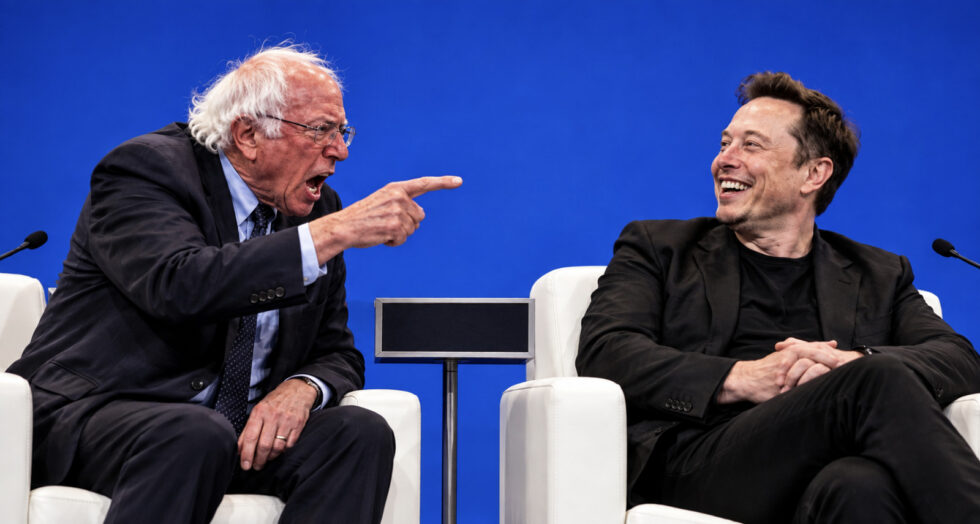
“One man (Mr. Musk) owns more wealth than the bottom half of American households,” Sanders whined on the Musk-owned X platform.
“Meanwhile, 60% of Americans live paycheck to paycheck, nearly 800,000 are homeless and 85 million are uninsured,” he added. “We can do better. We must do better.”
Communism and socialism – Sanders’ “solutions” – have failed in every country those economic models have been implemented.
Meanwhile, Musk has pushed back against criticism centered on the size of his fortune, arguing that much of his wealth consists of ownership stakes in SpaceX and Tesla rather than cash that could simply be spent.
That distinction has become increasingly relevant now that SpaceX is publicly traded.
Advertisement
A large portion of Musk’s wealth rises and falls along with the market values of companies he owns, while retirement funds and other institutional investors may own shares in those same businesses.
“I have stock in SpaceX and Tesla, not some big pile of cash,” Musk wrote on X in response to Sanders.
“As my companies do more and more useful things, their value increases proportionate to their projected usefulness. All shareholders benefit along the way, including most retirement programs,” he added.
I have stock in SpaceX and Tesla, not some big pile of cash.
As my companies do more and more useful things, their value increases proportionate to their projected usefulness. All shareholders benefit along the way, including most retirement programs.
— Elon Musk (@elonmusk) September 5, 2026
Advertisement
SpaceX began trading publicly under the ticker SPCX on June 12 after pricing its initial public offering at $135 per share.
The company ultimately sold nearly 639 million shares, including an underwriters’ option, raising approximately $85.7 billion in what Nasdaq described as the largest IPO in history.
Less than a month later, Nasdaq announced that SpaceX would join the Nasdaq-100 Index beginning July 7.
The index tracks 100 of the largest nonfinancial companies listed on Nasdaq and is followed by more than 200 investment products representing more than $800 billion in assets.
That means retirement savers who own funds tracking the Nasdaq-100 — either directly or through certain broader retirement products — may now hold SpaceX shares without having specifically chosen the company.
Popular exchange-traded funds such as the Invesco QQQ and QQQM are designed to track the Nasdaq-100 and therefore must adjust their holdings when the index changes.
Advertisement
The same can be true for some 401(k) and target-date funds that include Nasdaq-100 investments as part of their portfolios.
However, not every retirement account owns SpaceX.
A worker whose 401(k) is invested exclusively in an S&P 500 index fund, for example, would not automatically gain direct SpaceX exposure simply because the company joined the Nasdaq-100.
Investors would need to examine their individual fund holdings and benchmarks to determine whether SpaceX is included.
SpaceX’s move into retirement portfolios comes as Musk’s enormous paper wealth has become part of a broader political debate.
Democrats believe punishing Musk and other wealthy Americans for their success is the answer, while Republicans counter that government policies should reflect the country’s capitalist founding and encourage all Americans to do better.
This article may contain commentary which reflects the author’s opinion.