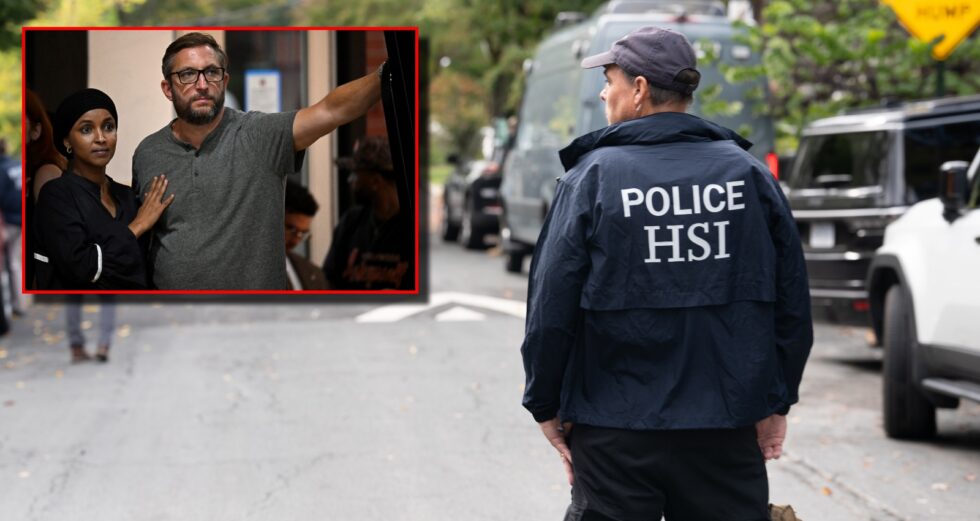
The investigation into Rep. Ilhan Omar is turning out to be much more extensive than what was first reported.
Federal agents collected discarded trash seeking DNA from the left-wing Minnesota Democrat and her family, sources told NewsNation.
The collection preceded Monday’s search of the Minnesota Democrat’s Washington home, according to reporting by Leland Vittert.
Sources described genetic evidence as important to a broader investigation involving relatives and anticipated grand jury proceedings.
NewsNation also reported more than a dozen simultaneous raids, with the investigation coordinated through Homeland Security Investigations in Minneapolis.
The outlet suggested a possible connection to public benefits fraud, but did not establish such a link.
Omar says the Justice Department has been weaponized against her, while Homeland Security Secretary Markwayne Mullin defended the investigation.
Advertisement
Mullin described the case Friday as “about enforcing our nation’s laws.”
NewsNation reported that a Biden-era investigation was closed before portions were reopened and expanded under President Donald Trump.
Its account does not disclose DNA results or establish that investigators successfully recovered usable genetic material.
Advertisement
That distinction matters: An effort to collect evidence is different from a laboratory finding.
Nor does seeking DNA establish any particular family relationship, fraudulent statement, or criminal offense.
For investigators, genetic material would have to answer a relevant question and connect to other evidence.
For the public, the immediate development is the reported investigative tactic, rather than a disclosed scientific conclusion.
The reporting adds another dimension to an inquiry that has already moved beyond reviewing old records.
Reuters reported that the search warrant listed conspiracy, immigration fraud, and false statements concerning immigration paperwork as potential offenses.
Its sources said investigators were examining information provided by Omar or relatives during immigration and citizenship proceedings.
One source described stripping citizenship and deportation as a possible objective; neither outcome has been ordered.
Advertisement
Omar has denied wrongdoing and called the search political intimidation.
The Justice Department declined to discuss the case’s details with Reuters.
The use of discarded garbage also raises a constitutional question with a long-established legal framework.
In California v. Greenwood, the Supreme Court addressed trash left for collection outside a home’s protected surrounding area.
Advertisement
The justices held that the Fourth Amendment did not prohibit its warrantless search under those circumstances.
That ruling concerns abandoned garbage accessible to others, rather than unrestricted police access to someone’s home or private property.
Whether a particular collection meets those conditions depends on where and how officers obtained the material.
NewsNation’s account does not provide enough detail to independently assess every aspect of the reported collection.
The constitutional limits remain relevant even when the investigative target holds a powerful public office.
Equally, holding office does not place someone beyond a lawful investigation supported by evidence.
Omar’s attorneys pushed back Friday, demanding the return of property seized during the home search, The Associated Press reported.
They challenged the investigation’s legitimacy and alleged authorities failed to follow instructions imposed by the judge.
Advertisement
The Justice Department rejected those accusations and said its personnel complied with court orders and legal obligations.
Her lawyers also requested preservation of recordings made during the search.
Those competing accounts have not been resolved by the reporting.
The potential citizenship consequences require a separate legal determination, rather than a political declaration.
The Justice Department says naturalization can be revoked when illegally obtained or secured through material concealment or willful misrepresentation.
A contested family history, standing alone, does not establish that those requirements have been met.
Investigators would need to connect any alleged falsehood to the applicable immigration rules and the relevant records, NewsNation reported.
DNA could potentially inform a factual dispute, but its significance would depend on what prosecutors actually allege.
This article may contain commentary which reflects the author’s opinion.