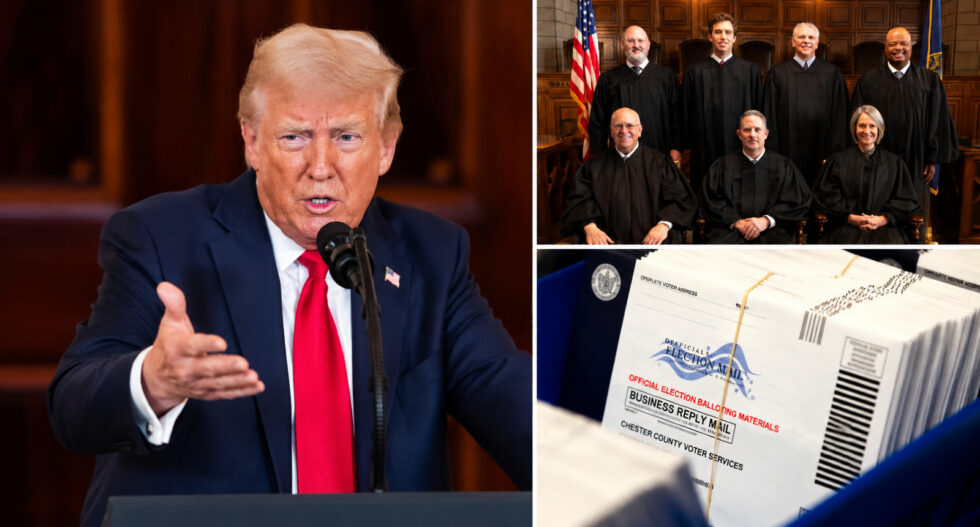
President Donald Trump’s administration has taken an urgent California election dispute to the Supreme Court just before Tuesday’s midterms.
Advertisement
The Justice Department wants officials to separate ballots associated with more than 20,000 registered voters suspected of lacking citizenship.
Federal lawyers argue those ballots should remain uncounted until officials can determine whether the voters meet federal eligibility requirements.
Solicitor General D. John Sauer submitted the emergency appeal Monday after federal courts rejected the administration’s earlier requests.
The government seeks temporary relief preserving disputed ballots while litigation continues rather than an immediate final ruling on citizenship.
Advertisement
Sauer warned that once questioned ballots enter the count, separating them from other votes may become impossible.
Federal law prohibits noncitizens from voting in elections for president, Congress, and other federal offices.
However, the government’s list identifies suspected noncitizens, not 20,000 people proven to have voted illegally.
California officials dispute the list’s reliability and warn that legitimate citizens could lose their votes.
The Justice Department initially contacted California’s secretary of state and Los Angeles County election officials about the flagged registrations.
California rejected that demand, prompting the Justice Department to file a lawsuit seeking emergency judicial intervention.
United States District Judge David Carter denied the requested temporary restraining order last Wednesday.
Carter, appointed by Democratic President Bill Clinton, warned that sudden changes could disrupt voting already underway.
He wrote that the government’s proposed action “would wreak havoc and disrupt the election.”
The Justice Department appealed to the Ninth Circuit, which also declined to order ballots separated Friday.
Sauer described the proposed intervention as a “modest remedy” designed to protect lawful ballots.
He argued that illegal votes, if counted, could dilute ballots cast by eligible American citizens.
California maintains its election safeguards, which already protect voting eligibility while preventing mistaken exclusion of lawful voters.
Officials say that federal authorities identified some people as born in the United States.
Advertisement
Others reportedly had canceled registrations or no voting history, raising questions about whether the list identifies actual ballots.
By Sunday, well over six million mail ballots had arrived statewide, according to election officials.
Election administrators say processed ballots can become detached from identifying envelopes, complicating efforts to isolate individual votes.
First Assistant United States Attorney Bill Essayli criticized the district court’s refusal to intervene.
Advertisement
He contended that continuing ballot processing creates risks for voters whose lawful ballots deserve equal weight.
The government’s position rests on a fundamental principle that only eligible citizens may vote in federal elections.
But courts must also protect citizens from losing their ballots through inaccurate records or unsupported suspicions.
Judge Carter questioned the strength of federal evidence and the consequences of disrupting election procedures.
He also considered appointing a special master to examine how the government assembled its voter list.
The administration has pursued broader efforts to improve citizenship verification using federal databases.
In September, the Supreme Court allowed expanded federal citizenship checks to continue while related litigation proceeds.
That ruling did not establish that California’s disputed voters are noncitizens or authorize rejecting their ballots.
Advertisement
Reuters reported relatively few federal prosecutions involving noncitizen voting over several decades.
Those figures do not eliminate the government’s responsibility to investigate credible individual violations.
They also do not establish that the entire group identified in California committed any offense.
The case unfolds amid intense competition for control of the House and Senate.
California’s congressional contests could help determine which party controls the House next year.
The Supreme Court has not yet resolved the administration’s newest emergency request.
Any ruling would address immediate election procedures rather than necessarily settle the underlying lawsuit.
Republicans see the appeal as a forceful attempt to defend election safeguards under federal law.
The justices now face competing demands involving ballot integrity, voter protection, and the timing of judicial intervention.
This article may contain commentary which reflects the author’s opinion.