Supreme Court Justice Samuel Alito warned Thursday that a Democrat-controlled Congress could use federal spending decisions to disrupt the court’s work.
Advertisement
He delivered the warning to more than 1,000 conservative lawyers gathered for the Federalist Society’s annual Antonin Scalia Memorial Dinner.
Alito raised the prospect of lawmakers deciding to “turn off the lights at the Supreme Court” by withholding funding.
He also said lawmakers had many other ways to exert pressure on the judiciary if they chose to try.
Advertisement
“So, it is important to preserve the independence of the judiciary,” he added.
“If that is eliminated, then the Constitution as adopted in 1789 will no longer be the same.”
The dinner came a week after Democrats won control of both houses of Congress in the midterm elections.
Alito spoke about the powers available to Congress without mentioning the election results or the pending change in congressional leadership.
Democrats have previously considered using Congress’s spending authority as leverage against the Supreme Court, where conservatives hold the majority.
The remarks concerned what lawmakers could do with that authority if they tried to cut off funding for court operations.
Alito described the judiciary as the least powerful branch and said it was “vulnerable” to Congress and the executive.
His warning was about the practical consequences of a funding cutoff, including the court’s ability to keep hearing cases.
A fight over appropriations could reach the court’s day-to-day operations even if it began with objections to a particular ruling.
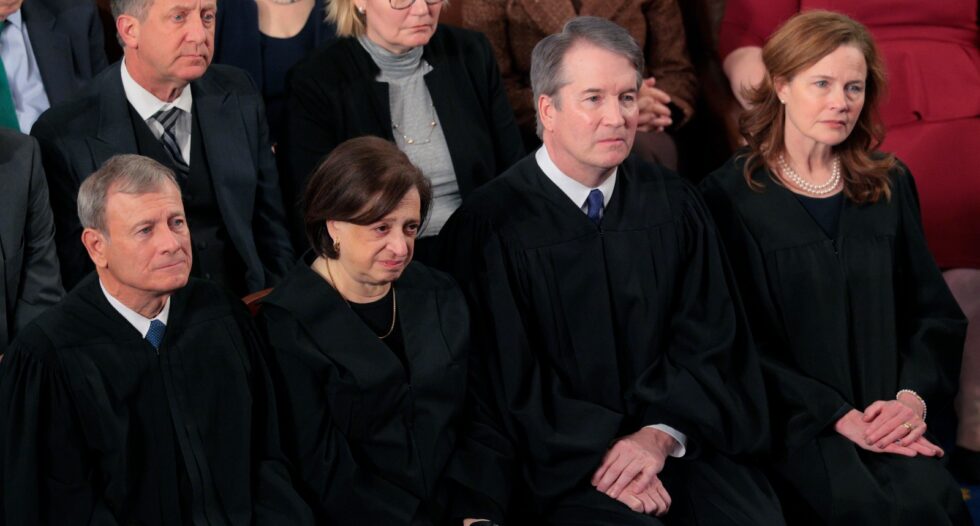
Two of Alito’s colleagues had already taken the judiciary’s case for increased funding to lawmakers over the summer.
Justices Elena Kagan and Amy Coney Barrett made a rare Capitol Hill visit to advocate for a larger judiciary budget.
They also sought more money for security as threats increased, putting the protection of judges before lawmakers.
Advertisement
The joint appearance put two justices from different wings of the court before members of Congress on the same request.
Alito also used the dinner to address how judges themselves exercise power when cases challenge policies set by elected officials.
He compared the branches’ relative power to the differences among a hand grenade, a 500-pound bomb and a nuclear weapon.
His point was that a branch with less power than its counterparts can still do damage when it oversteps.
Advertisement
“But that is not to say that it is not dangerous,” Alito said of the grenade.
Alito took particular issue with some lower court orders blocking presidential policies in recent years, describing certain orders as “unjustified.”
He acknowledged the ability and commitment of lower court judges before delivering a sharper criticism of some of their decisions.
“They are dedicated and they are skillful, but they’re not perfect and they make mistakes,” Alito said.
“And in some instances, I think they have gone far astray in abuse of their powers.”
His criticism focused on cases where judges halted policies set by presidents, putting the exercise of judicial power under scrutiny.
Named for the late conservative Justice Antonin Scalia, the dinner is part of the Federalist Society’s annual convention each November.
Advertisement
The event has featured several of Alito’s Supreme Court colleagues, including justices who have appeared together on the same stage.
Justice Brett Kavanaugh and Barrett shared the stage at last year’s dinner, before Alito returned to address the gathering.
Justice Neil Gorsuch appeared with former Justice Stephen Breyer the year before Kavanaugh and Barrett took part in the dinner.
Alito previously addressed the dinner virtually during the pandemic, when his remarks focused on restrictions imposed during the health crisis.
In that speech, he described the pandemic as bringing “previously unimaginable” restrictions on civil liberties during the health crisis.
The Federalist Society is a nonprofit organization that says it takes no official positions on legal or political questions, NBC News reported.
Over decades, it has become a fixture of the conservative legal movement and a source of Republican judicial nominees.
This article may contain commentary which reflects the author’s opinion.