The number of Muslims has been growing throughout the West at an alarming pace, thanks in large part to lax immigration enforcement.
Advertisement
And while Democrats have mostly embraced the spread of Islamic culture througout the U.S. and Europe, a CNN host is now warning the party to give some serious thought to how much more we should tolerate.
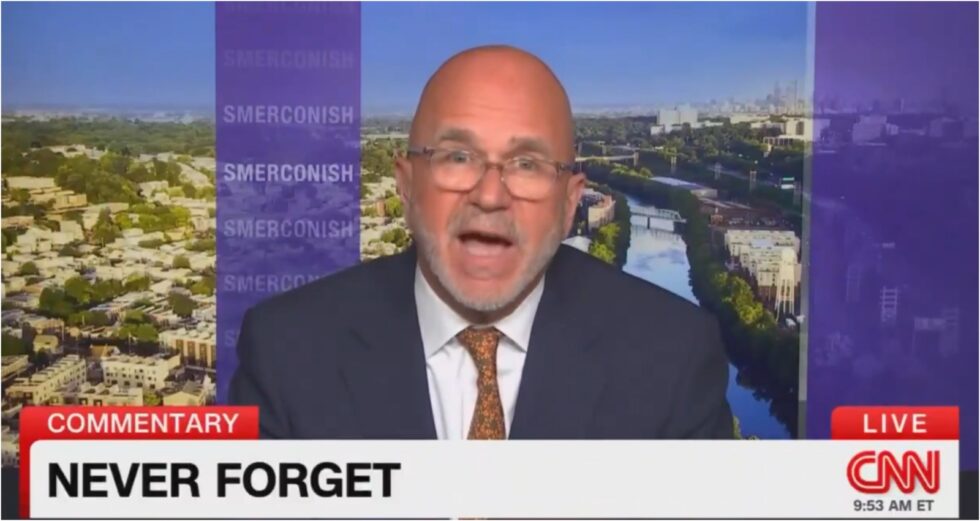
Host Michael Smerconish said people should be willing to confront difficult questions about Islam and its relationship with Western values, pointing to restrictions on women, gay people and religious dissenters in several Muslim-majority countries.
Smerconish raised the issue during Saturday’s edition of his show while discussing debates surrounding immigration, religious freedom and assimilation in Western countries.
Advertisement
The CNN host emphasized that Islam encompasses a vast and diverse population and warned against treating the world’s roughly two billion Muslims as a monolithic group.
But he argued that concerns about laws and cultural practices in most Muslim-majority nations should not automatically be dismissed as bigotry.
“There are hard questions that we need to confront,” Smerconish said. “Not every question about Islam is Islamophobic.”
Smerconish pointed to countries where governments enforce strict interpretations of Islamic law and impose severe penalties for conduct protected as individual liberty in the United States and other Western democracies.
Those issues include laws criminalizing same-sex relationships, restrictions on women’s rights, blasphemy statutes and penalties for abandoning Islam.
Smerconish specifically highlighted apostasy laws.
“There are countries in the world today where leaving Islam can be punishable by death,” he said. “And I think Americans have a right to ask: How does that square with our values?”
The United States Constitution protects both religious exercise and the right of individuals to change their religious beliefs or practice no religion at all.
Smerconish said the relevant question is not whether Muslims should be permitted to practice their faith in America, something protected by the First Amendment, but how societies should approach ideological or religious doctrines that conflict with liberal democratic principles.
The issue has become increasingly contentious across Europe, where governments have struggled with debates over immigration, integration, religious expression and the treatment of women and sexual minorities.
Advertisement
Several Muslim-majority countries continue to criminalize consensual same-sex activity.
Some countries also maintain apostasy or blasphemy laws carrying severe penalties, although enforcement and legal standards differ substantially from nation to nation.
At the same time, Muslims living in the United States hold widely varying political, theological and social views.
Advertisement
American Muslim organizations have repeatedly argued that extremists and authoritarian governments should not be treated as representative of Muslims generally.
Civil liberties organizations have similarly warned that legitimate policy debates can cross into religious discrimination when individuals are judged solely on their faith rather than their conduct or beliefs.
Smerconish acknowledged those distinctions during his discussion.
His argument centered on whether fear of appearing intolerant has made some Americans reluctant to discuss genuine conflicts between certain religious practices and Western concepts of individual rights.
The CNN host also drew a distinction between criticism of a religion and hostility toward its followers.
Americans routinely debate doctrines within Christianity, Judaism and other religions, he argued, and Islam should not be exempt from scrutiny simply because Muslims are a religious minority in the United States.
Advertisement
The discussion comes as immigration and assimilation remain major political issues following the 2026 midterm elections.
Debates over immigration frequently involve not only border enforcement and legal status but also broader questions about whether newcomers should be expected to embrace constitutional principles such as religious liberty, equality before the law and freedom of speech.
Those questions have become especially heated when they involve Islam.
Smerconish argued that Americans should be capable of simultaneously defending Muslims against discrimination while scrutinizing practices or doctrines that appear incompatible with constitutional freedoms.
The distinction, he suggested, is essential to having a serious debate.
“You can defend the rights of Muslims in America,” Smerconish said, “and still ask difficult questions about what is happening in parts of the Muslim world.”
This article may contain commentary which reflects the author’s opinion.