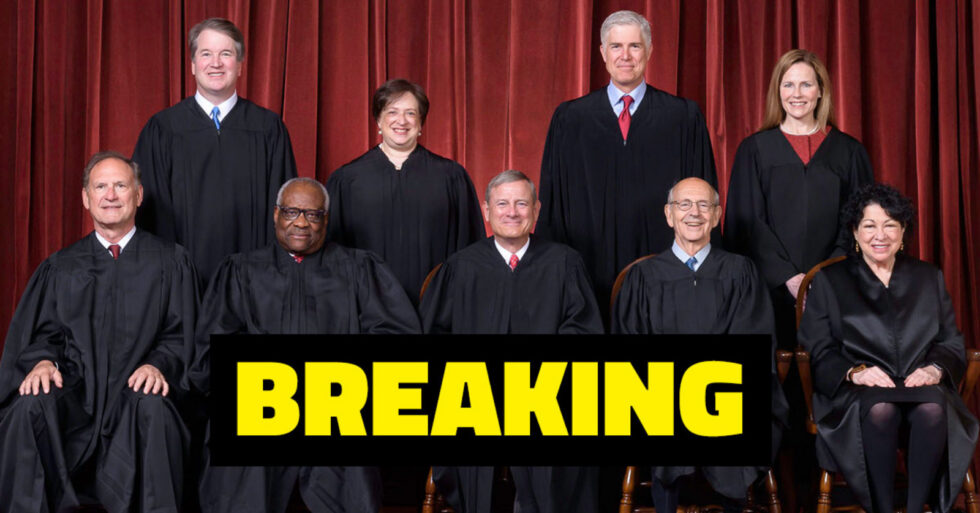
A divided Supreme Court of the United States on Thursday rejected Alabama’s effort to execute a convicted murderer whom lower courts determined is intellectually disabled.
The decision leaves intact lower court rulings in favor of Joseph Clifton Smith, 55, who has spent roughly half his life on death row following his conviction in the 1997 beating death of a man.
Advertisement
The Supreme Court barred the execution of intellectually disabled individuals in its landmark 2002 ruling in Atkins v. Virginia.
The justices later expanded on that standard in decisions issued in 2014 and 2017, directing states to consider broader evidence of intellectual disability in close cases because IQ testing carries a recognized margin of error.
At the center of Smith’s case is how courts should evaluate defendants whose IQ scores fall slightly above the commonly recognized threshold of 70 associated with intellectual disability. Smith received five IQ test scores ranging from 72 to 78.
According to his attorneys, Smith was placed in special education classes for students with learning disabilities and left school after seventh grade.
They also said that at the time of the crime he performed math at a kindergarten level, spelled at roughly a third-grade level, and read at approximately a fourth-grade level.
Advertisement
The justices reviewed the case to determine how courts should approach borderline cases of intellectual disability. Oral arguments were presented in December.
Rather than issuing a full ruling on the merits, the Supreme Court of the United States dismissed the appeal — an unusual move that leaves the lower court’s ruling in favor of Joseph Clifton Smith intact.
The majority consisted of the court’s three liberal justices along with Brett Kavanaugh and Amy Coney Barrett.
The court’s four remaining conservative justices dissented, criticizing the federal appeals court in Atlanta for what they described as an improper analysis of the case. The dissenters argued the Supreme Court should have ordered the lower court to reconsider Smith’s claims.
Meanwhile, the high court on Wednesday refused to examine a $2.4 billion bankruptcy settlement for the Boy Scouts of America.
The nation’s highest court dismissed an appeal from a cohort of childhood sexual abuse victims who contended that the agreement unlawfully impeded their ability to sue organizations that operated local scouting programs.
A cohort of 75 victims, among over 82,000 claimants against the Boy Scouts, contended that the justices ought to have revisited the settlement following their ruling last year in a comparable legal matter concerning Purdue Pharma, the manufacturer of the opioid analgesic OxyContin.
A 5-4 majority dismissed a bankruptcy settlement that would have protected the Sackler family from future litigation, despite their wealth being derived from operating the company.
In the Boy Scouts’ case, certain victims seek the ability to litigate against independent councils managing local scouting programs and third-party entities, including churches and civic organizations, that endorsed these programs.
Third-party entities contributed billions of dollars to a settlement trust for victims and, pursuant to the agreement, are protected from future civil litigation.
Critics of these arrangements assert that courts typically do not have the authority to impede such lawsuits.
Proponents argue that without safeguards for third-party entities, significant bankruptcy agreements, such as those involving Purdue and the Boy Scouts, would not be implemented.
The Boy Scouts of America declared bankruptcy in 2020 following expenditures exceeding $150 million to resolve numerous abuse lawsuits from 2017 to 2019, as per court documents.
In 2022, a federal bankruptcy court in Delaware sanctioned the reorganization plan, facilitating the Boy Scouts of America’s resurgence and establishing a fund to compensate victims.
The lower courts, including the Third Circuit Court of Appeals, affirmed the settlement agreement.
The Lujan claimants petitioned the Supreme Court in October.
In early 2024, the Supreme Court denied an emergency appeal from the identical group of victims.
This article may contain commentary which reflects the author’s opinion.