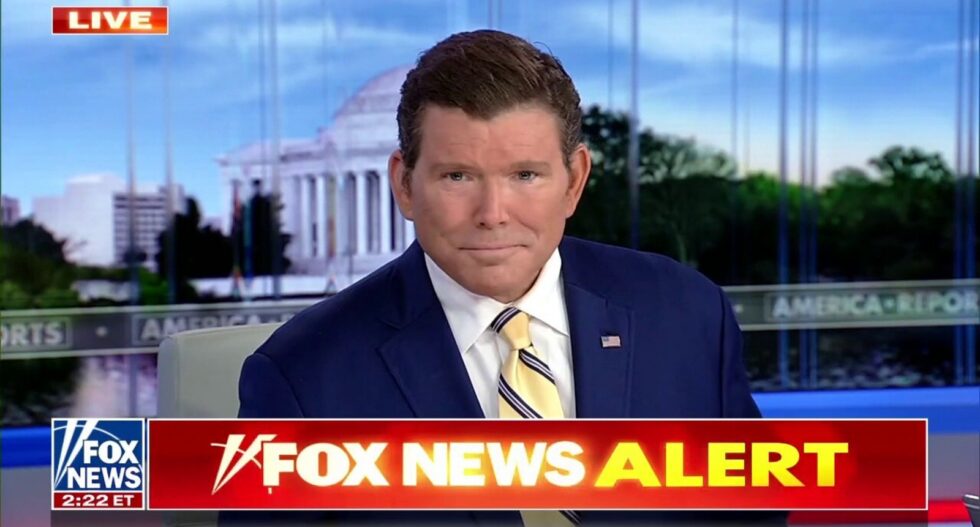
Fox News anchor Bret Baier said President Donald Trump told him he was “cautiously optimistic” about the United States reaching a deal with Iran.
“We’re in the middle of this — what the president is looking at on this proposal, this one-pager, this memorandum of understanding, I talked to him today, and there was this sense of optimism, not — I would say cautious optimism that they maybe get to a deal within a week,” Baier said on “America Reports.”
Advertisement
“However, at the same time, you have the United Nations, Iran has introduced a new mechanism, the Persian Gulf Strait Authority, to regulate maritime transit through the strategic Strait of Hormuz. That’s according to Iranian state media,” Baier added.
“Under the system, vessels intending to pass through the strait will receive guidance from an official email address outlining the rules for transit. Ships are required to comply with the framework and obtain prior authorization before crossing the waterway.’ That doesn’t seem like that’s going to fly,” Baier continued.
U.S. Ambassador to the United Nations Mike Waltz responded by saying, “No, absolutely not. It’s in violation of all kinds of international laws, Hague Convention, Geneva Convention, law of the sea.”
“I mean, Bret, it would be like, I don’t know, can Spain and Morocco, if they get into some kind of conflict — hypothetically, of course — start throwing sea mines into the straits of Gibraltar and start charging shipping to go through and punish all the Mediterranean until the other side gives?” Waltz asked.
“So there is a really important precedent here on the freedom of navigation that I think the world takes for granted. But that’s what this next U.N.,” Waltz added.
Advertisement
“Resolution that Secretary Rubio was actually talking about there, is that no matter what your conflict is, whether you agree with it or not, you can’t respond by sowing sea mines in international waterways and then trying to charge tolls. Clearly, Iran is thinking about announcing setting up an infrastructure to do just that,” Waltz concluded.
WATCH:
This week, Iran’s Supreme Leader Ayatollah Mojtaba Khamenei ordered that the stockpile of enriched uranium “should not leave the country,” rejecting the key demand of President Trump in ongoing peace talks.
Amid highly volatile and fragile diplomatic engagements between Tehran and Washington, the parties made this decision.
According to Israeli officials who spoke to Reuters, Trump had previously given Israel assurances that Iran’s inventory of highly enriched uranium, which is a critical component in the construction of a nuclear weapon, would be entirely removed from the Islamic Republic.
One of two Iranian sources who spoke on the condition of anonymity due to the highly sensitive nature of the geopolitical situation described the internal consensus within Iran’s highest decision-making bodies.
Reuters reported that the Supreme Leader maintains ultimate authority over all critical state policies under Iran’s constitutional framework.
The present diplomatic impasse is occurring in the context of a precarious cessation of hostilities that has been in place since April 8.
This fragile truce was initiated in response to a series of military attacks against Iran by the United States and Israel on February 28.
Tehran initiated retaliatory strikes against Gulf nations that hosted American military detachments in the immediate aftermath of those attacks.
At the same time, Israeli forces and Iran-backed Hezbollah units in Lebanon engaged in intense cross-border combat.
Negotiators have been unable to make a substantial diplomatic breakthrough, despite the current pause in active combat.
Tehran’s strategic leverage over the Strait of Hormuz, an essential choke point for the global energy supply, is counterbalanced by a stringent US naval blockade that stifles Iranian shipping centers.
Pakistani mediation is currently facilitating these high-stakes discussions, as some think they could be making progress.
This article may contain commentary which reflects the author’s opinion.