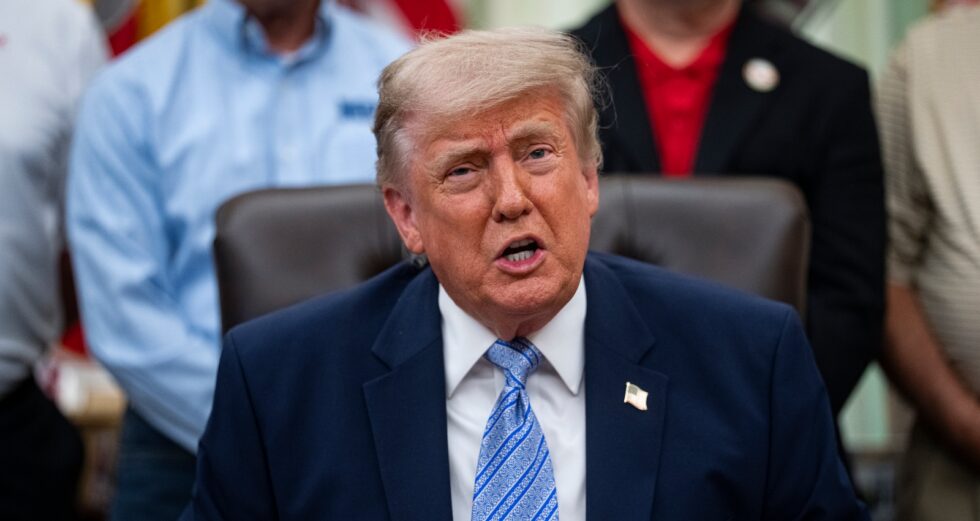
President Donald Trump announced Thursday that the United States will send an additional 5,000 troops to Poland, marking a sharp reversal after recent indications that the administration was preparing to scale back some military deployments in Europe.
Trump made the announcement in a Truth Social post, directly tying the move to his relationship with Poland’s new president, Karol Nawrocki.
“Based on the successful Election of the now President of Poland, Karol Nawrocki, who I was proud to Endorse, and our relationship with him, I am pleased to announce that the United States will be sending an additional 5,000 Troops to Poland,” Trump wrote.
Advertisement
The decision comes after a turbulent stretch of U.S.-European tensions.
Trump recently signaled he would pull thousands of American troops from Germany, escalating friction with European allies.
That dispute intensified after German Chancellor Friedrich Merz publicly criticized the administration’s approach to negotiations involving Iran.
Trump had also reportedly been expected to reduce deployments in Poland.
That prospect alarmed both U.S. allies abroad and some voices domestically who view Poland as a critical NATO frontline state given its proximity to Russia and the war in Ukraine.
Instead, Trump reversed course.
“PRESIDENT TRUMP MOVES 5,000 MORE U.S. TROOPS TO POLAND While Pulling Forces Out of Germany! Secretary Rubio made it crystal clear: This is NOT punitive, it’s pure AMERICA FIRST. Trump endorsed the new President of Poland and is rewarding a strong, reliable ally right on the front lines. Germany has been a freeloading NATO partner for years, talking tough but letting America carry the heavy load. No more one-way alliances,” conservative influencer Gunther Eagleman posted on X.
Advertisement
The troop increase represents a significant show of force in Eastern Europe and a clear sign that Warsaw remains a favored partner inside Trump’s foreign policy framework.
Nawrocki assumed office in August 2025 and is widely viewed as politically aligned with Trump.
The Polish leader has embraced nationalist and conservative positions while keeping a distance from deeper European Union integration.
That ideological alignment appears to have mattered.
Trump explicitly framed the deployment as both strategic and personal.
The announcement quickly drew praise from conservative Polish figures.
Piotr Müller, a member of the European Parliament, celebrated the decision publicly.
“This is how you ensure Poland’s security,” Müller wrote on X.
“Do not waste this opportunity that has just presented itself.”
The move is likely to be welcomed by NATO hawks who have pushed for a stronger U.S. military posture in Eastern Europe.
Poland has become one of Washington’s closest regional defense partners in recent years, increasing military spending and positioning itself as a central logistics hub for support tied to Ukraine.
At the same time, Trump’s broader Europe policy has often unsettled traditional allies.
He has repeatedly criticized NATO members over defense spending and pushed European governments to shoulder a larger security burden.
The apparent withdrawal from Germany appeared consistent with that approach.
The Poland reversal adds a more complicated layer.
It suggests Trump is not opposed to troop deployments in Europe outright, but may instead be selectively rewarding governments he sees as politically aligned and strategically cooperative.
That could reshape how European capitals interpret U.S. military commitments.
The deployment also comes during a volatile international moment.
Tensions involving Iran, shifting NATO calculations and broader global security concerns continue to pressure the White House.
Trump’s troop announcement could also be read as a message to Moscow, signaling that U.S. force posture in Eastern Europe remains flexible and potentially expandable.
The exact timing of the deployment and operational details were not immediately released.
It also remains unclear whether the 5,000 additional troops represent permanent repositioning, rotational deployments or temporary force increases, The Washington Times reported.
Still, politically, the message was unmistakable.
Trump is rewarding an ally.
And Poland just became the beneficiary of one of the most dramatic military reversals of his recent foreign policy moves.
This article may contain commentary which reflects the author’s opinion.