President Donald Trump’s administration just picked up another major immigration win at the U.S. Supreme Court.
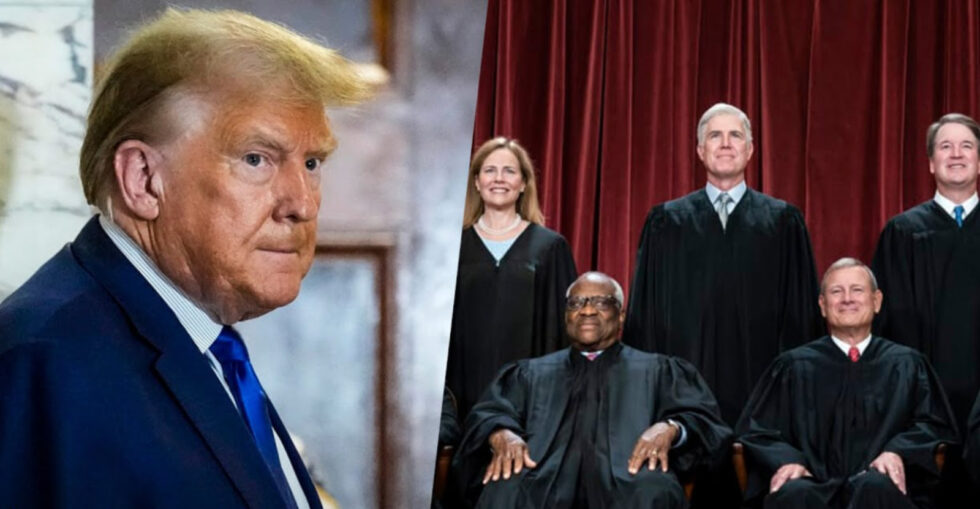
In a decisive 6-3 ruling, the Supreme Court ruled Thursday that the Trump administration may proceed with terminating Temporary Protected Status (TPS) designations for nationals of Haiti and Syria.
Advertisement
The decision in Mullin v. Doe, consolidated with Trump v. Miot, reinforces congressional limits on judicial interference in executive immigration decisions.
It also strikes a blow against activist lawsuits seeking to block commonsense border and immigration policies.
Justice Samuel Alito authored the majority opinion, joined in full by Chief Justice John Roberts and Justices Clarence Thomas and Brett Kavanaugh.
Advertisement
Justices Neil Gorsuch and Amy Coney Barrett joined most of the opinion.
The Court held that 8 U.S.C. §1254a(b)(5)(A) bars judicial review of non-constitutional claims challenging terminations, nations, and that the equal protection challenge to Haiti’s termination was unlikely to succeed.
Advertisement
“The TPS statute plainly bars consideration of respondents’ non-constitutional claims,” Alito wrote.
“It allows ‘no judicial review of any determination . . . with respect to the . . . termination’ of a TPS designation,” Alito added.
Alito emphasized that the broad statutory language covers both the final decision and the process leading to it, preventing courts from second-guessing the Secretary of Homeland Security’s authority.
On the equal protection claim regarding Haiti, Alito noted a strong race-neutral explanation: “the current administration, which has terminated every TPS designation that has come up for renewal, simply opposes the TPS program as it has been implemented in the past.”
The opinion rejected attempts to infer racial motivation from policy statements, stressing context in immigration and foreign affairs.
Justice Clarence Thomas filed a concurring opinion reinforcing the decision’s textualist foundation and separation-of-powers principles.
The Trump administration strongly supported the case and pushed for a swift resolution, arguing that endless litigation undermined national sovereignty and encouraged abuse of humanitarian programs meant for truly temporary relief.
The Solicitor General emphasized that TPS, originally designed as short-term aid, had become a de facto permanent residency loophole lasting decades in some cases, conflicting with America First priorities of controlled immigration and enforcement of existing law.
Justice Elena Kagan dissented, joined by Justices Sonia Sotomayor and Ketanji Brown Jackson.
Kagan argued the majority’s reading of the judicial review bar was too broad and that procedural claims should proceed.
She warned that the decision “effectively insulates” executive action from meaningful oversight.
This ruling is a landmark victory for constitutional order, executive authority in immigration, and the rule of law.
By upholding clear statutory limits on judicial review, the Court prevents activist judges and plaintiffs from turning every policy disagreement into a nationwide injunction blocking lawful executive action.
It vindicates the Trump administration’s objective of ending the abuse of TPS — a program that had ballooned far beyond its original humanitarian intent — and restores accountability to a system long exploited to undermine border security.
For the entire country, the decision means stronger enforcement of immigration laws, reduced strain on public resources, and a reaffirmation that foreign policy and national security decisions belong to the political branches, not the federal judiciary.
It paves the way for broader TPS terminations and deters forum-shopping by those seeking to nullify election results through litigation.
Conservatives hail it as a return to textualism and restraint, protecting American workers, taxpayers, and sovereignty from an entrenched administrative state and its allies in the courts.
While the left decries the outcome, millions of Americans understand it as essential to putting America first after years of open-border policies.
The Supreme Court’s term ends at the end of June and there are still a handful of key opinions remaining to be released.
The ruling on Birthright Citizenship may be the most important case remaining.
This article may contain commentary which reflects the author’s opinion.