President Donald Trump is set to meet on Wednesday with the leaders of America’s largest defense contractors as concerns grow about the nation’s ability to replenish key weapons stockpiles following months of military operations in the Middle East.
The White House gathering will bring together senior Pentagon officials and executives from major defense firms to discuss expanding production of advanced munitions and missile systems.
Advertisement
According to reports, the meeting is expected to focus on increasing manufacturing capacity and addressing long-standing bottlenecks in the defense industrial base.
The session had originally been planned earlier this month but was postponed as the administration focused on negotiations surrounding the conflict with Iran.
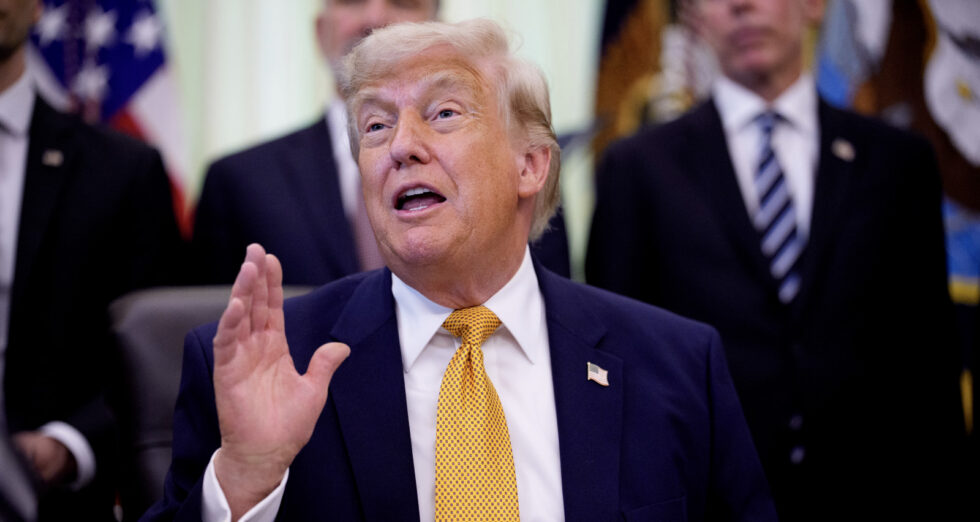
Trump appeared to confirm the meeting during remarks from the Oval Office on Monday.
Advertisement
“We’re building plants all over the country,” Trump said.
The president also suggested that major American automakers could play a role in expanding defense production.
“Some of the car companies, if they have any excess capacity, they’re making a deal to build missiles and the Patriot in particular,” Trump said.
Advertisement
The comments come amid reports that defense giant Lockheed Martin has been exploring partnerships with automakers, including General Motors, to help accelerate weapons manufacturing.
Trump last met with defense industry leaders in March.
Following that meeting, he announced that major contractors had agreed to significantly increase production of what he described as “exquisite class” weaponry.
Executives from companies including Boeing, Northrop Grumman, L3Harris Technologies, Honeywell, BAE Systems, RTX (Raytheon) and Lockheed Martin participated in those discussions.
While Trump has repeatedly insisted that America’s weapons inventories remain strong, defense analysts have warned that several critical systems are being consumed faster than they can be replaced.
Patriot missile interceptors, THAAD interceptors and Tomahawk cruise missiles have all been heavily utilized during military operations involving Iran and its regional allies.
Experts have noted that production timelines for these sophisticated systems often stretch for months or even years due to complex supply chains and specialized manufacturing requirements.
Earlier this month, Trump invoked the Defense Production Act to accelerate weapons production.
In a memorandum to Defense Secretary Pete Hegseth, Trump cited “systemic constraints in the munitions industrial base” and warned that limited manufacturing capacity, fragile supply chains and production bottlenecks could undermine national security.
“The issues may impair the ability of the United States to produce, sustain, and expand the availability of munitions, missiles, and equipment required for the national defense,” Trump wrote.
The administration’s push comes as lawmakers prepare to debate defense spending for fiscal year 2027.
Trump has proposed a historic $1.5 trillion defense budget.
That proposal includes approximately $1.15 trillion in traditional defense spending along with another $350 billion through the budget reconciliation process.
The request faces significant obstacles on Capitol Hill.
Lawmakers from both parties have expressed concerns about the size of the proposed increase and the use of reconciliation to fund portions of the defense package.
Complicating matters further, Pentagon officials have reportedly informed senators that military operations connected to the Iran conflict could require an additional $80 billion.
The Defense Department has separately requested nearly $53 billion to increase production of 12 critical munitions systems, including Patriot and THAAD interceptors.
Much of that funding remains tied to ongoing budget negotiations.
Hegseth is expected to make the administration’s case directly to House Republicans during a closed-door meeting Wednesday.
In a New York Post opinion article published Tuesday, the defense secretary argued that insufficient military spending now represents one of the greatest risks facing the United States.
“The single greatest threat to America’s national security today is under-investment in military spending,” Hegseth wrote, The Hill reported.
Wednesday’s White House meeting is expected to focus not only on funding but also on finding ways to rapidly expand production capacity before future military demands place even greater strain on America’s weapons inventory.
This article may contain commentary which reflects the author’s opinion.