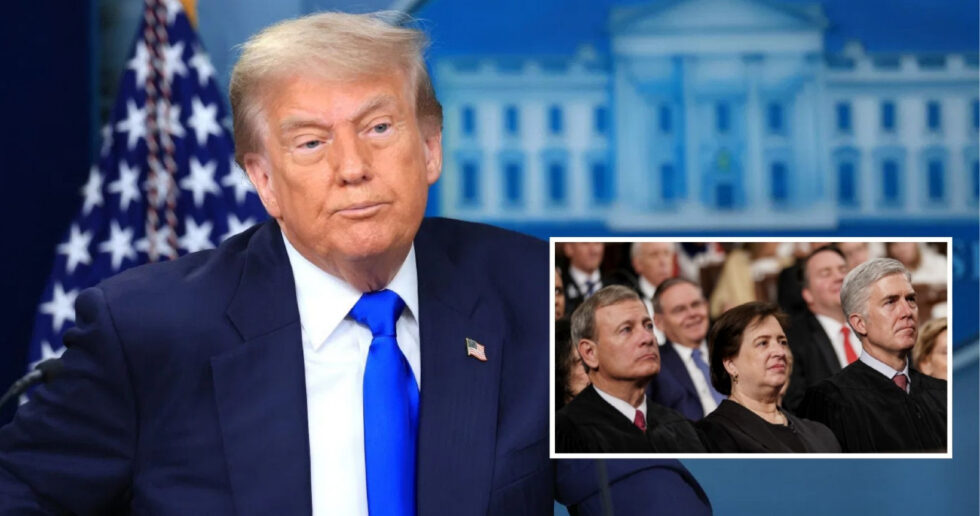
The U.S. Supreme Court on Tuesday delivered it’s highly-anticipated ruling on President Donald Trump’s executive order challenging the Constitution’s “birthright citizenship” provision.
The nation’s highest court has struck down Trump’s executive order.
Advertisement
In a 6-3 ruling, the Supreme Court held that the children of illegal aliens and foreign nationals born in the U.S. count as American citizens.
Justices Thomas, Alito, and Gorsuch dissented.
The Supreme Court ruled that the Fourteenth Amendment guarantees birthright citizenship to children born in the United States, including those whose parents are in the country unlawfully or only temporarily, striking down President Trump’s executive order.
On Jan. 20, 2025, Trump’s first day back in office, he issued an executive order titled “Protecting the Meaning and Value of American Citizenship.”
Advertisement
The order argued that the Fourteenth Amendment was intended to convey citizenship on newly freed American slaves following its ratification after the Civil War, and that at the time it was implemented, its creators in Congress never meant for it to convey citizenship to anyone who was born in the U.S. to a mother or parents who came in illegally.
“The Fourteenth Amendment has always excluded from birthright citizenship persons who were born in the United States but not ‘subject to the jurisdiction thereof,’” the order stated.
“Consistent with this understanding, the Congress has further specified through legislation that ‘a person born in the United States, and subject to the jurisdiction thereof’ is a national and citizen of the United States at birth, 8 U.S.C. 1401, generally mirroring the Fourteenth Amendment’s text,” the order continued.
It added:
Among the categories of individuals born in the United States and not subject to the jurisdiction thereof, the privilege of United States citizenship does not automatically extend to persons born in the United States: (1) when that person’s mother was unlawfully present in the United States and the father was not a United States citizen or lawful permanent resident at the time of said person’s birth, or (2) when that person’s mother’s presence in the United States at the time of said person’s birth was lawful but temporary (such as, but not limited to, visiting the United States under the auspices of the Visa Waiver Program or visiting on a student, work, or tourist visa) and the father was not a United States citizen or lawful permanent resident at the time of said person’s birth.
President Trump attended the oral arguments in the case, Trump v. Barbera in April, an unprecedented move for a sitting president.
Legal challenges to the executive order were filed in federal courts across the country.
The first ruling came from Senior U.S. District Judge John Coughenour in Seattle, who described the order as “blatantly unconstitutional.”
Advertisement
Several other federal judges subsequently issued rulings blocking the Trump administration from enforcing the policy.
The administration then appealed to the Supreme Court, asking the justices to address the legality of nationwide, or universal, injunctions—court orders issued by federal district judges that prevent the government from enforcing a policy anywhere in the United States while litigation is pending.
By a vote of 6-3, the Supreme Court in Trump v. CASA limited the ability of lower courts to issue universal injunctions. Challenges to the order continued in lower courts, but they were narrowly defined cases.
Eventually, the administration came to the Supreme Court and asked it to weigh in on one of those cases, Trump v. Barbera.
During oral arguments, U.S. Solicitor General D. John Sauer argued that the Citizenship Clause of the 14th Amendment was adopted primarily to guarantee citizenship for formerly enslaved people and their descendants following the Civil War.
Sauer told the justices that, for many years after the amendment’s ratification, legal commentators generally understood that children born in the United States to temporary visitors were not automatically entitled to U.S. citizenship under the Constitution.
This article may contain commentary which reflects the author’s opinion.