The U.S. Supreme Court has struck down limits on party spending in federal elections.
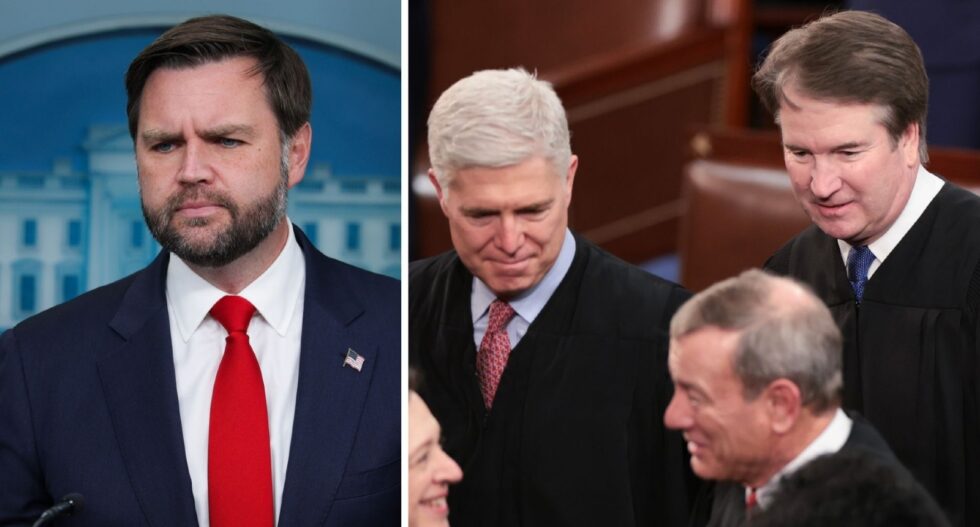
The nation’s highest court backed a Republican appeal that then-Senator J.D. Vance was involved with when the case began years ago.
Advertisement
The case began in 2022 when Vance, former Rep. Steve Chabot, the National Republican Senatorial Committee (NRSC), and the National Republican Congressional Committee (NRCC) sued the Federal Election Commission (FEC).
In a 6–3 vote, the Supreme Court struck down the federal limits on how much political parties may spend in coordination with their own candidates.
The majority held that the restrictions violate the First Amendment and overruled its 2001 decision in Colorado Republican II.
In December, the Supreme Court heard arguments in the case challenging a federal law that limits how much political parties may spend in coordination with candidates for federal office.
Advertisement
During more than two hours of oral arguments in National Republican Senatorial Committee v. Federal Election Commission, several justices appeared receptive to the challengers’ argument that the coordinated spending limits violate the First Amendment’s protections for political speech.
However, the outcome of the case remained uncertain. Justice Neil Gorsuch did not ask any questions during the arguments, while Justice Amy Coney Barrett spoke only once, leaving few clues about where they ultimately stood when the court issues its decision, the SCOTUSBlog reported at the time.
The case marks the Supreme Court’s second major review of the coordinated expenditure limits.
In 2001, the court upheld the restrictions in Federal Election Commission v. Colorado Republican Federal Campaign Committee by a 5-4 vote, with Justice Clarence Thomas dissenting.
More than two decades later, four plaintiffs—the National Republican Senatorial Committee, the National Republican Congressional Committee, then-Senate candidate J.D. Vance and then-Rep. Steve Chabot—filed suit in federal court in Ohio seeking to strike down the spending limits.
The plaintiffs argue that the restrictions violate the First Amendment by limiting the ability of political parties and candidates to coordinate campaign messaging.
Vance and Chabot also contended that the law improperly restricts candidates from accepting financial support from their political party while coordinating how those funds are used during their campaigns.
The U.S. Court of Appeals for the 6th Circuit upheld the limits, SCOTUSBlog noted.
Writing for the court, Chief Judge Jeffrey Sutton described the challengers’ claims this way: Since the court’s 2001 decision, the Supreme Court has “tightened the free-speech restrictions on campaign finance regulations,” and that “the terrain of political fundraising and spending has changed,” as “fair points.”
But since the Supreme Court had not overturned its 2001 decision, he continued, the 6th Circuit was obliged to reject the plaintiffs’ challenges.
Advertisement
The National Republican Senatorial Committee asked the Supreme Court last year to review the case after the lower courts upheld the spending restrictions.
The Trump administration supported that request, urging the justices to hear the dispute and overturn the lower court’s ruling.
After agreeing to take the case, the Supreme Court appointed attorney Roman Martinez, a former law clerk to Chief Justice John Roberts and then-Judge Brett Kavanaugh, to defend the lower court’s decision because the federal government no longer supported it.
During December’s oral arguments, Martinez reiterated the position he outlined in his written filings, urging the justices to dismiss the case without deciding whether the coordinated spending limits are constitutional.
Martinez argued that now- Vice President Vance’s claims could no proceed because he “has repeatedly denied having any concrete plan to run for office in 2028.”
Martinez also argued that the National Republican Senatorial Committee and the National Republican Congressional Committee lacked legal standing to bring the lawsuit or to seek the expedited judicial review requested in the case.
He further contended that there was little likelihood the Federal Election Commission would enforce the coordinated spending restrictions against Vance, noting that President Trump had issued an executive order directing the agency not to enforce the limits.
This article may contain commentary which reflects the author’s opinion.