The U.S. Supreme Court on Tuesday issued a string of decisions on its final day of the current session, including one involving a ban on transgender athletes.
The Supreme Court ruled that states can ban transgender students from competing in female sports.
Advertisement
The decision states the obvious: “The differences [between mean and women] include, among other things, height, weight, strength, speed, endurance, and jumping ability.”
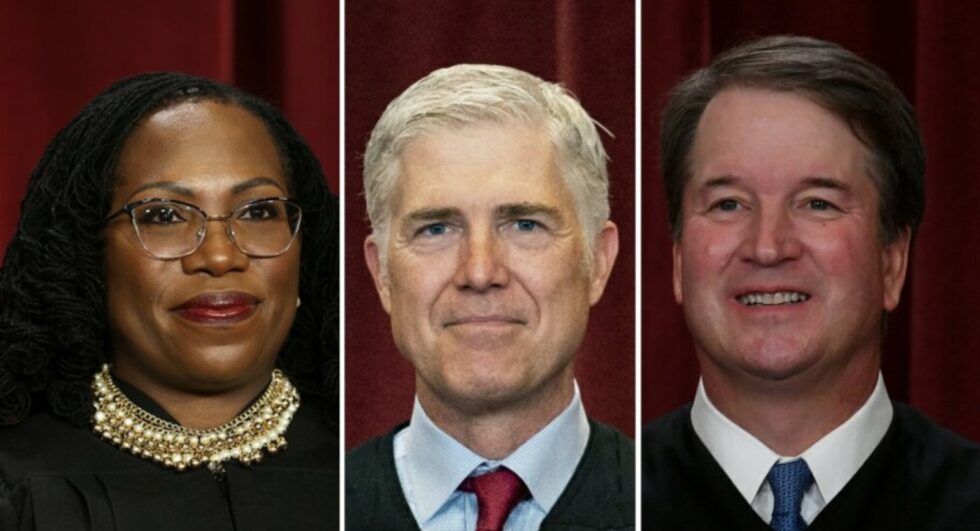
“Therefore, in contact sports, forcing female athletes to compete against males can create significant safety risks. And in virtually all competitive sports, forcing female athletes to compete against males can undermine competitive fairness,” Kavanaugh wrote.
Justice Sotomayor, joined by Justices Kagan and Jackson, concur in the judgment on the basis that claims under Title IX fail on a narrower basis than the majority holds.
She dissents from the majority’s holding under the 14th Amendment’s Equal Protection Clause.
The cases challenged the legality of state laws banning transgender student-athletes from competing on sports teams that match their gender identity.
Advertisement
In West Virginia v. B.P.J., a challenge was brought on behalf of Becky Pepper-Jackson, a 15-year-old transgender high school student who participates in track and field.
A biological male, Pepper-Jackson challenged West Virginia’s Save Women’s Sports Act, which bars athletes assigned male at birth from competing on female sports teams.
In Little v. Hecox, a challenge to Idaho’s Fairness in Women’s Sports Act was originally filed by Lindsay Hecox, a biological male who sought to try out for the women’s track and cross-country teams at Boise State University.
The athletes, represented by civil rights organizations like the ACLU and Lambda Legal, argued that the categorical bans discriminate based on sex and transgender status.
They asserted these laws violate the 14th Amendment’s Equal Protection Clause and Title IX, the federal statute prohibiting sex discrimination in education.
Idaho and West Virginia argued that sports categories must be determined strictly by biological sex to preserve fair competition, safety, and athletic opportunities for biological women and girls.
The Trump administration supported the states and implemented policies and executive orders asserting that federal protections recognize only biological sex at birth.
During oral arguments in January 2026, the court’s 6-3 conservative majority signaled skepticism toward the athletes’ challenges.
Justices raised concerns about imposing a uniform national mandate amid continuous debate over whether hormone therapies eliminate physiological advantages.
Legal experts tracking the case via SCOTUSblog note that the court may issue a narrow ruling focusing strictly on sports categories under Title IX, or a broader ruling defining “sex” across federal civil rights laws.
In January when the case was argued, SCOTUSBlog reported that the high court appeared inclined to uphold state laws that bar transgender women and girls from participating on female school sports teams.
Following nearly three-and-a-half hours of oral arguments in a pair of cases from Idaho and West Virginia, several justices indicated they were receptive to the states’ position that the laws are constitutional.
Advertisement
While a majority appeared likely to side with the states, it remained unclear how broadly the court’s eventual ruling would apply, the outlet reported.
The court’s three liberal justices also appeared to acknowledge the legal challenges facing those contesting the laws.
During the arguments, they focused much of their questioning on narrowing the scope of any ruling or resolving one of the cases on procedural grounds rather than issuing a sweeping constitutional decision.
Idaho adopted its law in 2020, followed by West Virginia in 2021.
The Idaho case was brought by Hecox, a 24-year-old transgender woman who challenged the state’s law after seeking to try out for the women’s track and cross-country teams at Boise State University.
Although Hecox did not make either varsity team, she later played club sports.
The West Virginia lawsuit was filed by Heather Jackson on behalf of her child, B.P.J., a 15-year-old transgender high school student who has publicly identified as a girl since elementary school.
According to court filings, B.P.J. has received treatment with puberty blockers and estrogen hormone therapy and has competed on her school’s track and cross-country teams.
This article may contain commentary which reflects the author’s opinion.