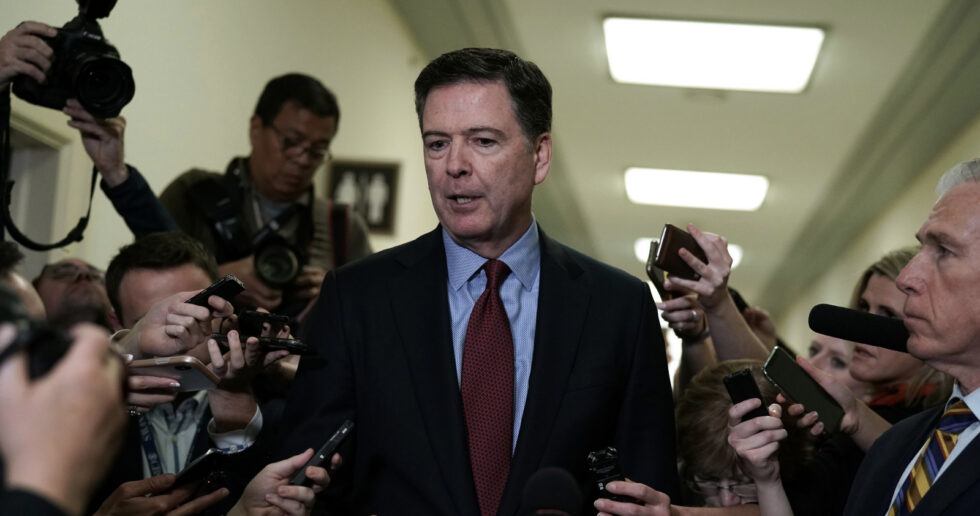
The plot thickens against former disgraced FBI Director James Comey.
Federal prosecutors have opened a fresh grand jury investigation into allegations that Comey was connected to the disclosure of classified information to the New York Times, with investigators issuing a new subpoena Monday to Daniel Richman, Comey’s longtime friend, former adviser and onetime attorney.
Advertisement
Multiple law enforcement sources told Fox News that the inquiry concerns an alleged classified-information leak to the New York Times and that Richman, a Columbia Law School professor who once served as a special government employee at the FBI, is now being compelled to provide information.
Advertisement
Richman was a significant figure during Comey’s tenure because the former FBI director acknowledged in 2017 that he gave Richman the contents of a memo describing a private conversation with Trump and asked him to relay that material to a New York Times reporter.
Comey later told Congress that his purpose was to spur outside scrutiny, saying, “I thought [the disclosure of the memo and its contents] might prompt the appointment of a special counsel.”
Advertisement
That disclosure intensified the political firestorm after President Donald Trump fired Comey in May 2017 and came just before Robert Mueller was appointed special counsel to investigate Russian interference in the 2016 election.
A 2019 Justice Department inspector general report found that Comey violated FBI policies and his employment agreement in his handling and disclosure of certain memos, but the watchdog also found no evidence that Comey or his attorneys released classified information from those memos to the media.
That distinction matters because the current grand jury inquiry reportedly concerns a separate allegation involving classified material published by the New York Times, meaning the subpoena itself does not establish that Comey or Richman committed a crime.
The earlier investigation focused in part on an April 2017 New York Times article concerning the FBI’s handling of the Hillary Clinton email investigation, with government records showing investigators examined whether classified information appearing in that report had been improperly disclosed.
Richman became a central subject in those inquiries, and the FBI obtained electronic material from him between 2017 and 2020, including a forensic image of his computer and information from email and cloud accounts.
Advertisement
The government’s handling of those files later created a constitutional controversy, as U.S. District Judge Colleen Kollar-Kotelly ruled in December 2025 that prosecutors violated Richman’s Fourth Amendment rights when they returned to retained electronic data without obtaining a new warrant.
The judge wrote that the government’s continued possession of Richman’s files amounted to an “ongoing unreasonable seizure,” a ruling that forced prosecutors to return material and complicated efforts to use the old evidence in another case against Comey.
The latest subpoena suggests the Trump Justice Department is building a new evidentiary record while revisiting an investigation Fox News reported had been pursued during Trump’s first term before ending after Joe Biden took office.
Advertisement
Comey is simultaneously fighting another federal prosecution over his controversial 2025 Instagram post showing seashells arranged as “86 47,” which prosecutors say could reasonably have been interpreted as a threat against Trump, the nation’s 47th president.
A federal grand jury indicted Comey in April on charges of threatening the president and transmitting a threat in interstate commerce, carrying a combined maximum punishment of 10 years in prison if he is convicted, while Comey has denied intending violence and remains presumed innocent.
Advertisement
“Threatening the life of the President of the United States is a grave violation of our nation’s laws,” Acting Attorney General Todd Blanche said when that indictment was announced.
The Justice Department says the threat case and newly disclosed leak investigation are separate matters, leaving Comey under legal pressure on multiple fronts as investigators again examine decisions and media contacts dating back to the 2016 election and Trump’s first administration.
This article may contain commentary which reflects the author’s opinion.