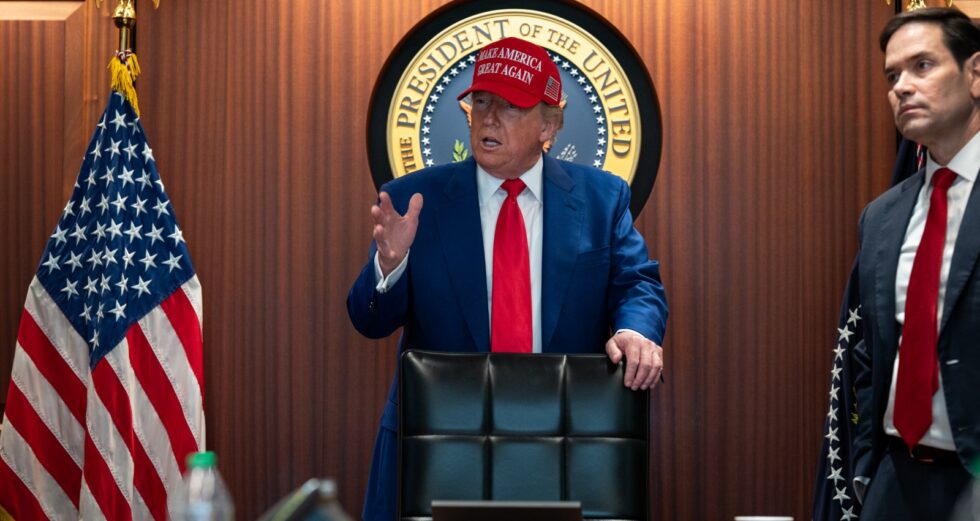
What’s left of the Iranian government still hasn’t gotten the hint that President Donald Trump will continue to punish their country if they refuse to make a peace deal that includes an agreement to never seek a nuclear weapon.
Here’s a fuller straight-news rewrite with additional context on the tanker network, Kharg Island and the broader confrontation:
Advertisement
The United States and Iran exchanged attacks in waters around the Persian Gulf on Saturday, Sept. 5, in another escalation of the months-long military confrontation between Washington and Tehran.
The exchange began when Iran’s Islamic Revolutionary Guard Corps launched ballistic missiles toward two U.S. Navy warships operating in the region, according to U.S. Central Command.
Advertisement
CENTCOM said an American aircraft carrier and a guided-missile destroyer successfully evaded multiple Iranian attacks and that no U.S. personnel were injured. The military did not identify the two warships in its initial statement.
American forces responded by striking three Iranian crude-oil tankers that CENTCOM said were connected to a multibillion-dollar network used to generate revenue for the IRGC and Iranian-backed groups elsewhere in the Middle East.
Advertisement
The M/T Downy was struck off the coast of Kharg Island, while the M/T Stark 1 was hit near Jask on Iran’s southeastern coast. CENTCOM said both ships were permanently disabled. ([Central Command][1])
U.S. forces also attacked the M/T Kylo, also known as the Noxen, in the Gulf of Oman.
CENTCOM said the tanker was not carrying cargo when it was targeted and that its crew was ordered to abandon the ship before American forces struck it in several critical locations. The military described the vessel as completely destroyed and no longer operable.
The strikes represented a direct attempt to impose an economic cost on Iran following the missile attack on the American vessels.
CENTCOM commander Adm. Brad Cooper said the U.S. response was deliberately larger than the Iranian attack, warning that American forces would continue defending U.S. personnel and could target additional Iranian oil assets if attacks persist.
Iran presented a different account of the wider maritime confrontation. The IRGC said its forces had attacked tankers and U.S.-linked vessels that it accused of operating through unauthorized routes in and around the Strait of Hormuz. Those Iranian claims were not independently confirmed, while CENTCOM said no American personnel were harmed in the missile attacks on its warships.
Advertisement
The confrontation followed a renewed burst of U.S.-Iran fighting after several weeks of relative calm. The Associated Press described Saturday’s exchange as the first major confrontation between the two sides following roughly a month without comparable fighting.
The location of one of the tanker strikes is particularly significant.
It’s simple: if Iran shoots at U.S. ships, we will destroy (and sink) their oil tankers. All they have to do is not shoot at @USNavy.
Iran’s oil tanker fleet is defenseless — Iran has no navy or air force. Our planes, ships & subs can strike them all, in @CENTCOM & @USPACOM. https://t.co/lr5TaxloBw
— Pete Hegseth (@PeteHegseth) September 5, 2026
Advertisement
Kharg Island has long served as the center of Iran’s crude-oil export system. Before the current conflict severely disrupted the country’s energy trade, the island handled roughly 90% of Iranian crude exports, according to Reuters. Its deep-water facilities allow large tankers to load oil transported from fields across Iran through an extensive pipeline network.
That makes ships operating around Kharg an important part of Tehran’s ability to generate hard currency.
The Trump administration has spent months attempting to restrict those revenues through sanctions, military pressure and actions against what U.S. officials describe as Iran’s “shadow fleet” — vessels and shipping companies used to move Iranian petroleum while avoiding international sanctions.
Advertisement
The Treasury Department has repeatedly sanctioned tankers, shipping companies and intermediaries that it says facilitate Iranian petroleum exports. Treasury says money generated through those networks supports the IRGC, Iran’s weapons programs and armed groups aligned with Tehran throughout the region.
The administration has also targeted networks accused of helping the IRGC acquire weapons and military technology abroad.
This article may contain commentary which reflects the author’s opinion.