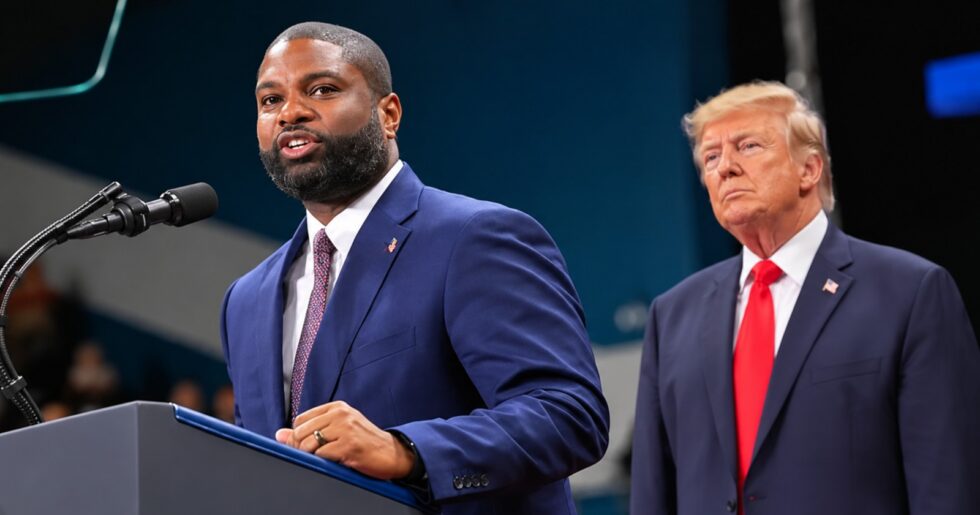
Florida’s governor-elect won’t take office until January, but Byron Donalds and his wife, Erika, are already preparing to get to work.
Advertisement
The couple is preparing to introduce several new policies or build upon those that outgoing GOP Gov. Ron DeSantis put in place during his popular two terms as the state’s top elected official.
Donalds, who is currently a U.S. congressman representing Florida’s 19th Congressional District, is signaling that his incoming administration will focus less on whether students attend public, charter, private, or home schools and more on whether those schools produce strong academic results.
Donalds and his wife, education advocate Erika Donalds, outlined their approach Friday during an education technology showcase in Hollywood attended by investors, education companies, and technology developers.
Advertisement
“I’m agnostic on the school. I’m much more focused on the outcomes for our students,” Byron Donalds said, per the Florida Phoenix.
“So, everything that we’re going to be doing in our state with respect to K-12 education and beyond is about making sure that the students of Florida have the rigor, have the information, have the support that they need in order to be better than any other students in the United States of America.”
The comments provide an early indication of how Donalds could approach Florida’s expansive school-choice system when he succeeds DeSantis.
Florida has dramatically expanded education alternatives in recent years, including charter schools, private-school scholarships, homeschooling and education savings accounts.
Erika Donalds said the next administration wants to change how Florida discusses those different options.
“We have to completely change the way that we communicate about schools and students in our state, in a way that is more cohesive as one education freedom economy, of which public, private, charter, and homeschool and modular types of hybrid schooling are all participants,” she said.
“So, we have to change the culture and the language that we’re using.”
Erika Donalds suggested that funding, assessments and accountability systems could eventually become more closely aligned across different types of schools receiving public money.
“I think you’ll find in the next administration an effort to align all of those infrastructure pieces — funding, counting students, assessments, accountability, transparency — will go along with that theme,” she said.
Advertisement
She said the objective would be creating “one, publicly-funded education system that does not consist of just one kind of school.”
Exactly what those accountability standards will look like remains unresolved.
Private schools participating in Florida’s voucher programs currently face different financial reporting, transparency and testing requirements than traditional public schools.
Advertisement
Florida Education Commissioner Henry Mack said he wants greater transparency regarding student performance at participating private schools.
“I’m not going to bind [private schools] to anything, other than I’m asking to know how their students are performing,” Mack told the Florida Phoenix.
Mack said tying voucher eligibility to transparency requirements “could be an option,” although he emphasized that policy decisions ultimately belong to the governor and Legislature.
The Donaldses also discussed the growing role of technology and artificial intelligence in education.
Florida schools will operate under new artificial-intelligence requirements beginning in July, including provisions requiring parental consent before students use certain AI systems at school.
Advertisement
Byron Donalds said technology should supplement teachers rather than replace them.
“My personal belief is that you have to have an adult human being in the classroom,” Donalds said.
“There’s not replacing the teacher. People naturally need to learn from another human being, that’s just how we process information as people,” he added.
Donalds said new technology can nevertheless provide “efficiencies to help teachers be able to deliver the best academic outcomes for their students.”
Erika Donalds similarly argued that school-choice programs can serve as testing grounds for educational innovation.
She described choice schools as potential “laboratories of innovation” where new approaches could be tested before successful ideas are incorporated into traditional public schools.
This article may contain commentary which reflects the author’s opinion.