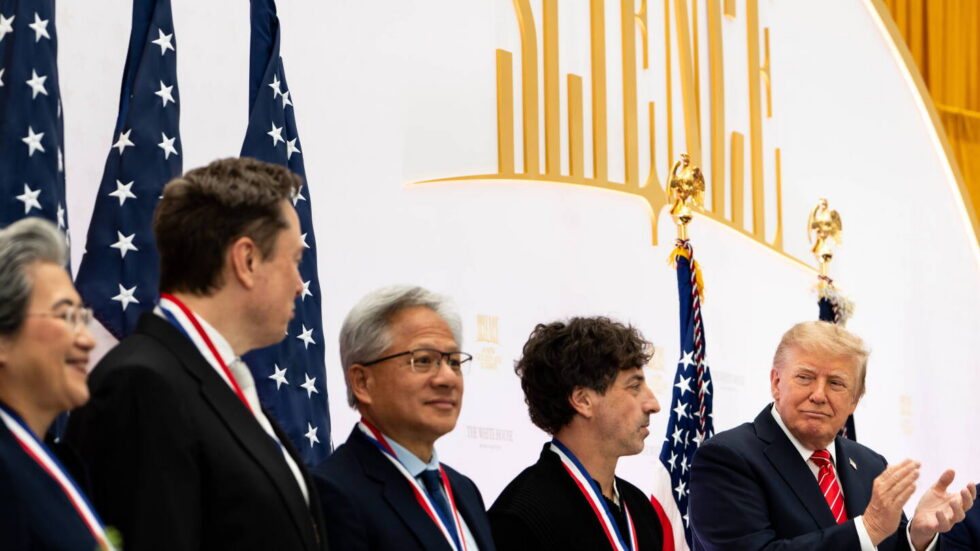

President Donald Trump, from right, applauds after presenting the National Medal of Science to Google co-Founder Sergey Brin, Nvidia CEO Jensen Huang, Elon Musk, and Lisa Su, CEO of Advanced Micro Devices, at the Science: A New Golden Age summit.
AP Photo/Julia Demaree Nikhinson
White House announces $6 billion in science initiatives
The Trump administration announced
science initiatives totaling $6 billion at its Science: A New Golden Age summit on Thursday. They included support for AI-powered scientific research, advanced computing facilities, accelerated doctoral training programs, and experiments with alternative approaches to research funding and peer review.
“This is the golden age,” President Donald Trump said during the event. “It wasn’t two years ago, but it is now.”
Initiatives announced at the event included:
- Computing commitments: Eleven companies pledged $2.4 billion in computing credits and AI tools to support DOE’s Genesis Mission, including $1 billion
from Nvidia, $500 million from AMD, and $200 million from OpenAI. - Accelerated STEM PhDs: DOE announced a $100 million Genesis Mission Graduate Fellowship
program for accelerated four-year PhDs in AI and science or engineering in collaboration with DOE labs and industry partners. DOE plans to pilot the program with $20 million in FY27, while later funding will be contingent on appropriations. NSF also announced a six-year integrated bachelor’s-to-PhD program called NextGen Workforce.
- New NSF projects: NSF launched
two $33 million Grand Research Challenge competitions focused on quantum applications and synthetic multicellularity, announced plans to invest up to $75 million over five years in AI-enabled laboratory instrumentation, and launched an X-Labs Consortium backed by more than $300 million in industry, philanthropic and research-partner commitments. - AI-powered biomedical research: NIH, DOE, and Biohub launched a $1.8 billion virtual biology initiative to develop AI models of cells and biological systems. NIH also launched
Generation Discovery to recruit 100 early-career scientists. - Space and quantum technology: NASA and DOE
expanded cooperation on space nuclear systems, while DOE identified eight scientific problems
for a previously announced $215 million quantum computing competition.
White House Office of Science and Technology Policy Director Michael Kratsios described the announcement as “the most transformative day for the American scientific enterprise since the reshaping of the federal research ecosystem following World War II.” The announcements came shortly after the end of fiscal year 2026. Science agencies such as NIH
and NSF
awarded far fewer research grants than in previous years during those 12 months, and NSF faced criticism
for leaving more than $1 billion of its budget unspent.
DHS proposes new fees for international student work program
The Department of Homeland Security proposed new fees
for the Optional Practical Training (OPT) program last week. International students use the OPT program
to gain work experience in their field after graduation. Under the proposed rule, an initial OPT recommendation would carry a $70,000 fee, which universities would be responsible for paying but could pass on to students or employers. STEM graduates looking to extend their OPT to a maximum of three years face an additional $30,000 fee. Comments on the proposed rule are due Nov. 9. (See AIP’s policy primer
on OPT for more information.)
DHS argues the fees will deter fraud, protect American workers, and discourage employers from using OPT to circumvent H-1B visa requirements. The department warns it may have to eliminate OPT entirely without the fees. U.S. Citizenship and Immigration Services Director Joseph Edlow has previously advocated eliminating the program.
NAFSA: Association of International Educators criticized
the proposal, arguing it would undermine American innovation, economic growth, and workforce development. “The research is clear: international students don’t take opportunities from Americans, they create them,” said NAFSA CEO Fanta Aw.
NSF grants will be rewritten for “super intelligence”
A National Science Foundation official said agency grants will be rewritten to alter references to artificial intelligence to “Super Intelligence”, following a White House executive order.
Speaking at a Directorate for Mathematical and Physical Sciences webinar
on Wednesday, division deputy directorate head Junping Wang said, “your program director may work with you by changing AI to SI,” in grant abstracts and related documents. Internal AI tools at the agency may summarize some grant submission materials, he added, “but not for making recommendations.”
Renaming existing grant materials would go beyond requirements in the September executive order. At the National Institutes of Standards and Technology, for example, a recent Super Intelligence update echoed the order by noting that it does not require “the alteration of previously issued regulations, Presidential actions, contracts, grants, or other historical documents.”
Jenessa Duncombe contributed reporting to today’s newsletter.
Also on our radar
- President Trump presented
National Medals of Science to technology industry figures Elon Musk, Sergey Brin, Jensen Huang, and Lisa Su. National Medals of Technology and Innovation went to Michael Dell and Satya Nadella. - The “Build America Caucus” in Congress released a bipartisan economic agenda.
It calls for less scientific grant paperwork, new funding vehicles, and shared autonomous labs. - Vice President JD Vance announced J-1 visa fraud investigations
into nine universities: Harvard, Yale, Stanford, Brown, Pitt, UC Davis, Caltech, Arizona State, and MIT. - The GAO concluded
last week that the HHS unlawfully withheld $78 million in FY2025 funding from the Agency for Healthcare Research and Quality (AHRQ). The Trump administration also sought to cancel another $28 million in FY2026 AHRQ funding through its recent “pocket rescission” proposal,
a practice GAO deems unlawful.
- NSF wants to change the name of eight proposal review committees
to align with new agency division names.