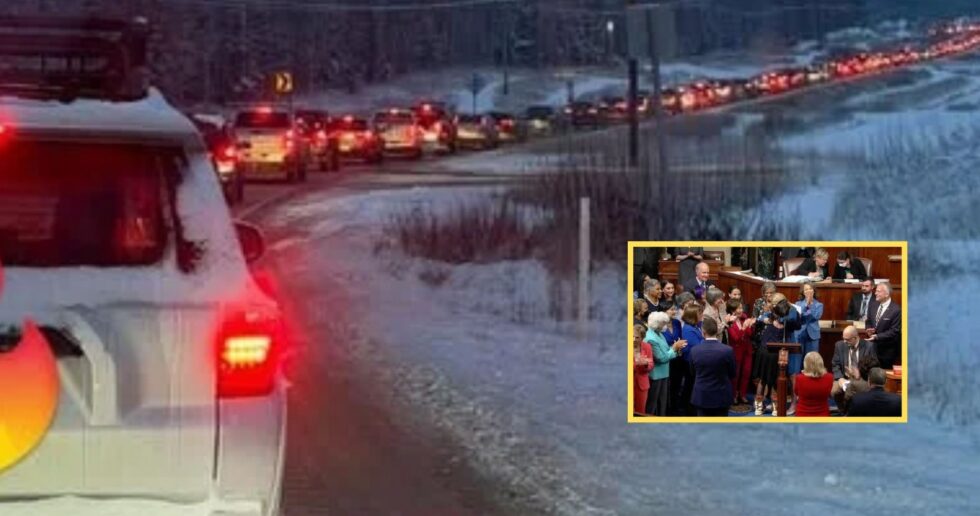
Alaska’s Senate race changed dramatically after Democratic challenger Mary Peltola was involved in a car crash in Anchorage.
Advertisement
The former congresswoman postponed campaign appearances as Republican Sen. Dan Sullivan continued fighting to defend his seat before November’s midterms.
Peltola and family members were traveling Saturday to the Alaska Federation of Natives Annual Banquet when another vehicle struck theirs.
Her campaign said the collision required medical attention, although the injuries were minor and she remained in good spirits.
Advertisement
Campaign manager Cheryl Bruce announced Sunday that medical professionals recommended postponing planned appearances in Fairbanks and Bethel while Peltola recovered.
Those events were set for Sunday and Monday, interrupting the start of the Democrat’s planned Alaska Always Tour.
The campaign expects Peltola to return Tuesday, with a scheduled appearance in Homer during the election’s crucial final week.
There is no evidence the crash was politically motivated, and the campaign has not suggested Sullivan or Republicans were involved.
Sullivan, meanwhile, is seeking a Senate term in a state that supported President Donald Trump in the previous presidential election.
Trump carried Alaska in 2024 by approximately 13 percentage points, underscoring the Republican advantage in recent statewide presidential voting.
The incumbent’s campaign has emphasized the importance of protecting Alaska’s interests and keeping its Senate representation aligned with Republican priorities.
Sullivan also benefits from Trump’s public support, including a rally the president held for the senator earlier this month.
Former Rep. Mary Peltola is rescheduling several upcoming campaign events after she and her family sustained “minor” injuries in a car crash, her campaign announces. https://t.co/PDouTp2j5n
— NBC News (@NBCNews) October 26, 2026
Republicans view the contest as critical because every competitive Senate seat matters in determining the chamber’s balance of power.
Peltola represented Alaska in the House, becoming the first Alaska Native woman elected to Congress after a 2022 special election.
Advertisement
She lost her House seat in 2024 and now hopes to become Alaska’s first Democratic senator elected since 2008.
Her campaign has focused on living costs and its promise to challenge what she describes as a rigged political system.
Both candidates are courting Alaska Native voters, whose support could prove consequential in a state with distinctive regional political dynamics.
The race has also been complicated by another candidate whose name closely resembles that of the Republican incumbent.
Advertisement
Daniel J. Sullivan Jr. appears on the ballot alongside Senator Dan Sullivan, prompting Republican complaints about potential voter confusion.
Republicans argue that the similar names could split support or mislead voters intending to back the incumbent senator.
Those concerns remain allegations, however, and the other candidate’s presence does not establish a coordinated Democratic effort to deceive voters.
Alaska election officials initially removed the similarly named candidate, but courts subsequently allowed him to remain on the ballot.
The state’s highest court upheld that outcome, leaving the Republican campaign confronting an unusual complication in the election’s final days.
Trump has criticized the situation and publicly urged Alaska voters to reject ranked-choice voting through a statewide ballot measure.
Advertisement
Under ranked choice voting, Alaskans can rank candidates in order of preference rather than selecting only one contender.
Supporters say the system broadens voter choice, while Republican critics argue that it creates confusion and unnecessary complexity.
The Justice Department has also filed litigation concerning certification of the Senate election if the Republican incumbent loses.
The administration argues that the similar candidate names threaten election integrity.
The dispute adds another dimension to an already intense contest featuring substantial fundraising and spending by both political parties.
According to figures reported by Fox News, Peltola raised $33 million through October, compared with nearly $14 million for Sullivan.
Yet Sullivan reported approximately $5.1 million in campaign cash remaining, compared with roughly $3.2 million for his Democratic opponent.
This article may contain commentary which reflects the author’s opinion.