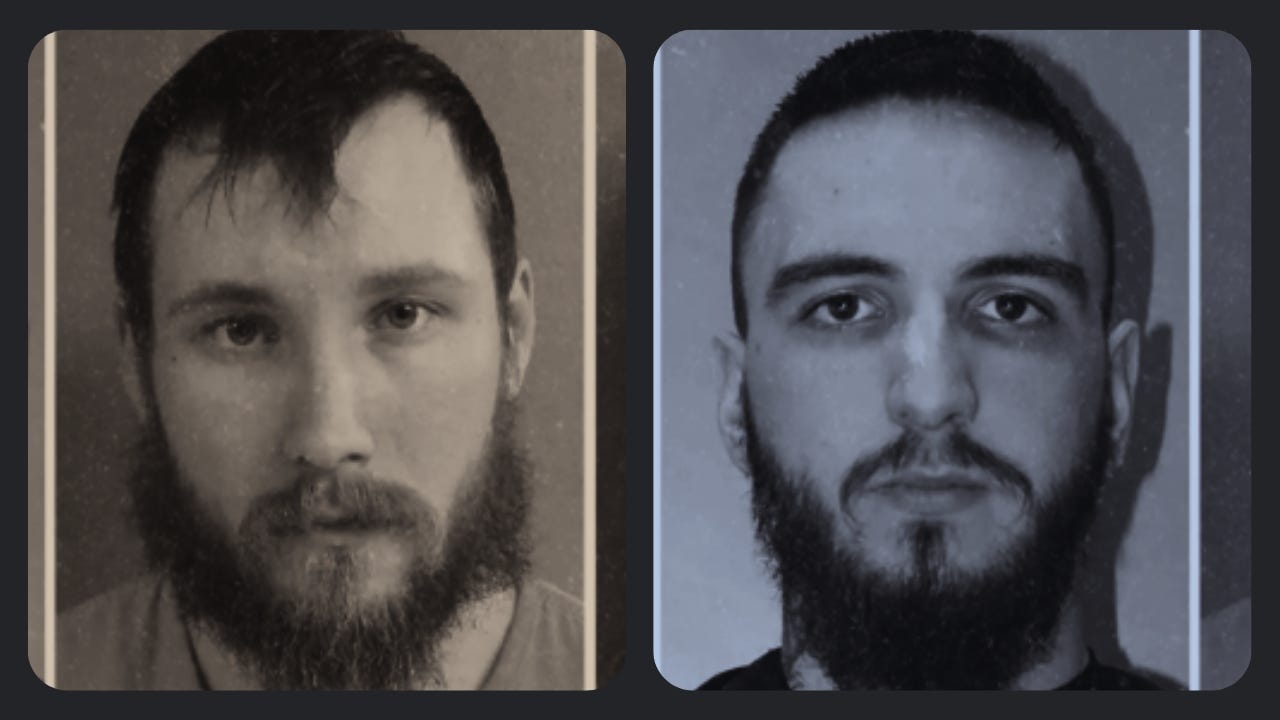
MICHIGAN, USA – August 15, 2025 – Appeals Briefs have been filed with the Michigan Court of Appeals on behalf of Joe Morrison and Paul Bellar, two men charged at the state level in connection with the FBI’s manufactured “plot” to kidnap Michigan Gov. Gretchen Whitmer.
Morrison’s Brief outlines several issues with the charges, the way the trial court handled the case, and the ineffective assistance of court appointed trial counsel. The brief raises three main issues:
-
Morrison argues that “kidnapping” does not meet the statutory definition of an act of terrorism under Michigan’s anti-terrorism statutes. An “act of terrorism” is a required element of both the gang membership and material support charges. So, because of this error, the trial court allowed the state to change the “act of terrorism” to “murder” after the fact – violating Morrison’s due process rights: There is no evidence Morrison supported a murder plot and therefore the convictions should be vacated. As Morrison made this argument on Appeal, the state suddenly decided to change it’s position, 18 months after the jury went home, to claim the trial was actually about a plot to murder the Governor. This is not supported by the trial record, and it is too late to change it after the fact. At the entrapment hearing, the “act of terrorism” was kidnapping, not murder. Post-conviction, the state now argues that the well known “plot to kidnap” to Governor was now the “Gretchen Whitmer murder plot.” If evidence existed that Morrison was lending support to a plot to murder the Governor, one would think the prosecution would have drawn attention to that at trial. Changing theories POST-TRIAL is a violation of due process. The prosecution disregarded applicable statutory language in order to pursue a strategy of “chaos and confusion,” (according to FBI agent Henrik Impola) combining memes and rants with conversations Morrison was not a participant in.
-
It was a plain error for the trial court to not read to the jury a specific unanimity instruction, and first amendment instruction. In the alternative, the trial lawyers failure to request these jury instructions deprived Morrison of his 6th amendment right to effective assistance of counsel. The motion for a new trial should have been granted: A detailed instruction was given to the jury to “ignore any impression the accused were entrapped.” Michigan’s constitution entitles the accused to a unanimous jury verdict. Morrison was denied his right to effective counsel. There was no sound strategy for counsel’s failure to request a specific unanimity instruction, this prejudiced Morrison. The failure of counsel to request an abandonment instruction was utterly unjustifiable. for over 26 lines, the trial court told the jury to reject the defense of entrapment. Therefore the jury was told to reject the ONLY defense advanced at trial. Accordingly, Morrison is entitled to a new trial.
-
Trial counsel for Morrison failed to present important evidence at the entrapment hearing and jury trial. This error constitutes ineffective assistance of counsel. A new entrapment hearing or new trial is warranted: Important evidence was not used at the entrapment hearing or trial. If it had been, it would have changed the outcome of both hearings. Not mentioned was the FBI’s pushing of credit cards. Chappel testified at the federal trial these cards had a $5k limit, and could be used to purchase weapons or “whatever somebody would maybe need if they were engaged in this planning.” No one took up the offer. Also not mentioned was that at some of the FBI-sponsored gatherings there were sign-in sheets for the attendees. What could be more reflective of an absence of any guilt of consciousness, and the belief the attendees that they were behaving lawfully, than the sign-in sheets were the defendants used their real names and contact info. Also not mentioned was that the FBI created a fake national three percent militia, had assets running various state chapters, administering Facebook pages and that they created the Michigan chapter and put Fox in charge. The use of drugs and alcohol was not mentioned during the entrapment hearing, which would have put the stoned trash talk in its proper context. Also not presented at the entrapment hearing was the evidence that the FBI orchestrated both “recons” of the Governors vacation cottage, with her input, scheduled at times convenient to her, coordinated with her staff. It is inexplicable that trial counsel failed to show the jury that the attendees of these events were stoned and/or drunk. No conceivable trial strategy explains not telling the jury the degree of FBI involvement in orchestrating the events. Accordingly, a new entrapment hearing or new trial is warranted.
Bellar’s Brief outlines a number of issues as well, although we disagree with some of the characterization of other defendants:
-
A conviction cannot stand where the evidence, viewed in the light most favorable to the prosecution, does not permit a rational trier of fact to find the essential elements of the crime beyond a reasonable doubt. Mr. Bellar cannot be guilty of knowingly providing material support for terrorist acts or gang membership felonies when he participated in legal training exercises when there was no illegal plan in place, Bellar had already left the group prior to the illegal plan being put into place, had left training with the group, had left the State of Michigan, and whatever he did was not shown to have supported Fox or Croft: Beyond vague assertions and speculation, the prosecution was not able to show material support or resources provided by Bellar to Fox and Croft. Merely being present at the same training exercises is not enough to convict. For these reasons, the court should vacate the convictions.
-
A criminal defendant has the constitutional right to the effective assistance of counsel, which includes preparing for trial and addressing issues for the defense. Mr. Bellar was denied the effective assistance of counsel when trial counsel defended solely on the kidnapping plot; did not move for separate juries; put on no defense; and failed to request pertinent jury instructions: Trial counsel should have known that the material support as alleged for the terrorist act was more encompassing than the plot to kidnap the Governor. Second, he should have moved for separate juries because the extremism of the other co-defendants was associated with Bellar. Third, not presenting a defense was a mistake, as no one told the story of Paul Bellar and why he joined the Wolverine Watchmen, why he trained, why he left the Watchmen, and why he left Michigan. And, fourth, favorable jury instructions were not advanced by trial counsel. Mr. Bellar was denied the effective assistance of counsel when trial counsel failed to request instructions on unanimity; abandonment; and constitutionally protected speech/conduct. Deficient performance is shown here when trial counsel failed to request pertinent and favorable jury instructions.
-
A defendant has a constitutional right to have a jury decide his/her fate, the right to present a defense, and the right to equal protection of the law. Mr. Bellar was denied the right to present the entrapment defense to the jury when other similarly situated defendants are allowed to raise the defense because Michigan considers the issue a legal question to be decided by the court, which is inconsistent with the vast number of courts in other jurisdictions and a violation of the 14th Amendment and equal protection: The current state of the law in Michigan is that entrapment is a legal question to be decided by the judge. This needs to change to get Michigan in conformity to the overwhelming rest of the nation. There is no need for a judge to decide the entrapment issue. The framework for having a jury decide the entrapment issue is easily adoptable from the federal court with the Pattern Criminal Jury Instruction. Let’s face it, police officers are not going to admit to entrapping someone. If a jury is to decide the issue, as is the case in the vast majority of the courts in this country, a defendant has a fighting chance of success. In the federal court, Adam Fox and Barry Croft were brought to trial with Daniel Harris and Brandon Caserta. Harris and Caserta were acquitted in the federal court setting, where entrapment played a major role. Harris and Caserta were actually part of the kidnapping plot in the later stages of the case, but were allowed to argue they were entrapped. Harris and Caserta were situated as Bellar, but Bellar was not able to make an entrapment claim to the jury. Michigan’s practice denies defendants the opportunity to have the jury— rather than the judge—decide whether the government induced them to commit the crime. Even under rational-basis review, Michigan’s disparate treatment of entrapment defendants cannot be justified. There is no legitimate state interest in denying the jury the opportunity to assess whether the government improperly induced a defendant to commit the offense. On the contrary, Michigan’s practice undermines confidence in verdicts by denying juries the opportunity to resolve key factual disputes bearing directly on culpability.
-
A criminal defendant is entitled to have a properly instructed jury consider the evidence against him. The special jury instruction on entrapment denied Mr. Bellar a fair trial when entrapment evidence was first raised by the prosecution, the defense never argued entrapment to the jury, and the instruction provided to the jury highlighted the court believed the government on this issue: It was not enough for the burden to be placed on the defense to show entrapment by a preponderance of the evidence, which failed. The prosecution takes its victory and pushes the envelope, contending that a special jury instruction should be read to the jury, highlighting the fact that the trial court determined entrapment in favor of the prosecution, lending credibility to its witnesses. Defendant-Appellant Paul Edward Bellar asks this Honorable Court to vacate the convictions and sentences. There was insufficient evidence of providing material support for a terrorist act and gang membership felonies. Also, a remand for a new trial is needed due to Bellar being denied the effective assistance of counsel—alternatively, a remand for the trial court to decide issues presented, but not ruled upon.