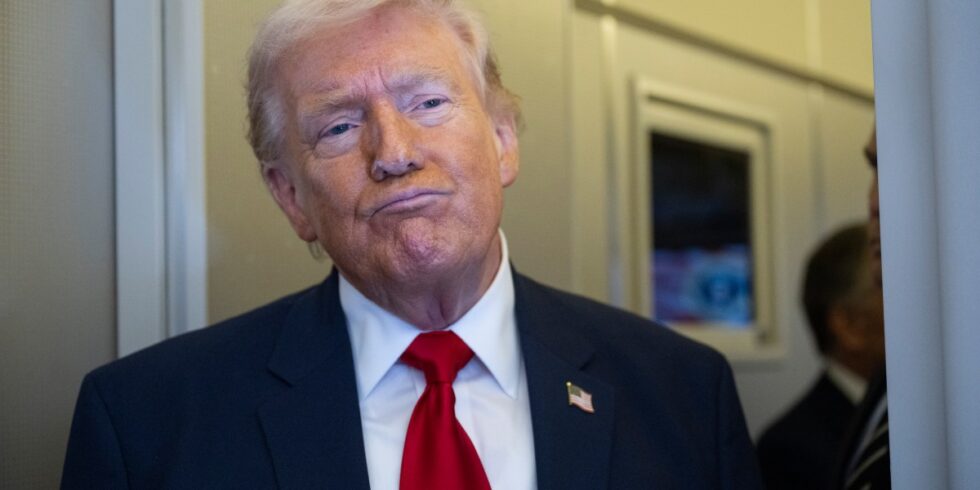
After the U.S. Supreme Court struck down much of President Donald Trump’s tariff regime in February, he threatened to use other legal powers to reimpose import duties on the rest of the world. The world got the first indication of how sweeping those measures would be last week, when the U.S. opened two trade investigations on dozens of countries. Together, the two Section 301 probes—the first on “excess manufacturing capacity,” the second on not doing enough to stop the import of goods made using forced labor—cover 60 different economies, including key trading partners like China, India, Mexico and the European Union.
On Monday, the Chinese commerce ministry condemned the investigations as “extremely unilateral, arbitrary and discriminatory, and a typical protectionist act”.
“The U.S. has once again abused the 301 investigation process to override domestic law over international rules,” a Chinese spokesperson said. “We urge the U.S. to immediately correct its wrong practices, and meet China halfway.”
U.S. and Chinese officials are currently meeting in Paris to hash out the agenda for a meeting between Trump and China President Xi Jinping in early April, even as Trump said he might postpone his visit in an interview with the Financial Times, and demanded Beijing help protect ships traveling through the closed Strait of Hormuz.
Other Asian governments are slowly formulating their response to the new trade investigations.
Singapore’s Ministry of Trade and Industry (MTI) said in a media statement that it would “engage the USTR” on the new Section 301 investigations, and disputed its claim that it maintained a large trade surplus with the U.S.
Taiwan, which was listed in both probes, said it remained “confident” the investigation wouldn’t affect the terms of its U.S. trade deal, agreed last month.
“It is the government’s abiding goal to bring labor standards in line with international norms,” Taiwan’s cabinet wrote in a press statement released Friday.
Awkwardly, South Korea’s government approved $350 billion in new U.S. investments on March 12, after the U.S. launched its probe of the country’s “excess manufacturing capacity.” The investment pledge was part of the East Asian country’s trade deal with the U.S. announced last year.
Other countries are taking a more forceful approach. On March 15, Malaysia’s minister of Investment, Trade and Industry, Datuk Seri Johari Abdul Ghani, called the country’s trade deal with the U.S. “null and void.”
“It is not on hold, it is no longer there,” Datuk Seri told Malaysian reporters at the New Straits Times. “If [the U.S. claims] it is due to a trade surplus, they must specify the industry involved. They cannot impose tariffs on a blanket basis.”
Who in Asia was hit by the Section 301 probes?
Asia has been hit especially hard by Trump’s sweeping trade investigations.
The first investigation, announced on March 11, accused 16 global economies of maintaining “excess manufacturing capacity.” The majority of countries targeted are in Asia, including regional giants like Japan and China, and Southeast Asian nations like Singapore, Vietnam, Thailand, Malaysia and Cambodia.
“Asian governments are extremely interested in how this latest trade initiative unfolds,” Deborah Elms, head of trade policy at the Hinrich Foundation, tells Fortune. “Most Asian governments named have in place a trade agreement with the Trump administration, and will want to know how a Section 301 case determination might affect them.”
Many of the economies under scrutiny are export‑led, relying on foreign demand to sustain manufacturing and jobs. “Much of Asia has been very successful selling into the U.S.,” Elms said. “But that leads to high goods trade imbalances, especially if the domestic market is smaller or poorer than the U.S., and imports less stuff from them.”
Just one day later, the U.S. followed up with a second investigation, now covering 60 countries and accusing them of failing to ban the import of goods made with forced labor. The list spans every major region, naming Central and South American nations such as Chile, Colombia, Costa Rica, El Salvador, Guatemala and Venezuela, as well as U.S. allies including Canada and Israel.
“American workers and firms have been forced to compete against foreign producers who may have an artificial cost advantage gained from the scourge of forced labor,” U.S. Trade Representative Jamieson Greer said in a press statement. The investigations will determine whether foreign governments have taken sufficient steps to prohibit the import of goods produced with forced labor and how that could affect U.S. firms.
Section 301 allows the USTR to investigate and penalize foreign countries for “unjustifiable, unreasonable, or discriminatory” trade practices. The law has a more stringent regulatory period, which means the procedures must be open for public comment. Previous 301 investigations have taken close to a year to complete, yet Greer has stated that new tariffs could be imposed within five months.
Since the Supreme Court’s ruling, Trump has imposed a blanket 10% tariff on U.S. imports using Section 122, which allows the president to impose tariffs without Congressional approval for up to 150 days.