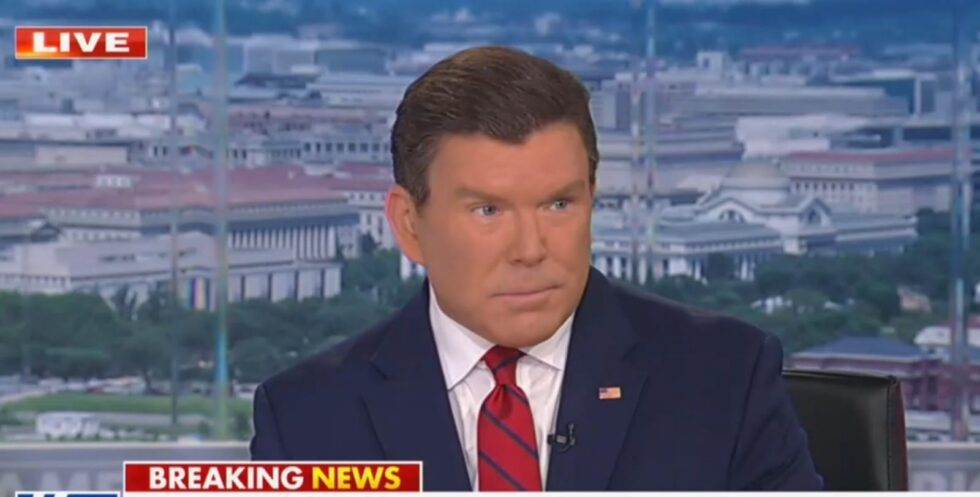
Fox News anchor Bret Baier said President Donald Trump told him he was “cautiously optimistic” about the United States reaching a deal with Iran.
But the president warned that the U.S. military would be stepping up efforts in the coming days to push Iran into making a deal.
Advertisement
“We’re in the middle of this. I talked to him today, and there was this sense of optimism, not — I would say cautious optimism that they maybe get to a deal soon,” Baier said on “America Reports.”
“However, at the same time, you have the United Nations, Iran has introduced a new mechanism, the Persian Gulf Strait Authority, to regulate maritime transit through the strategic Strait of Hormuz. That’s according to Iranian state media,” Baier added.
“Under the system, vessels intending to pass through the strait will receive guidance from an official email address outlining the rules for transit. Ships are required to comply with the framework and obtain prior authorization before crossing the waterway.’ That doesn’t seem like that’s going to fly,” Baier continued.
Trump also spoke with another Fox News figure on Wednesday and gave a slightly different update on the situation in Iran.
Trump personally warned Fox News correspondent Trey Yingst about impending U.S. military action against Iran just hours before American forces launched a new round of strikes targeting the country’s military infrastructure.
Advertisement
According to Yingst, Trump spoke with him by telephone from the Situation Room shortly before the attacks and described the operation that was about to unfold.
The president later confirmed through social media posts that he believed Iran would face severe consequences after negotiations failed to produce an agreement.
“Iran’s Military is a complete and total mess,” Trump wrote on Truth Social.
He added that much of the country’s naval and air capabilities “doesn’t even exist anymore” and warned that Iranian leaders would “pay the price” after taking too long to negotiate.
U.S. Central Command announced that additional self-defense strikes began at 5:15 p.m. Eastern Time against multiple targets in Iran at the direction of the commander in chief.
The military said the operations were conducted in response to what it described as Iran’s “unwarranted and continued aggression.”
According to Yingst’s account, Trump also disclosed that 49 Tomahawk missiles were fired during the operation and that some targets were located within 40 miles of Tehran.
The president reportedly said American fighter aircraft were simultaneously operating over Iranian airspace to destroy radar installations and air defense systems in the southwestern portion of the country.
When asked what would happen if Iran refused to accept an agreement proposed by American negotiators, Yingst said Trump responded, “We’ll bomb the ‘S’ out of them tomorrow night.”
Trump also reportedly told the Fox correspondent, “We’ve hit them hard tonight.”
Approximately two hours after the conversation, Central Command announced that the strikes had concluded successfully.
Military officials said U.S. Marine Corps, Air Force and Navy assets used precision-guided munitions against Iranian surveillance capabilities, communications systems and air defense sites that posed threats to American forces and commercial shipping in the region.
Defense Secretary Pete Hegseth defended the operation before the strikes began, saying the administration remained open to negotiations while simultaneously preparing to use military force if necessary.
He added that the night’s targets were intended to strengthen America’s diplomatic position while advancing military objectives.
Hegseth also argued that U.S. capabilities to gather intelligence and penetrate adversary networks had improved significantly, should broader combat operations become necessary.
The latest military action represents another escalation in tensions between Washington and Tehran as negotiations continue alongside military operations.
Trump has maintained that military pressure and diplomacy are complementary tools designed to produce an agreement favorable to American interests.
The administration has not publicly indicated whether additional strikes are planned beyond those announced by Central Command, though officials have emphasized they will continue responding to threats against U.S. personnel and international shipping.
This article may contain commentary which reflects the author’s opinion.