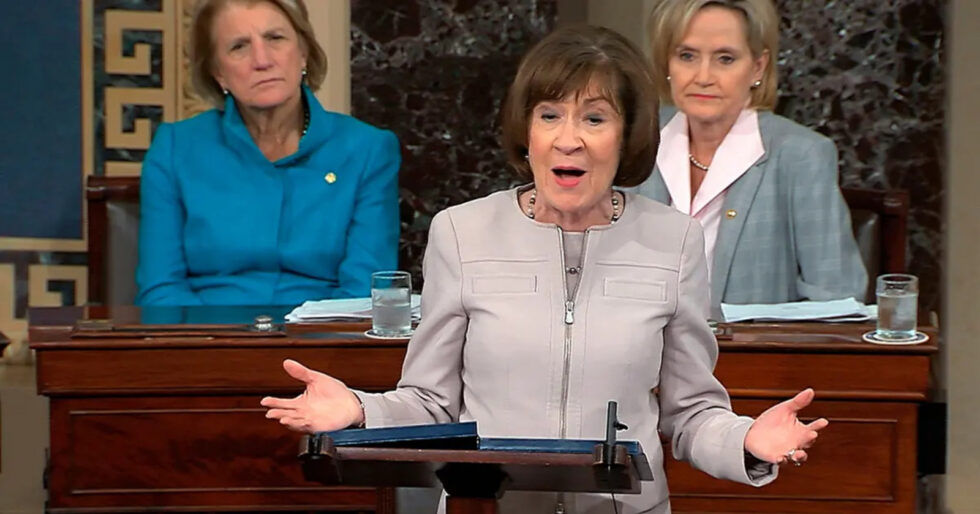
Maine Republican Sen. Susan Collins broke with Senate Republican leadership this week and voted with Democrats on a key vote.
Collins voted with liberals on a Democratic-backed motion to send the Senate’s $70 billion budget reconciliation package back to committee for further review.
Advertisement
The procedural motion, offered by Sen. Jon Ossoff (D-Ga.), sought to recommit the legislation to the Senate Judiciary Committee to investigate allegations that insurance companies have improperly denied medical treatment and coverage to patients.
Collins’ vote placed her at odds with most Senate Republicans, who opposed delaying the legislation and argued that the reconciliation package should continue moving through the legislative process without additional committee review.
The motion failed 47-50.
Advertisement
“Let’s ban insurance companies from denying or delaying medically necessary healthcare to Americans,” Ossoff said on the Senate floor when introducing his amendment.
He shared with fellow senators the challenges faced by a constituent diagnosed with multiple myeloma, a rare blood cancer, who struggled to get her medical care covered by her insurance company.
“Across America, insurance companies continue to deny and delay medically necessary healthcare,” Ossoff added.
Ossoff’s motion was similar to one he proposed during the Senate budget resolution in April, which aimed to create a point of order against any budget reconciliation bill that did not address insurance companies delaying or denying medical care, said the outlet.
Collins joined two other Republicans—Sen. Dan Sullivan (R-Alaska) and Sen. Josh Hawley (R-Mo.)—in supporting Ossoff’s amendment in April.
But Sullivan and Hawley both voted against the amendment.
Advertisement
If Ossoff’s motion had passed, it would have annihilated the budget reconciliation bill, which would provide funding for Immigration and Customs Enforcement and Border Patrol through 2029 if signed into law by President Trump.
This comes as November’s midterm elections are less than two months away.
The Senate Leadership Fund, a powerful Republican super PAC aligned with Senate Majority Leader John Thune of South Dakota, says it and its affiliated groups have raised more than $500 million ahead of the 2026 elections, giving Republicans a record-setting financial arsenal as they fight to preserve their Senate majority.
The fundraising haul represents more money than any previous Senate-focused political effort, according to SLF.
Advertisement
The organization alone has already committed more than $350 million to supporting Republican candidates across the Senate battlefield.
GOP groups have spent months building an enormous financial advantage designed to counter those pressures and force Democrats to defend races across an increasingly expensive Senate map.
SLF is already targeting critical contests in states including Alaska, Iowa, Maine, Michigan, and North Carolina, while pouring additional resources into other battlegrounds as Republicans seek not only to protect their majority but also potentially expand it.
“Thanks to Leader John Thune and our generous investors, Senate Leadership Fund and its affiliated groups have raised more resources than any other Senate effort in history,” SLF Executive Director Alex Latcham said in a statement to Fox News Digital.
Meanwhile, Democrats are having difficulties raising money.
The Democratic National Committee has even been forced to use its headquarters building as collateral for a $15 million loan over the summer.
Advertisement
“However, we cannot slow down as Chuck Schumer and Radical Democrats seek to take our nation back to open borders, rampant crime and crushing inflation,” Latcham added.
Those issues are expected to form a central part of the Senate Leadership Fund’s strategy as Republicans attempt to define Democratic candidates ahead of the November midterms.
SLF has sought to tie Democrats to their opposition to key parts of President Donald Trump’s legislative agenda while highlighting previous positions that Republicans characterize as outside the political mainstream.
Across competitive Senate races in Alaska, Iowa, Maine, Michigan, and North Carolina, the group is deploying advertising campaigns focused heavily on crime, veterans’ issues and controversies involving individual Democratic candidates.
The ads accuse Democrats of supporting policies that Republicans argue contributed to violent crime, opposing measures that would increase compensation for veterans, and carrying political baggage that could make them vulnerable with swing voters.
This article may contain commentary which reflects the author’s opinion.