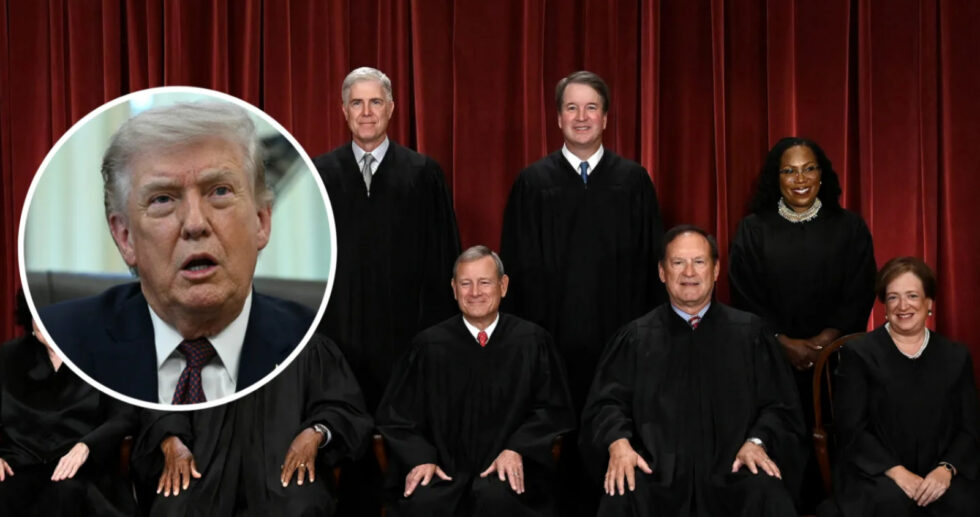
Justice Samuel Alito, 75, is the subject of growing speculation that he may step down from the Supreme Court of the United States before the end of President Donald Trump’s current term.
Such a move would allow the administration to nominate a younger conservative replacement who could serve for decades.
Prediction market data has added to the discussion surrounding Alito’s future on the court.
Advertisement
Polymarket, a platform where users wager on political outcomes, has placed the probability of Alito retiring before the end of 2026 at roughly 54 percent.
That figure represents a notable increase from earlier in the year, when the odds were below 50 percent.
The shift has been attributed to a combination of factors, including Alito’s age, recent health concerns, and the broader political calendar.
Alito has served on the Supreme Court since 2006, when he was appointed by former President George W. Bush to replace Justice Sandra Day O’Connor.
He is currently the second-oldest member of the court, behind only Justice Clarence Thomas, who is 76.
Recent health developments have also fueled speculation about a potential retirement.
Advertisement
Alito was briefly hospitalized earlier this year, an episode that drew attention from court observers and political analysts monitoring the court’s composition.
The justice has not made any public statements regarding his plans.
No formal indication has been given through official channels that he intends to step down.
The stakes surrounding a potential retirement are significant for both political parties.
If Alito were to leave while Republicans control both the White House and the Senate, Trump would be positioned to nominate a successor who is aligned with the court’s current conservative majority.
Republicans currently hold 53 seats in the Senate, giving them a working majority for judicial confirmations. Under current Senate rules, Supreme Court nominees require only a simple majority for confirmation.
That margin allows for some defections while still securing approval of a nominee. It also provides flexibility in selecting a candidate without requiring support from Democrats.
The current Supreme Court stands at a 6-3 conservative majority. Replacing Alito with a younger conservative would not alter that balance but could extend it for decades.
Trump’s first-term appointments to the court followed a similar approach. Justices Neil Gorsuch, Brett Kavanaugh, and Amy Coney Barrett were all nominated in their late 40s or early 50s and could serve for many years.
A comparable selection in the event of a vacancy would further solidify the long-term makeup of the court.
Legal observers note that the timing of any retirement could be critical in determining who fills the seat.
Discussions about retirement timing continue to reference the experience of Justice Ruth Bader Ginsburg.
Ginsburg remained on the court during Barack Obama’s presidency and died in 2020, allowing Trump to appoint Barrett shortly before the presidential election.
That appointment cemented the current 6-3 conservative majority. The episode is often cited as an example of how timing can influence the court’s long-term direction.
Alito’s allies have reportedly encouraged him to consider the political environment in weighing any decision. The argument centers on retiring while a favorable confirmation pathway exists rather than risking a shift in political control.
At the same time, several uncertainties remain. Alito’s personal preferences, health outlook, and views on continuing his judicial work have not been publicly disclosed.
There has also been no confirmation of any discussions between the Justice Department and the White House regarding retirement timing.
Officials have not indicated whether preparations for a potential vacancy are underway.
The Senate calendar could also play a role in the timing of any announcement.
A retirement declared in the coming months could allow for a confirmation process to unfold before the 2026 midterm elections.
A later decision could compress that timeline and increase political tensions.
Justices often choose to step down at the end of a court term, which typically concludes in late June.
This article may contain commentary which reflects the author’s opinion.