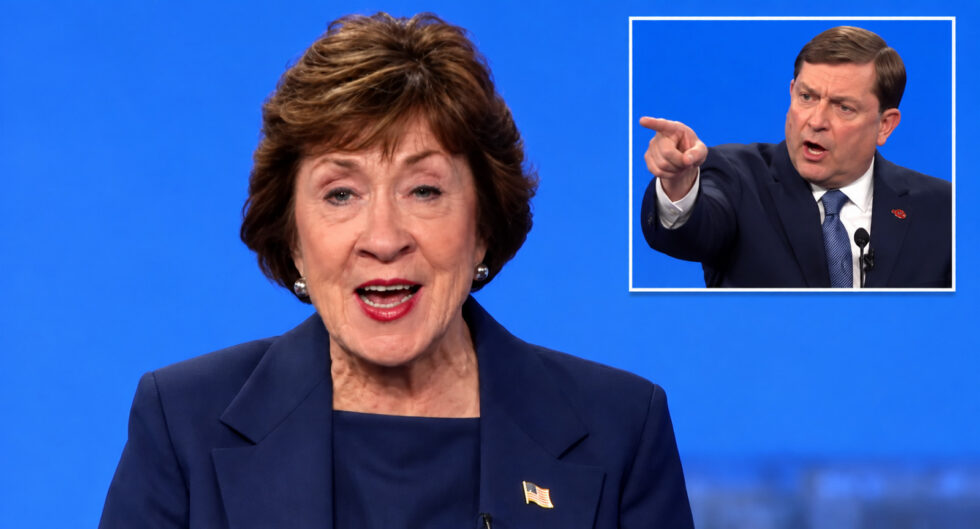
Republican Senator Susan Collins confronted a chaotic debate interruption Thursday as Democratic challenger Troy Jackson snapped at the Maine incumbent.
The heated exchange unfolded during their fourth and final Senate debate in Bangor, highlighting tensions surrounding a closely contested election.
Security moved to remove the demonstrator as Collins suggested the interruption came from someone supporting her Democratic opponent.
“So, this is obviously one of Troy’s supporters,” Collins remarked as the confrontation briefly halted the debate.
Jackson immediately responded with an angry denial, telling the Republican senator to stop talking during the televised exchange.
“Oh, shut up, I did not — I didn’t, I don’t even know who that kid,” Jackson replied.
Maine Republicans condemned his response, describing the remark as unacceptable behavior toward the incumbent senator.
Advertisement
Jackson’s campaign declined to comment on the exchange when contacted by the Associated Press following Thursday’s debate.
The disagreement soon shifted toward the candidates’ personal backgrounds, legislative records, and competing claims about political independence.
Collins recalled her humble upbringing, explaining, “My first job was picking potatoes.”
Advertisement
Collins also challenged Jackson’s attempts to portray her as automatically supporting President Donald Trump’s administration.
The Republican emphasized her record of bipartisan cooperation and willingness to oppose members of her own party.
Jackson countered that Collins supports Trump when consequential votes require Republican unity, disputing her independent reputation.
Collins said a broader examination showed her voting with Trump approximately 72 percent of the time.
She contrasted her approach with what she characterized as Jackson’s likely loyalty to Democratic leadership.
“We don’t need more people who are going to vote a straight party line,” Collins declared.
WATCH:
Troy Jackson tells Susan Collins to “SHUT UP” after a heckler interrupts their debate. https://t.co/CmV07wtJRN
— RNC Research (@RNCResearch) October 15, 2026
That argument could resonate with Maine voters accustomed to supporting candidates from different political parties.
Advertisement
Collins previously demonstrated her remarkable crossover appeal in 2020, defeating Democrat Sara Gideon despite substantial national Republican headwinds.
She won by nearly nine percentage points while Democratic presidential nominee Joe Biden carried Maine by approximately nine.
Her current campaign again emphasizes seniority, constituent services, and federal resources secured through congressional appropriations.
Advertisement
Collins currently chairs the powerful Senate Appropriations Committee, a position offering substantial influence over federal spending negotiations.
Her campaign argues replacing that experience would diminish Maine’s leverage when competing for infrastructure and federal investment.
The senator recently secured an endorsement from Maine’s state chapter of the Fraternal Order of Police.
That backing strengthens her public safety credentials as Republicans emphasize policing, border enforcement, and community security.
He became the Democratic nominee after primary winner Graham Platner withdrew amid serious allegations he denied.
The statewide contest remains competitive, with major election forecasters classifying Maine’s Senate race as a tossup.
Public surveys likewise indicate a contest within polling margins of error rather than a decisive advantage.
Collins remains the only Republican senator seeking reelection in a state Trump lost during the 2024 presidential election.
Advertisement
Democrats consider Maine one of their strongest opportunities to capture a Republican held seat in November.
Thursday’s debate also covered immigration, energy prices, the Iran War, budget deficits, and Supreme Court reform.
Jackson acknowledged billionaire donors associated with his campaign while denying that he had promised them favorable treatment.
Financial reports show Jackson raised approximately 20.4 million dollars during the third quarter, surpassing Collins’s quarterly haul.
Collins reported approximately 5.2 million dollars during that period, although she entered the race with substantial earlier fundraising.
Her campaign had raised well over 18 million dollars by the end of June, before Jackson became nominee.
Those figures complicate any suggestion that Republicans enjoy an uncontested financial advantage in this particular Senate race.
For Collins, Thursday offered another opportunity to demonstrate experience while highlighting her opponent’s confrontational response.
Nevertheless, Republicans quickly seized on Jackson’s remark as an example of the contrast they hope voters notice.
This article may contain commentary which reflects the author’s opinion.