Democrats campaigned heavily on affordability during the midterm elections, but four senators are already threatening to oppose government funding legislation over President Donald Trump’s war with Iran.
Advertisement
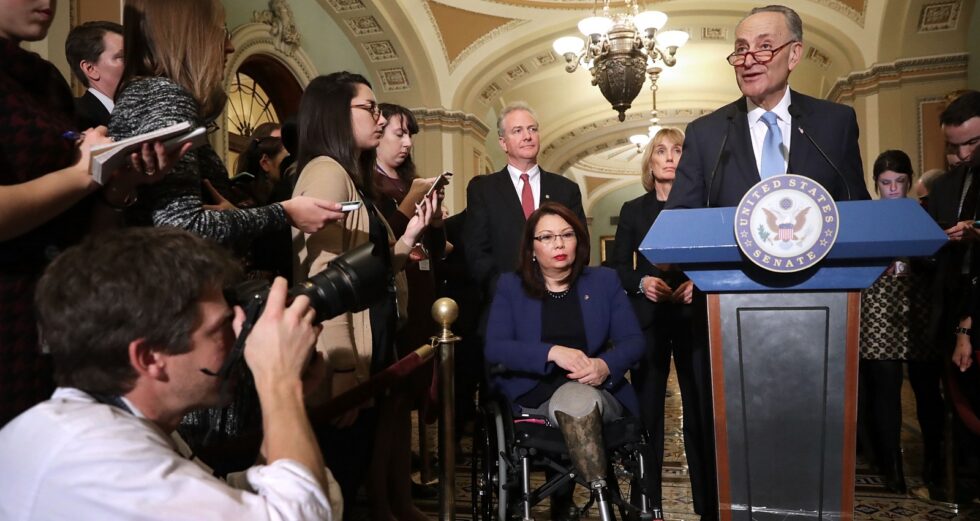
Sens. Tammy Duckworth of Illinois, Michael Bennet of Colorado and Chris Van Hollen of Maryland joined independent Vermont Sen. Bernie Sanders, who caucuses with Democrats, in issuing the warning Thursday.
The four lawmakers said they would oppose any spending package containing what they characterize as unrestricted funding for continued military operations against Iran.
“We will not vote for a government funding package that provides a blank check for President Trump’s illegal and unauthorized war in Iran,” the senators said in a joint statement.
Advertisement
The threat raises the possibility that the Iran conflict could become a major obstacle during Washington’s next government funding battle.
Congress recently emerged from a lengthy shutdown fight, and lawmakers will again need to reach an agreement to keep federal agencies operating.
Republicans currently control both chambers, while Democrats are preparing to take control of the House on Jan. 3 following their midterm victories.
Republicans will retain control of the Senate.
Because major spending legislation generally needs 60 votes to overcome a Senate filibuster, Democratic votes could still be required to advance a funding agreement.
Duckworth, Bennet, Sanders and Van Hollen argued that Congress should not continue financing military operations without explicitly authorizing the conflict.
“The Constitution is clear: Congress, not the President, has the power to declare war,” they said.
Their announcement comes as Democrats prepare to exercise greater power in Washington after campaigning extensively on lowering costs for American families.
Democratic leaders repeatedly emphasized affordability, housing, healthcare and other kitchen-table economic issues during the campaign.
Senate Democratic Leader Chuck Schumer has described the party’s agenda using three priorities: costs, competence and corruption.
The Iran war, however, has quickly emerged as another major issue for congressional Democrats.
Advertisement
Sanders has repeatedly pushed Congress to restrict Trump’s ability to continue military operations without congressional authorization.
Duckworth, an Iraq War veteran who lost both legs after her helicopter was attacked in 2004, has also sharply criticized the administration’s handling of the conflict.
Van Hollen’s participation is particularly notable because he announced Thursday that he is challenging Schumer for the Senate Democratic leadership position.
Advertisement
The Maryland senator has argued that Democrats need new leadership following the midterms.
Trump has defended the Iran campaign as necessary to protect American interests, prevent Tehran from obtaining nuclear weapons and weaken Iranian-backed terrorist organizations.
He has also suggested the fighting could soon end.
“When this conflict is over, and it will be soon, the entire world will be a much safer and better place,” Trump said during Veterans Day remarks at Arlington National Cemetery.
Trump subsequently signaled that he sees little reason to make concessions to Tehran.
“We don’t need a deal with Iran. Those days have long since passed,” Trump wrote Thursday.
Advertisement
The senators’ statement does not mean a shutdown is inevitable.
Congress could separate Iran-related military funding from broader appropriations legislation, negotiate restrictions on the money or reach another compromise before the deadline.
But the threat adds another potentially contentious issue to funding negotiations already expected to be difficult.
Republicans could also attempt to force Democrats to choose between opposing Iran funding and voting against legislation financing other federal departments and programs.
For Democrats, the dispute highlights the competing priorities they will face after taking control of the House.
The party won its new majority after making affordability a centerpiece of its midterm campaign.
Before Democrats even take power, however, some lawmakers are signaling that foreign policy and presidential war powers could become major congressional battles alongside those economic promises.
This article may contain commentary which reflects the author’s opinion.