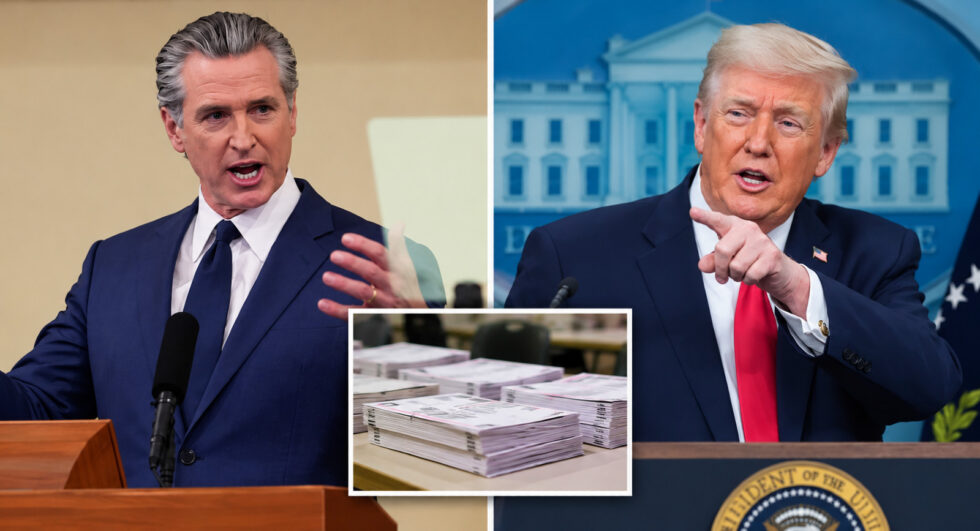
The Trump administration is continuing its crackdown on non-citizen voting, even as Democrats continue to claim that it’s a “rare” occurrence.
The Justice Department has charged 28 noncitizens in California with federal election-related crimes, escalating the Trump administration’s battle with state officials over voter eligibility just two weeks before the November 3 midterm elections.
Federal authorities arrested 11 of the defendants Monday as part of “Operation Protect the Vote,” a coordinated effort involving all four U.S. Attorney’s Offices in California, while authorities said the remaining defendants would also be taken into custody.
All 28 defendants are lawful permanent residents, commonly known as green-card holders, meaning they are legally present in the United States but are not American citizens and therefore cannot legally vote in federal elections.
Advertisement
“Every illegal vote cancels out the vote of a lawful American citizen,” said Acting Deputy Attorney General Trent McCotter.
“Each of the 28 defendants charged today appears on the list of more than 20,000 likely noncitizen registrants we provided to California election officials last week,” he continued, per a DoJ press release.
Advertisement
“California refused to look at that list. Today’s charges show exactly what that refusal puts at risk. California must verify the citizenship of those more than 20,000 registrants before mail-in ballots are counted,” he added.
First Assistant U.S. Attorney Bill Essayli, who is based in California, said the arrests demonstrate that the Democrat-controlled sanctuary state has mailed ballots to noncitizens and argued that state officials must do more to ensure only eligible citizens participate.
DoJ alleges the defendants committed offenses ranging from voting as noncitizens and fraudulently registering to vote to making false statements on naturalization applications about their previous voting activity.
Federal officials say 21 of the 28 defendants actually cast ballots, with some allegedly voting in multiple elections over several years.
One defendant, 72-year-old Belizean national Omar Alexander Muñoz, allegedly registered to vote in 2019 by falsely claiming U.S. citizenship and subsequently voted in elections in 2020, twice in 2022 and again in 2024.
Advertisement
Prosecutors also accused Muñoz of falsely stating on his naturalization application that he had never claimed to be an American citizen.
Another defendant, Mexican national Camino Giles Jiménez, allegedly voted in three U.S. elections despite knowing he was not a citizen, with prosecutors saying his most recent ballot was cast during California’s June 2026 primary.
Other defendants are accused of registering and voting during the 2024 presidential election before later denying their voting histories or previous claims of citizenship while seeking naturalization.
Advertisement
The felony charges involving fraudulent voter registration and false statements on naturalization applications can carry maximum sentences of five years in federal prison, while voting as a noncitizen can carry a maximum one-year sentence.
The administration provided the list to California officials on October 13 and requested that mail ballots connected to those voters be set aside until their citizenship could be verified, but state officials declined to take the requested action.
The Justice Department subsequently sued California, seeking a federal court order preventing potentially ineligible ballots from being counted until the citizenship status of the affected voters can be determined.
California officials have strongly disputed the administration’s broader claims, warning that federal databases can incorrectly identify naturalized Americans as noncitizens and arguing that abruptly removing voters could disenfranchise eligible citizens.
Advertisement
State officials and voting-rights advocates have also pointed to cases elsewhere where federal lists proved inaccurate, including Nevada, where state officials said all 185 people previously flagged as potential noncitizens were actually citizens.
The 28 California prosecutions therefore do not establish that all, or even a large share, of the more than 20,000 people identified by federal authorities are illegally registered.
The charges nevertheless provide the Justice Department with specific criminal cases as it argues that California’s voter-registration safeguards have allowed some noncitizens to register and cast ballots.
California Attorney General Rob Bonta and Secretary of State Shirley Weber have rejected allegations that the state tolerates widespread illegal voting, while emphasizing that noncitizen voting is already prohibited under state and federal law.
The California cases come amid a broader Justice Department enforcement effort that has produced election-related charges against more than 100 people across roughly 20 states in recent weeks.
This article may contain commentary which reflects the author’s opinion.