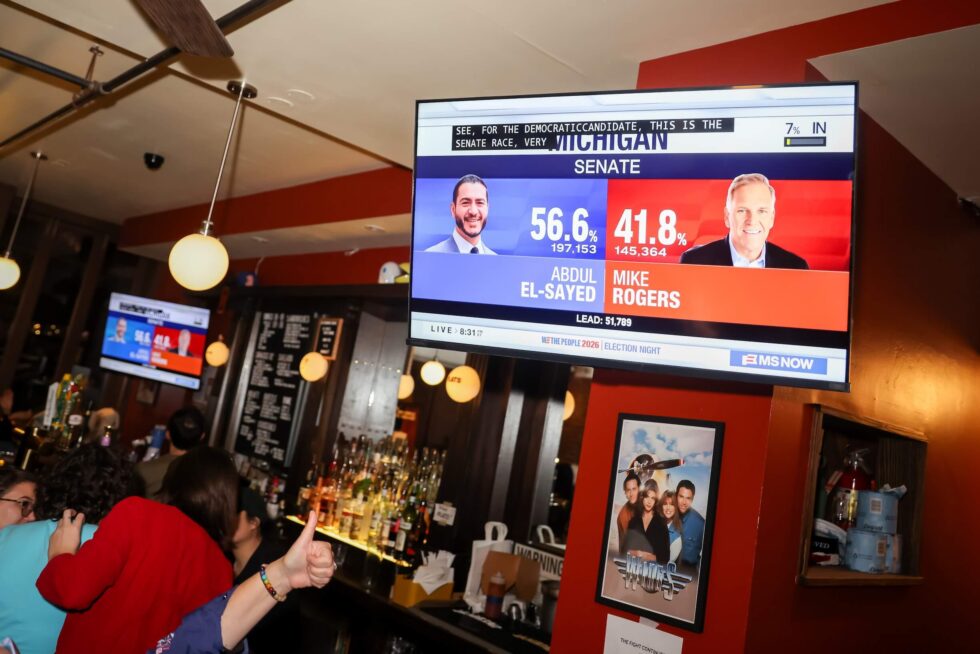
Election night results on Nov. 3. Photo by Michael Nagle/Bloomberg
By Jacob Kornbluh
November 5, 2026
Jewish voters overwhelmingly backed Democrats in Tuesday’s midterm elections, even as concerns about Israel and antisemitism played a growing role in their political decisions, according to a new exit poll published on Thursday.
The GBAO Strategies survey of 800 Jewish voters found that 72% of Jewish respondents supported Democratic candidates for Congress, compared with 24% who voted Republican. The poll, sponsored by J Street, a progressive pro-Israel, pro-peace advocacy group, was conducted via text message from Oct. 28 to Nov. 3 and had a reported margin of error of plus or minus 3.5 percentage points.
The Democratic share was slightly lower than in previous midterm elections, when Democrats received 74% of the Jewish vote in 2022 and 76% in 2018. In the 2020 presidential election, 77% of Jewish voters backed Joe Biden, according to GBAO’s polling. These findings differ from a national NBC News exit poll, which found that 68% of Jewish voters supported Democrats this year and 31% backed Republicans, compared with 78% who voted for Kamala Harris in 2024. (The national surveys used different methods, making it harder to say how preferences actually changed.)
Jim Gerstein, GBAO’s pollster and a Democratic campaign consultant, cautioned against reading too much into the change over time. “You’d have to squint really hard to try and see that that is a shift or anything really meaningful,” Gerstein told the Forward during a press briefing. He noted that Republican support also fell, from 25% in the 2022 midterms to 24% this year. Gerstein suggested that strong opposition to President Donald Trump during his first term, including during the COVID-19 pandemic, may help explain the higher Democratic numbers in 2018 and 2020.
He also noted that campaigns and outside groups have spent significantly more money targeting Jewish voters in the past two election cycles. “These are really negligible, and we don’t look at this as much shifting,” he said.
Even as Democrats regained control of both chambers of Congress, Republicans did appear to make gains among Jewish voters in some closely watched races amid a divide over U.S. support for Israel. Several outspoken critics of Israel won seats in the House, including five members of the Democratic Socialists of America. Abdul El-Sayed of Michigan and Troy Jackson of Maine, two new senators who made criticism of Israel a major part of their campaigns, also won highly contested races.
The exit poll suggests that disagreements over Israel have not fundamentally changed how American Jews vote.
The future of American democracy remained the top concern for Jewish voters, with 44% naming it as one of the two most important issues influencing their vote, followed by 34% who said the cost of living was among their leading concerns. But Israel and antisemitism became more important than in previous elections. Twenty-one percent named antisemitism as one of their top two issues, up from 11% in 2024. Israel ranked sixth, cited by 14% of voters, compared with just 4% in 2022.
Compared to previous elections, Israel and antisemitism moved up the list of priorities — 21% identified antisemitism as one of their top two issues, up from 11% in 2024. Israel was ranked six with 14%, compared with just 4% in 2022.
Gerstein argued that rising antisemitism and the debates over support for Israel serve as a basic test for candidates rather than the deciding factor in most elections. “I think we see candidates in both parties passing that threshold quite easily,” Gerstein said.
Asked which positions expressed by candidates during the campaign they agreed with most, 30% chose unconditional support for Israel, while 39% favored support tied to Israel’s compliance with American interests and values. Another 31%, including 60% of voters between the ages of 18 and 34, agreed with the statement that Israel has committed genocide and should no longer receive U.S. aid.
Orthodox voters, representing 9% of the sample, voted Republican by a 63-34 margin.
A Jewish split on Israel
Congressman-elect Brad Lander on Nov. 3. Photo by Michael Nagle/Bloomberg
The survey also found a Jewish electorate that itself is becoming more divided over Israel.
Thirty-nine percent said their sympathies in the Israeli-Palestinian conflict were primarily with Israelis, compared with 23% who sided with Palestinians. Another 38% sided with both. Among younger Jews, 49% said they sympathized more with Palestinians, compared with 20% who sided with Israelis.
A majority — 51% — said it supported continuing $3.8 billion in annual U.S. military assistance to Israel, while 49% opposed it. However, 44% also said arms sales should be conditioned on compliance with U.S. law.
Jewish voters showed greater agreement on how criticism of Israel should be treated and whether Israel’s policies directly impact them.
Sixty percent said Jewish organizations that label harsh criticism of Israel as antisemitic are using concerns about antisemitism to defend unpopular Israeli policies. About two-thirds said AIPAC’s spending against candidates critical of Israel increases antisemitism in the United States, while 80% said Israel’s actions in Gaza and the West Bank contribute to antisemitism. An overwhelming majority of 76% support sanctions against violent Israeli settlers.
The survey also found that 39% of Jewish voters, including 63% of those under 35, said that spending by AIPAC to defeat Israel critics this election cycle made them less likely to support candidates backed by the pro-Israel group.
Mamdani scores high
New York City Mayor Zohran Mamdani on Nov. 3. Photo by Angelina Katsanis/Bloomberg
One of the more striking findings was that New York City Mayor Zohran Mamdani was more popular among Jewish voters nationwide than Israeli Prime Minister Benjamin Netanyahu, despite his criticism of Israel and strained relationship with some Jewish organizations.
The poll found that 49% of respondents viewed Mamdani favorably, compared with 43% who viewed him unfavorably. Netanyahu received a favorable rating of just 20%, while 72% viewed him unfavorably. That marks a 12% decline in two years for the Israeli leader, who is struggling to form a government after the last Israeli election ended in deadlock.
In an interview with CNN Wednesday night, Mamdani pointed to his approach to governing as an example of how elected officials can represent Jewish voters even when they disagree with them on Israel.
“I represent the most Jewish city in the United States of America, and I know that there are some Jewish New Yorkers, for example, that may have a different set of opinions on Israel and Palestine as I do, and that doesn’t mean that I work any less hard to deliver for them across the board,” Mamdani said. “I think that’s the same truth for anyone who was elected last night.”
We believe that there shouldn’t be any barriers to quality, independent Jewish news. That’s why we invite millions to read and share our journalism without a paywall or subscription.
But did you know that only 2% of Forward readers donate to support us?
While the Forward is free to read, it isn’t free to produce. Big stories — like deep dives into the antisemitism data, political scoops or reporting trips to college campuses — take months of research and fact-checking. All while we keep you informed of what you need to know each day.
Reader support is the only way that we are able to do this work. If you find value in what we do, please support our nonprofit newsroom.


