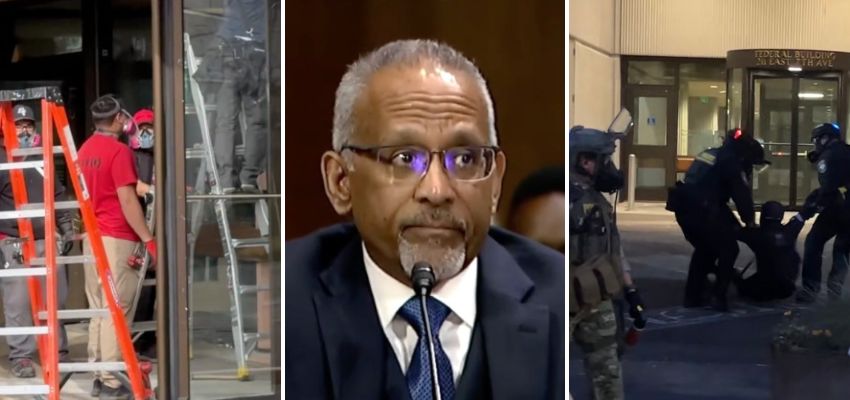
Judge Kasubhai issued a preliminary injunction last month, ordering the federal government to remove the fence that had been installed to protect the facility amid ongoing violent anti-US Immigration and Customs Enforcement (ICE) riots.
The Ninth Circuit Court of Appeals has asked a lower court judge to reconsider his ruling requiring the removal of the perimeter fence at the Federal Building in Eugene, Oregon. The three-judge panel on Tuesday directed US District Judge Mustafa Kasubhai to consider alternatives to his order.
Judge Kasubhai issued a preliminary injunction last month, ordering the federal government to remove the fence that had been installed to protect the facility amid ongoing violent anti-US Immigration and Customs Enforcement (ICE) riots. A large-scale breach of the federal building occurred in January, resulting in FBI manhunts. Kasubhai ruled in favor of a group of leftist activists and claimed that the fence had likely violated their First Amendment rights.
The Oregonian reported that the appeals panel asked Kasubhai to allow the fence to be reconstructed so that it hugs the building rather than runs along the perimeter. This would allow demonstrators to access the upper plaza, where most of the violence has occurred, while keeping the building secure.
Additionally, the appeals panel requested a pause on the July 2 fence removal timeline pending oral arguments next week. However, Judge Kasubhai decided not to take the higher court’s recommendations into account, and the fencing was removed early Thursday morning. In his opinion, he described the fence as a “vast overreach” by the US government because it “excludes” protesters from gathering near the building.
Lawyers for the Department of Justice argued during Tuesday’s hearing that removing the fence would endanger occupants inside the building and the facility’s structure. Assistant US Attorney James Blum said that federal officials can restrict physical access to federal property and that Judge Kasubhai had “misconstrued the First Amendment.”
Blum argued that the fence should remain in place at least until the building has completed its security upgrades, such as fortifying the facility with riot-proof glass and steel doors. Renovations are expected to be completed by December 22.
Federal Protective Service (FPS) William Turner testified about his concerns with the fence’s removal. He said that manpower would need to be significantly increased to safeguard the building. Turner also objected to placing the fence closer to the facility, explaining that protesters could launch projectiles at the second-floor windows or drop incendiary devices over the fence, which would land beside the building, per the Oregonian.
On Thursday morning, while the fence was being removed, Assistant US Attorney James Blum said that an unknown group of protesters mobilized to interfere with the fence’s removal, prompting FPS to call 911 for assistance.
Despite the violence already occurring, Judge Kasubhai expressed satisfaction with the US government’s compliance with his order. He cautioned protesters to lawfully exercise their First Amendment rights, saying the Ninth Circuit Court judges will likely be watching what happens at the building before next week’s decision. Demonstrations have been planned this weekend to protest the 4th of July.