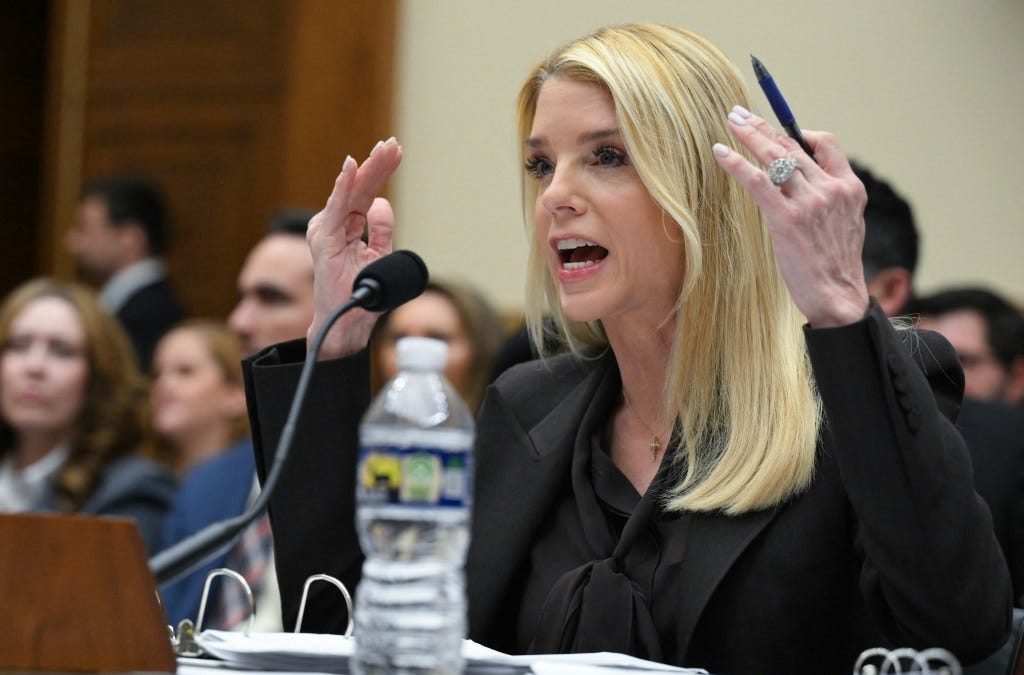
Federal prosecutors want to be treated differently. Attorneys across Colorado were recently notified of a proposed federal rule change that would allow ethics complaints against Department of Justice prosecutors to be rerouted to U.S. Attorney General Pam Bondi. That change would suspend any investigation by Colorado’s Office of Attorney Regulation Counsel, which independently evaluates attorney misconduct.
Under the proposal, if Colorado sought to proceed anyway, Ms. Bondi could “take action” to prevent the state from interfering with her review. And once she completed her review, she could decide whether to share the results with Colorado at all.
Why does the Department of Justice want to control investigations into the ethics of its own attorneys? DOJ claims political activists have weaponized ethics complaints and that state investigations give undue weight to allegations involving high-level federal prosecutors. Lions, tigers, and bears, oh my. That explanation reads less like concern for fairness and more like an attempt to silence complaints and shield federal prosecutors from accountability, contradicting core principles of the legal profession.
Allowing the DOJ to investigate its own conduct behind closed doors, unlike any other licensed profession, would set a dangerous precedent. We must ask whether the DOJ is the appropriate entity to judge potential violations by its own attorneys. And we must ask whether the legal profession can afford such a double standard.
At the First Judicial District Attorney’s Office, I lead a team of 200 staff, including more than 80 attorneys who serve Jefferson and Gilpin counties. My duty is to both my office and the community we serve. That includes ensuring we are held to the same ethical standards as every other member of the Colorado bar.
An attorney’s ethics, and therefore their licensure, is separate from employment. Like the DOJ, we have internal processes to address performance concerns ranging from disorganization to potential misconduct. I can evaluate an attorney’s performance. I can fire someone. I can report an ethics issue. I have done these things. Performance and ethics can overlap, but the decision about whether an attorney violated a rule of ethics rightfully belongs with an independent body.
Colorado’s Attorney Regulation Counsel plays that role, and it has held even elected prosecutors accountable for misconduct. In 2022, District Attorney Alonzo Payne, a Democrat, was disbarred after serving in the 12th Judicial District. In 2024, District Attorney Linda Stanley, a Republican, was disbarred after serving in the 11th Judicial District, following a complaint submitted by fellow prosecutors and the Colorado District Attorney’s Council. These outcomes underscore why independent ethics oversight tied to licensure matters, particularly for prosecutors who hold such significant authority.
Attorney Regulation serves at the pleasure of the Colorado Supreme Court and helps regulate the practice of law. Its goal is to review attorney conduct objectively and resolve complaints fairly. It has a range of tools available, including suspension or disbarment. The DOJ cannot credibly argue that independent oversight is unnecessary when our profession is committed to minimizing conflicts of interest and honoring our oaths to uphold the rule of law.
This is not the first attempt by federal prosecutors to limit state ethics oversight. Members of both political parties have resisted outside scrutiny, which led Congress to enact the Citizens Protection Act in 1998. Also known as the McDade Murtha Amendment, it made federal prosecutors subject to state ethics rules. Unlike earlier debates that centered on logistical concerns, the Department is not offering any practical justification this time. Instead, it is simply seeking to operate beyond external scrutiny, insulated from the oversight that applies to every other attorney. That should alarm us.
Ms. Bondi’s attempt to subvert independent state ethics accountability for federal prosecutors is noxious. Attorney ethics and accountability cannot depend on one’s employer, whether the attorney serves a client, a community, a district, a state, or the nation.
Alexis King is district attorney for the First Judicial District.
Sign up for Sound Off to get a weekly roundup of our columns, editorials and more.
To send a letter to the editor about this article, submit online or check out our guidelines for how to submit by email or mail.