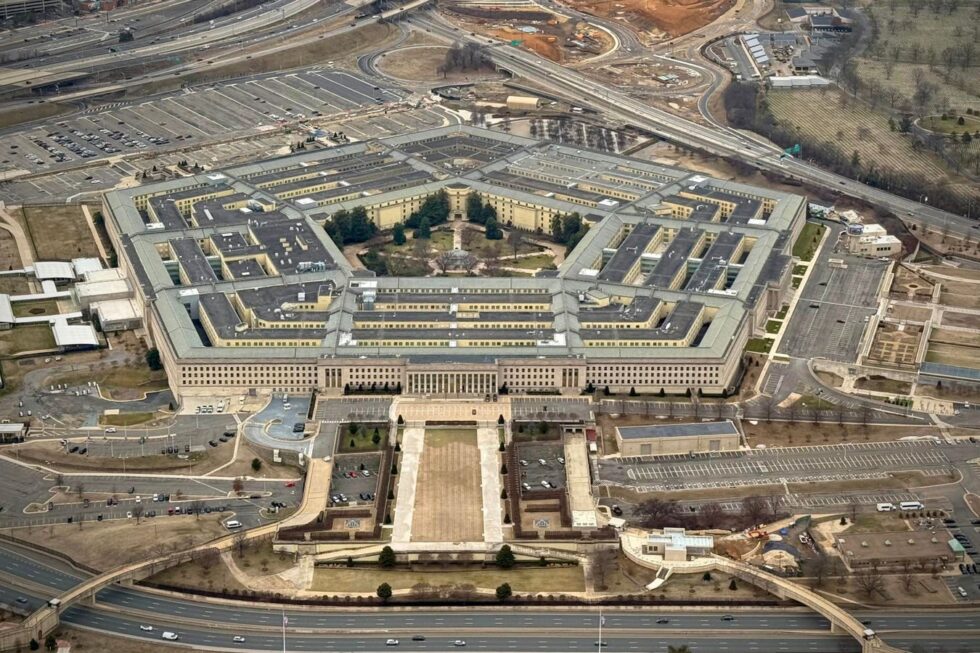
Aerial View of the Pentagon (Photo by J. David Ake)Getty ImagesPresident Trump’s declaration of a potential increase in U.S. defense spending to $1.5 trillion in 2027 has renewed long-standing debate over the appropriate scale of defense outlays and, more importantly, what such funding could realistically deliver. One perspective sees higher defense spending as necessary to address a deteriorating global security environment, which includes rebuilding a shrinking and geriatric Air Force and building up an undersized Space Force. Another regards such increases as fiscally excessive.The more consequential challenge is translating additional funding into optimal military power—power required to meet U.S. global commitments, deter aggression across multiple theaters, and prevail in conflict should deterrence fail. Achieving this outcome requires prioritizing FY2027 funding for both military services within the Department of the Air Force to reverse decades of underfunding.Air Force and Space Force Capacity TrendsFor more than three decades after the Cold War, the Air Force was forced to absorb persistent investment shortfalls, exacerbated by its role as a bill-payer for the prolonged counterinsurgency campaigns in Iraq and Afghanistan. Deferred recapitalization of aircraft and missile systems has reduced its combat force to less than half its Desert Storm size while increasing the age of its geriatric fleet. Today, more than ten major aircraft types first flew over 50 years ago and constitute over two-thirds of the Air Force inventory.The Space Force, established six years ago, is also under resourced and has too few personnel. Additionally, it still lacks sufficient authority to consolidate military space responsibilities, leaving unresolved the fragmentation and accountability gaps that prompted its establishment. Both services underpin effective, decisive military power projection in the modern age, which is why any increased defense spending must focus first and foremost on the Department of the Air Force. Implications of a Higher Defense ToplineLast year, Col. Mark Gunzinger, USAF (Ret.), and I published a policy paper outlining the minimal spending requirements necessary to reverse the decline of the U.S. Air Force and modestly boost the U.S. Space Force—approximately $45 billion annually above then-projected budgets. Those figures were viewed by some as unrealistic. A defense topline of $1.5 trillion alters that assessment by introducing a budget better aligned to America’s security needs. Our 2025 recommendations now represent a practical starting point for restoring necessary American air and space military capacity. If sustained over multiple years, a higher defense topline will enable meaningful increases in Department of the Air Force funding without displacing other military service priorities. One-time budget spikes have limited impact; durable and necessary capacity and capability improvements to the U.S. military depend on a multi-year re-leveling of defense spending that will provide predictable signals to both the services and the defense industry.Global Commitments Demand Air and Space Power—Everywhere, All the Time.The United States is a global power with responsibilities around a world that is increasingly dangerous. From deterring China in the Indo-Pacific, to reassuring allies in Europe, to countering Iranian aggression in the Middle East, to reestablishing security in the Western Hemisphere, and defending the homeland, every U.S. military commitment depends on airpower and spacepower.No joint military operation can occur without critical reliance of some element of the Department of the Air Force. Exploiting the domains of air and space provide the ability to see globally, decide rapidly, move forces at intercontinental distances, strike with precision, defend critical infrastructure, and sustain operations over time—in other words, they provide global vigilance, global reach, and global power. No other military department can replicate these effects, and no substitute exists if they fail. Yet today, both the Air Force and the Space Force are operating well below the capacity required to meet U.S. global security demands.Because of its chronic underfunding, the Air Force is the smallest and oldest in its history. Readiness is at risk as pilots fly less than they ever have before, and maintainers struggle to keep aged planes in the air with over 700 grounded on any given day due to lack of spare parts. Despite its central role in every joint operation, the Space Force operates with roughly three percent of the defense budget and fewer than 10,000 uniformed personnel—about 20 percent the population of a single Army installation—Ft. Bragg. This mismatch between demand and capacity is not sustainable in a world where America now faces the greatest number of capable threats in its history.If President Trump’s defense spending target is realized, an additional $125–$150 billion annually for the Department of the Air Force would be an executable investment with critically important strategic impact.Rebuilding The Air Force: Capacity and Readiness Are Critical RequirementsFor decades, the Air Force budget strategy of “divest to invest” emphasized retiring legacy aircraft to preserve investment for future modernization. In practice, modernization never keep pace with divestment, resulting in an Air Force too small to meet combatant commander demands, and readiness eroding to dangerous levels.Reversing this decline begins with force structure. The production lines for the F-35, B-21, F-15EX, EA-37B, KC-46, E-7, collaborative combat aircraft, uninhabited aerial vehicles, and others already exist. The same holds true for many types of munitions. With increased and sustained funding, growing these production lines can increase output to rates necessary to rebuild the Air Force. Options to consider include building the capacity to double or triple B-21 production; increase F-35A production to 80 per year; F-15EX production to 48 per year; double EA-37B production rate to four per year with an inventory objective of 40; procure 30 E-7’s; ramp production of CCA tranches as development and proof of concepts mature; accelerate F-47 development and plan to procure 48 per year with a 381 total inventory objective. Mobility forces also face modernization demands. Long-range refueling and airlift remain critical to U.S. military success. Additional resources could support development of a next-generation refueling system and new airlift concepts while upgrading legacy fleets with improved datalinks and battlespace awareness—both survivability-enhancing capabilities.Additionally, the Sentinel ground-based nuclear deterrent program must be fully funded and completed as fast as possible, given the 50-year-plus age of present systems and the pressing need to modernize. Readiness is another area requiring immediate attention. Today, too many Air Force aircraft are grounded due to spare-parts shortages. Fighter pilots fly far fewer hours than required to be ready for high-end combat. With higher defense funding, both these shortfalls could be addressed across every mission area. Readiness cannot be surged once a crisis begins. It must be built in peacetime, or it will not exist during wartime.Advanced capabilities central to global deterrence—including long-range penetrating strike, homeland missile defense, advanced aircraft engine technologies, autonomous systems, the F-47 air dominance aircraft, resilient command and control, electronic warfare, and ground-based air defense—could be fielded on faster timelines rather than extended over decades. Two decades of research in the adaptive engine transition program produced F-35 engine prototypes delivering substantial improvements in range, thrust, and thermal management. Despite extensive testing, they were not fielded due primarily to funding limitations. Expanded investment could also accelerate adaptive propulsion development for the F-47.Department of the Air Force bases face growing threats from ballistic and cruise missiles, uninhabited aerial vehicles and small drones. Addressing those risks may require expanded Department of the Air Force responsibility for ground-based air defense where previous arrangements with the Army fall short. That will introduce substantial procurement and sustainment costs requiring further growth in Department of the Air Force funding.Foundational Department of the Air Force accounts, including information technology, alongside the integration of artificial intelligence across all mission areas, represent significant resource requirements. Together, these areas could account for roughly 10 percent of potential Department of the Air Force funding increases, or approximately $15 billion.Building A Space Force for Space Superiority and Global OperationsSpace systems provide missile warning, communications, navigation, intelligence, targeting, and command and control for every U.S. military operation. China and Russia are developing counterspace capabilities designed to disrupt or deny U.S. access to space in crisis or conflict. Accordingly, space superiority must become a national priority. Yet the Space Force remains far too small to execute the missions it already has, let alone new and emerging missions. Additional funding could expand solve current Space Force mission shortfalls. Examples include: Acquisition: about $5 billion and 500 new personnel to speed development and fielding of resilient, warfighting space systems.Launch services: roughly $4 billion and nearly 1,000 personnel to increase launch cadence, responsiveness, and survivability.Satellite operations: $3 billion and roughly 950 personnel to operate, defend, and sustain on-orbit systems under threat.Training: $1 billion and 250 personnel to build a combat-credible space warfighting culture.Expanded combatant command support: $750 million and 150 personnel to ensure space expertise is integrated into joint planning and execution.Space superiority sensing: approximately $6 billion to dramatically improve space domain awareness and warning of hostile actions.At the same time, new missions are emerging and could be fully funded, including: Tactical Surveillance, Reconnaissance, and Tracking, about $2.5 billion and 350 personnel to directly support joint force targeting and missile defense.Dynamic Space Operations, about $4 billion and 470 personnel to maneuver, reconstitute, and fight through attacks in space.Advanced data analysis, roughly $850 million for contractor support to turn massive data flows into decision advantage.Defending U.S. military operations from space-enabled attack, approximately $3 billion and 350 personnel focused on protecting joint forces worldwide.Without these additional investments—amounting to an additional $30.1B and 4,000 more uniformed personnel—U.S. military joint force operations in every theater will be increasingly blind, slow, and vulnerable.Execution and the Industrial BaseSkeptics rightly ask whether the Department of Defense/War and the defense industrial base can absorb a 50 percent funding increase. For the Department of the Air Force the answer is yes. However, execution challenges will need to be addressed. Workforce growth, training pipelines, acquisition capacity, test infrastructure, and program management must all scale intelligently. Simply increasing budgets without reform in these areas will suboptimize results. But these challenges are manageable precisely because the investments address known gaps, not speculative issues.The industrial base responds to demand signals. Aircraft production, launch services, and many space capabilities can ramp up if industry sees stable, multi-year commitments. Munitions, propulsion, and microelectronics require predictable procurement as that is exactly how capacity is rebuilt. Industry will not invest without confidence; sustained funding provides that confidence. Congress and the President must work together to demonstrate sustained commitment to this modernization drive.Federal Budget Context and Strategic TradeoffsCritics will argue that a $1.5 trillion defense budget is excessive. However, U.S. defense spending as a share of GDP is lower today than at any point since World War II—even as the number and capability of potential adversaries have increased. At the same time, modern warfare is inherently capital-intensive: global vigilance, global reach, and global power require sustained investment but reduce casualties, shorten conflicts, and strengthen deterrence. The cost of deterrence is far lower than the cost of major conflict—particularly if we lose due to deficiencies in capacity, capability, and readiness. Underfunding defense does not save money. It merely defers costs until they are paid under far worse conditions. A flat defense budget risks preserving a smaller and less capable force rather than addressing dangerous shortfalls. A $1.5 trillion defense budget will matter greatly, if it rebuilds the Air Force and boosts the Space Force to meet U.S. global commitments while adequately protecting our homeland.Our early 2025 recommendations for rebuilding the Air Force and growing the Space Force were grounded both in operational and fiscal reality at the time. A $1.5 trillion defense topline expands these options, realistically supporting additional annual investments on the order of $40 billion for the Space Force and $90 billion for the Air Force. Those figures are not only executable, but necessary to adequately grow the Space Force, stop the decline in the Air Force and rebuild it.ConclusionSustaining U.S. global leadership demands a defense topline that matches the scale of today’s threats. A $1.5 trillion defense budget in 2027 is a prudent, reasonable re-leveling of defense investment in historical proportion of GDP, and essential to achieve peace through strength. It will allow for rebuilding a seriously diminished Air Force and appropriately boosting the Space Force. It is essential to ensure the United States remains the world’s sole superpower—positioned to deter future threats, safeguard American lives, and secure enduring global leadership.
Source link