This article may contain commentary
which reflects the author’s opinion.
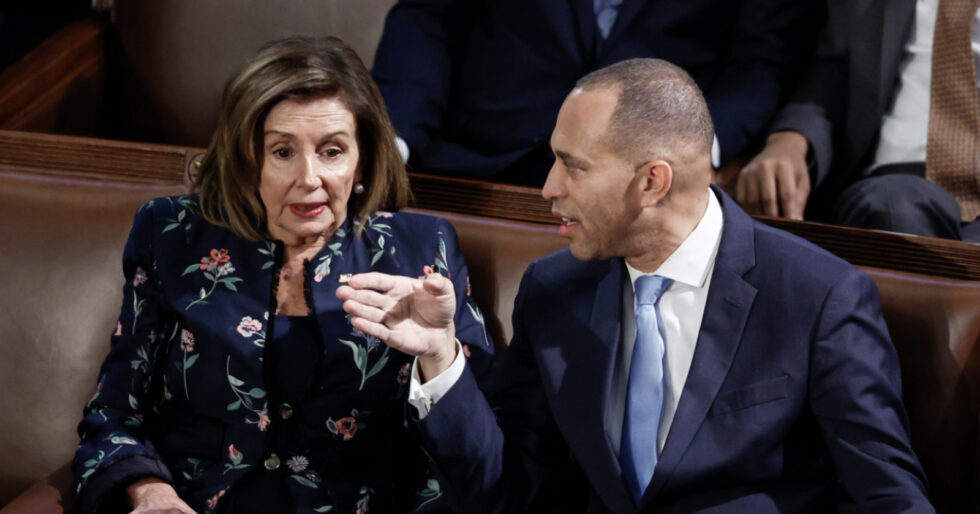
House Minority Leader Hakeem Jeffries (D-N.Y.) may find himself caught in the very blue wave he hopes to ride into power this November. More and more Democratic candidates are telling Axios that they can’t promise to support his leadership.
This group of new students could potentially be the first challenge to the previously unyielding support. A group of viable candidates has made it clear that voting for Jeffries as speaker is not a given if the Democrats win the House.
Axios reported last fall that more than 80 Democratic House candidates across the country were either not sure if they would support Jeffries’ leadership or were completely against it. Since then, things have only gotten worse for him.
Mai Vang, the leading progressive primary challenger to Rep. Doris Matsui (D-Calif.), previously said she would “support the person that my future colleagues elect as our leader.”
Advertisement
But in an unprompted statement last week, she told Axios: “The Democratic Party and its leadership—Chuck Schumer and Hakeem Jeffries—have failed to mobilize meaningful opposition to Trump’s illegal war and their silence as AIPAC and corporations flood Congressional primaries with millions of dollars is deafening.”
When asked if she would support Jeffries’ leadership, Claire Valdez, a New York State Assembly member who is running to replace retiring Rep. Nydia Velázquez (D-N.Y.), said in an interview with Axios that “there would need to be some conversations.”
Some candidates who are against Jeffries have suggested other options. Anabel Mendoza, a progressive candidate in Illinois’ 7th District, told Axios that she wants Rep. Rashida Tlaib (D-Mich.) to be in charge because she is “10 toes down on what matters.”
Advertisement
Some candidates said that if Democrats don’t win the House, talks about Jeffries’ leadership will probably be completely different.
Also, the redistricting fight is now going very badly for Democrats.
“On April 22, House Democrats were riding high. They’d just won a huge gamble in Virginia, spending tens of millions of dollars on a redistricting referendum aimed at netting them up to four new seats. President Donald Trump — who set off the unprecedented national redistricting fight in Texas last year — was tanking in the polls, dragging down Republicans everywhere,” Punchbowl News reported.
“Overall, it looked like Democrats had held Republicans to a draw in the redistricting wars and were on their way to the House majority. But the last two weeks have suddenly turned rough for House Minority Leader Hakeem Jeffries and the Democratic Caucus. They’re facing legal setbacks on redistricting across multiple fronts, developments that have reshaped the battle for the House. As many as 10 seats could now swing toward Republicans in a worst-case scenario for Democrats, although this all remains very fluid,” the outlet added.
In a worst-case scenario for Democrats, as many as 10 seats might suddenly flip to Republicans, but it is all still very fluid.
What’s obvious is that the Supreme Court’s decision to eviscerate Section 2 of the Voting Rights Act and another late round of GOP redistricting have substantially changed the fortunes of Democrats.
Advertisement
Florida Republicans, for starters, pushed through an aggressive gerrymander that might oust four Democrats from the delegation. Even many Republicans were stunned by the plan from GOP Gov. Ron DeSantis.
Then Virginia’s Supreme Court indicated it was contemplating overturning the Democrats’ hard-won referendum triumph. Nobody knows what will happen there.
Plus, a Supreme Court decision in Louisiana v. Callais has opened up several seats across the South, notably in Louisiana, Alabama, South Carolina, and Tennessee.
Virginia Democrats are starting to worry that the Virginia Supreme Court will strike down the voter-approved plan that might give them up to four blue seats. The court refused to certify the April 21 redistricting referendum and left Virginia election authorities and candidates in uncertainty.
The Virginia Supreme Court allowed the referendum to go forward, over GOP objections. But the Virginia justices also indicated they had reserved the power to rule on the Republican procedural appeal once the vote had been completed.
If the new map gets blocked, Democrats’ best chance is to take down GOP Reps. Rob Wittman and Jen Kiggans, but Republican Reps. John McGuire and Ben Cline are expected to survive.
Tennessee GOP lawmakers have already circulated a map that’s aimed at pushing Rep. Steve Cohen out of his Memphis seat while doing little for the state’s other Republicans.
Advertisement
Louisiana Republicans are poised to drag at least one of the two Democrats out of the Bayou State’s House.
Alabama GOP officials are asking the Supreme Court to remove an injunction that requires the state to hold onto its congressional map until 2030. Republicans might also target Democratic Rep. Terri Sewell, whose district is headquartered in Birmingham, in theory.
South Carolina is considering a new map that would erase the deeply blue seat of Democratic Icon Jim Clyburn.
Republican Mississippi Gov. Tate Reeves told the Daily Caller he is considering running to knock out Democratic Rep. Bennie Thompson’s seat in the western section of the state. Mississippi already had its primary, thus this is probably a 2028 move.
None of these GOP-drawn maps are set in stone yet.
Florida map faces various lawsuits. But even if the map holds, Jeffries and Democratic leaders hope they can flip a few light red seats from the GOP. South Carolina Republicans are no sure bet to get their map through.