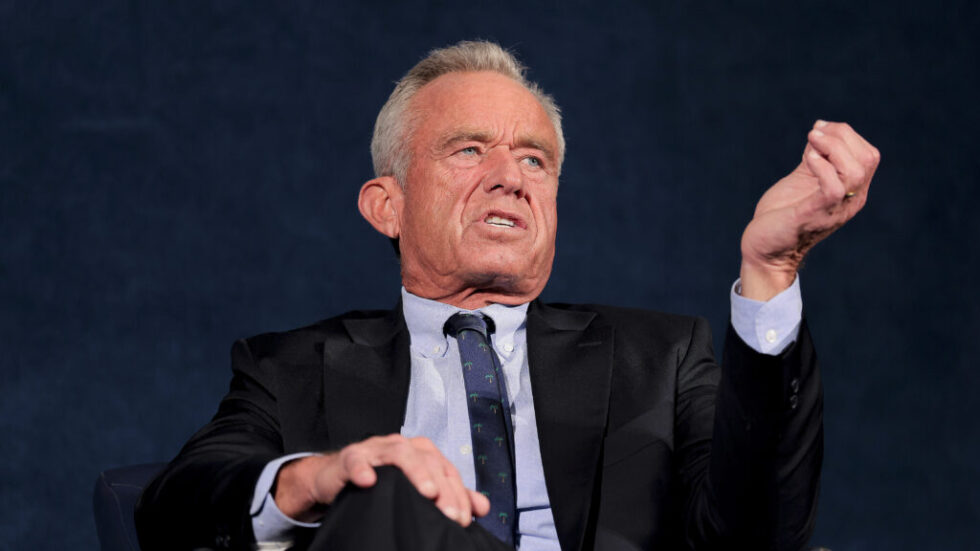
Health secretary Robert F. Kennedy Jr. on Monday lamented a nationwide “spiritual malaise” as he unveiled new plans to tackle the nation’s addiction and substance use epidemic, casting the initiative as a game-changing effort to align government and recovery organizations.
The announcement included new details and funding sources behind the sweeping but vague addiction initiative he rolled out last week, unveiling a new program to address homelessness and plans to involve religious organizations in the government’s response to the addiction epidemic. In a series of events across Washington, Kennedy cast the initiative as a first-of-its-kind attempt to unify the government’s addiction efforts across the many federal agencies focused on substance use and behavioral health.
Kennedy said the effort was an attempt to align government, nonprofits, and the private sector behind a structure that incentivizes high-quality care and, by extension, long-term recovery.
“This is a chronic disease. It’s a physical disease, it’s a mental disease, it’s an emotional disease,” he said. “But above all, it’s a spiritual disease, and we need to recognize that. Faith-based organizations play a critical role in helping people reestablish their connections to community.”
The health secretary and his aides also previewed a barnstorming tour to visit and solicit input from recovery organizations, including ones operated through a faith-based lens. The trip would mirror a similar tour Kennedy took as an independent presidential candidate in 2024, when he visited drug courts, sober living facilities, and “wellness farms” across the country while filming a documentary about the nation’s addiction crisis titled “Recovering America.”
Monday’s announcements appear designed to fulfill the vision Kennedy outlined when that film premiered in New Mexico nearly 20 months ago.
“The government has a role in actually pressuring the addict, to say, ‘We’re not going to tolerate you on the street anymore,’ to do tough love,” he said then.
Kennedy, who is in long-term recovery from addiction to alcohol and heroin, talks frequently about his own struggles with substance use. He is also a vocal proponent of 12-step recovery programs like Alcoholics Anonymous, and has said publicly that he attends as many as eight meetings per week.
Alongside Kennedy’s forthcoming road show and increased collaboration with faith-based organizations, the administration announced a new program to bolster access to three medications used to treat opioid use disorder: methadone, buprenorphine, and naltrexone. Through the Administration for Children and Families, the program would provide a 50% federal match to states that offer the medications to parents at risk of losing their children to the foster care system as they battle opioid addiction.
The Trump administration did not identify a funding source for the new programs, and it was not immediately clear whether the announcement would quell the concerns of many addiction treatment and recovery groups still feeling whiplash from the administration’s sudden cancellation and reinstatement last month of roughly $2 billion in funding from the Substance Abuse and Mental Health Services Administration.
Separately, the administration announced an initiative called STREETS, or Safety Through Recovery Engagement and Evidence-based Treatment and Supports. Kennedy said the $100 million program was based in part on protocols developed in the Netherlands. It aims to involve law enforcement, counseling, housing support services, psychiatric, and other medical care, all in an effort to connect drug users experiencing homelessness first to housing, employment, and eventually long-term recovery.
Despite the emphasis on helping people struggling with addiction to access housing services, the administration explicitly cast the new policies as a departure from “misguided” Biden administration approaches. In a press release, the Department of Health and Human Services specifically referenced the prior White House’s historic openness to the philosophy of harm reduction, which aims to help people who consume substances preserve their health even as their use continues.
“These policies focused not on preventing and treating individuals, but rather non-effective interventions such as harm reduction, supporting housing first, and other strategies that enabled future drug use,” the statement said, “and were never intended to support people in their recovery to lead productive lives in their communities.”
Drug overdose deaths continued their long-term rise during President Trump’s first term in office. They skyrocketed during the Covid-19 pandemic, hitting an all-time high of roughly 112,000 midway through the Biden administration before beginning a precipitous drop in 2023. That drop continued through 2024 and after Trump took office in 2025, declining to roughly 70,000 in the most recent 12-month period data was available.
Kennedy’s supporting cast on Monday included his cousin Patrick, a former Democratic congressman from Rhode Island who is also in long-term recovery and advocates for equal coverage of mental health and addiction treatment. Patrick Kennedy, who was criticized by some addiction experts a year ago for endorsing his cousin’s Senate confirmation, acknowledged the pair’s significant political differences but argued that behavioral health leaders “can’t be divisive” in tackling harmful substance use.
It also included Mehmet Oz, the administrator of the Centers for Medicare and Medicaid Services, as well as Tom Koutsoumpas, a longtime friend of Robert F. Kennedy Jr. and the founder and president of Healthsperien, a lobbying firm focused on health policy that now employs Patrick Kennedy.
During his remarks, the health secretary stressed his belief that America’s addiction response has been ineffective because incentives remain misaligned with public health. As an example, he cited the rehab industry, which profits every time a patient reenrolls. The incentive, Kennedy argued, is therefore not to kickstart long-term recovery but to enable a highly profitable and often deadly circle of rehab and relapse.
“There’s a tremendous amount of low-hanging fruit,” he said. “I’m hoping that when I leave this job in three years that we will have changed the trajectory and changed public attitudes toward the treatment of addiction, and at least develop a lot of models in the states for outcome-based care and for integrated care.”
STAT’s coverage of chronic health issues is supported by a grant from Bloomberg Philanthropies. Our financial supporters are not involved in any decisions about our journalism.