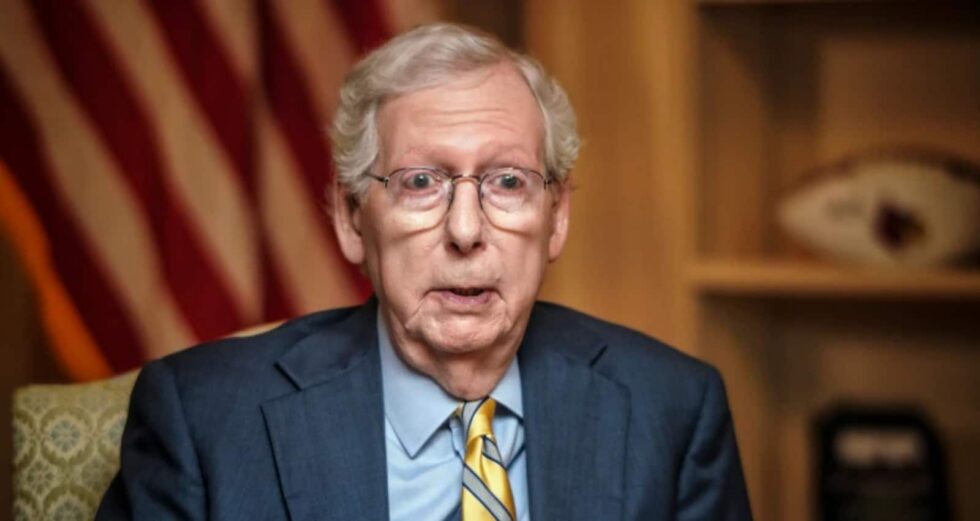
There’s been another chilling update on Kentucky GOP Sen. Mitch McConnell.
Emergency dispatch audio indicating that an individual at McConnell’s Washington, D.C., residence suffered a reported “cardiac arrest” earlier this month has renewed questions about the former Senate Republican leader’s health and whether he will return to the Senate.
Since the reported incident, McConnell’s office has provided scant details on the former Senate GOP leader’s health condition, except to say that he allegedly “appreciates the outpouring of support he’s receiving while he continues his recovery in the hospital.”
His office last week also said the 84-year-old senator “continues to improve, and is working closely with his staff on Kentucky and Senate matters while the Senate is out of session.”
The limited information released about what led to McConnell’s hospitalization on June 14, coupled with emergency dispatch audio referencing a reported cardiac arrest, has prompted renewed speculation about the severity of the senator’s condition.
Al Cross, a veteran Kentucky political journalist who has interviewed McConnell extensively in recent weeks, said the senator’s office has disclosed few details about the medical emergency, a lack of information that has fueled rumors and heightened public speculation about his health, The Hill reported.
“They’re causing themselves problems by not saying more about it, but he’s always been very private about his health matters,” said Cross.
The observer also conducted two interviews with McConnell within the past six weeks for a historical project, The Hill added.
McConnell has appeared increasingly frail during his time at the Capitol this year.
In recent months, he has frequently been seen using a wheelchair while traveling through the Senate’s hallways.
When walking into the Senate chamber, he is often accompanied by aides or members of his security detail who assist him as he moves through the building, the outlet noted.
McConnell’s office announced on June 14 that the Kentucky Republican had been hospitalized that morning and was “receiving excellent care,” but it did not disclose the reason for his admission or provide details about the seriousness of his condition.
Questions about the senator’s health intensified last week after emergency dispatch audio from the morning of June 14 indicated that paramedics responded to an address matching McConnell’s Capitol Hill townhouse and performed CPR on an unconscious individual reported to be in cardiac arrest, The Hill reported.
The recording has fueled renewed speculation about whether McConnell will return to the Senate before his term ends.
It has also prompted questions about how Kentucky would fill the seat if it were to become vacant during the final months of 2026, as Senate Republicans continue pursuing major legislative priorities, including an emergency defense spending package and the possibility of another budget reconciliation bill.
Conservative activist Laura Loomer cited a “high level source close to the White House” in a Monday post on X, writing that that McConnell’s health condition is much worse than anyone knows and is “not coming back” to the Senate.
Desirée Townsend, a digital journalist who was among the first to publish the emergency dispatch audio describing a reported “cardiac arrest” at McConnell’s residence, later reposted Loomer’s claim on social media.
She wrote: “I have heard the same thing from my sources for days.”
On June 15, Senate Majority Leader John Thune (R-S.D.) said he had spoken with McConnell following the senator’s hospitalization and told reporters that McConnell “sounded good.”
“He wants to be back, but I’ll defer to his staff on when,” Thune told Politico.
Earlier that day, Thune told reporters he was “hopeful” McConnell would return to the Senate later that week.
McConnell, however, has not cast a Senate vote since June 11.
His absence proved significant on June 23, when four Republican senators joined Democrats in approving a House-passed resolution directing President Donald Trump to withdraw U.S. forces from the military conflict with Iran.
The measure passed after both McConnell and Sen. David McCormick (R-Pa.) were absent for the vote.
This article may contain commentary which reflects the author’s opinion.