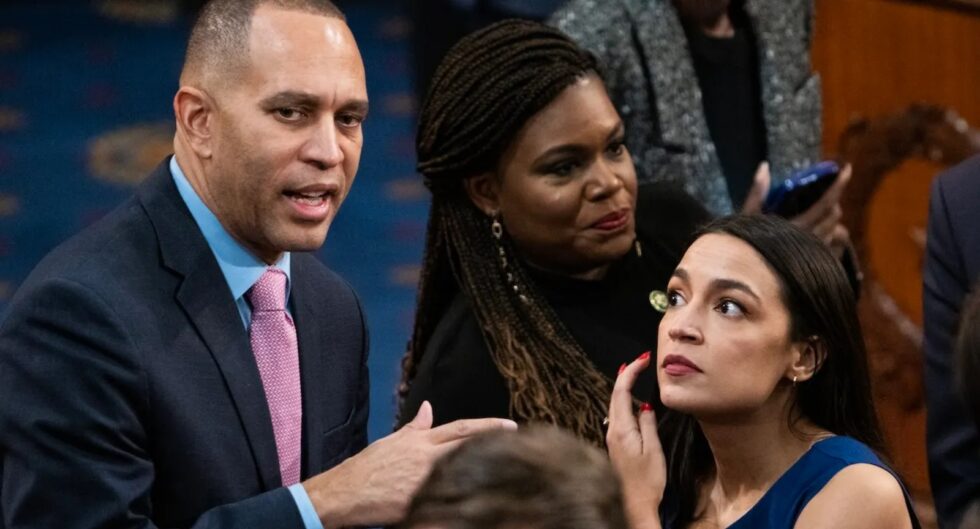
The progressive “Squad” could emerge from Tuesday’s midterms with a significantly larger bloc of allies in the House of Representatives.
Advertisement
The group that rose to prominence after Rep. Alexandria Ocasio-Cortez’s 2018 election could gain several Democratic Socialists of America-backed members.
The potential expansion could give the party’s progressive wing additional leverage if control of the House is decided by a narrow margin.
The New York Post reported that the Squad’s current seven-member core could expand to roughly 16 lawmakers after the election.
Advertisement
A broader collection of aligned progressives could approach two dozen members, although not every lawmaker supports every DSA-backed policy.
DSA has endorsed 10 congressional candidates this cycle alongside hundreds of candidates for state and local offices nationwide.
Several DSA-endorsed House candidates are running in heavily Democratic districts where their general-election contests have drawn national attention.
The organization says seven endorsed congressional candidates are positioned to serve in the next Congress, including incumbents Ocasio-Cortez and Rashida Tlaib.
The list also includes Chris Rabb, Melat Kiros, Donavan McKinney, Darializa Avila Chevalier and Claire Valdez.
Some progressive lawmakers and candidates have discussed operating as a coordinated congressional faction sometimes referred to as “the Bloc.”
Such coordination could become consequential if Democratic leaders hold only a small House majority after Tuesday.
A disciplined group of lawmakers can exercise significant influence when leadership cannot afford to lose more than a handful of votes.
That dynamic previously allowed the Squad and other progressives to influence negotiations over spending legislation and President Joe Biden’s domestic agenda.
The incoming group could push Democrats further on healthcare, immigration, housing, labor policy and the Israeli-Palestinian conflict.
Medicare for All remains one of the progressive movement’s most prominent priorities, replacing much of the existing insurance system with federally financed coverage.
Several DSA-backed candidates also support rent controls, expanded public housing and higher taxes on corporations and wealthy Americans.
Immigration could become one of the sharpest dividing lines between the progressive bloc and Republicans.
Advertisement
Some DSA-backed politicians have called for abolishing Immigration and Customs Enforcement or dramatically restructuring federal immigration enforcement.
Those proposals would collide directly with President Donald Trump’s immigration agenda, which has centered on increased ICE enforcement, arrests and deportations.
Progressive candidates have also supported expanded protections and healthcare access for transgender Americans, including broader access to gender-affirming care.
Advertisement
Other proposals associated with members of the movement include government-supported grocery stores and municipal food programs intended to lower prices in underserved communities.
New York City Mayor Zohran Mamdani prominently campaigned on creating city-owned grocery stores during his successful mayoral campaign.
Criminal justice proposals supported by some progressive candidates include eliminating cash bail, restricting life-without-parole sentences and reducing incarceration.
Foreign policy, particularly U.S. support for Israel, could create another major confrontation inside the Democratic caucus.
Several DSA-backed politicians have demanded restrictions or an end to American military assistance for Israel.
However, the emerging progressive coalition is not ideologically identical, and individual members differ significantly on specific policies and tactics.
The Squad itself has also evolved since Ocasio-Cortez, Tlaib, Ilhan Omar and Ayanna Pressley entered Congress in 2019.
Advertisement
Additional lawmakers subsequently became associated with the group, giving its members a larger platform within Democratic politics.
Ocasio-Cortez has simultaneously become one of the Democratic Party’s most prolific fundraisers, raising more than $37 million during the 2026 election cycle, according to federal campaign-finance figures cited by the Post.
Her national profile has also fueled speculation about her political future beyond the House.
A Mamdani campaign strategist recently described the DSA’s broader goal as building enough political power to reshape the Democratic Party from within.
The strategist also discussed the possibility of Ocasio-Cortez eventually seeking the presidency, although she has not announced a 2028 campaign.
Republicans have increasingly highlighted the growing socialist movement as they campaign against Democrats nationally.
Democratic leaders, meanwhile, could face difficult decisions about accommodating progressive demands if their congressional majority depends on those lawmakers.
The ultimate influence of an expanded Squad will depend heavily on Tuesday’s election results and the size of whichever party’s House majority emerges.
This article may contain commentary which reflects the author’s opinion.