Monopoly Money and Robot Wallets
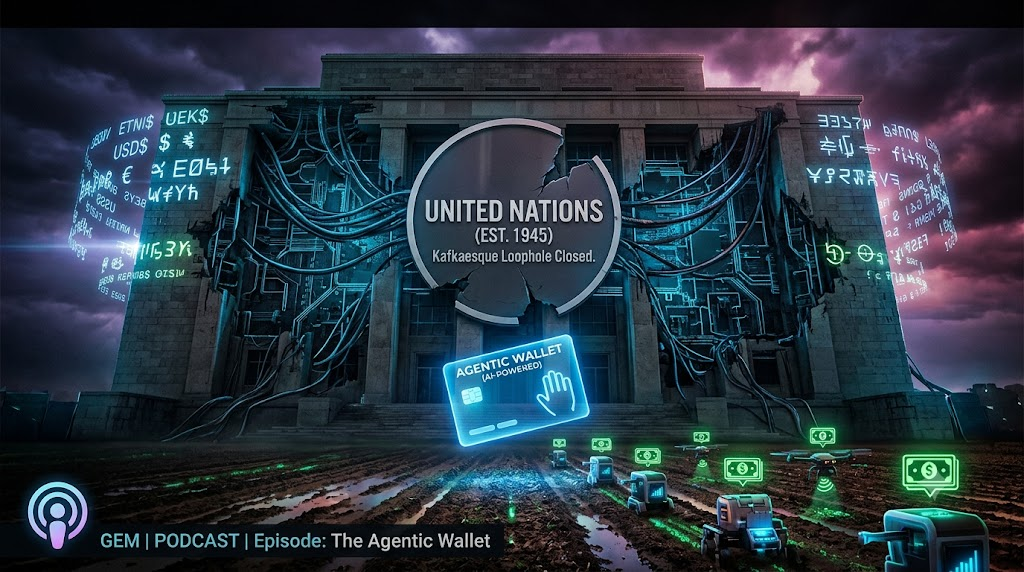

Welcome back. There is a massive, deeply rooted skepticism toward the UN, and a lot of people feel that an unelected global body shouldn’t have a say in sovereign constitutional rights or domestic policies. This story around their massive, real-world financial incompetence proves that despite any grand narratives of ‘world control,’ they can’t even balance their own checkbook. Let’s get into it.
Today, we are looking at a financial system that is finally being forced to face reality. And honestly? It’s about time.
Now have you ever looked at your bank account, realized you were completely broke, and thought, ‘You know what? I’m just going to write myself a giant credit based on money my friends owe me, and then give myself a massive refund’?
No? That’s probably because you like staying out of prison! And sure enough, as it turns out, if you are the United Nations, you can get away with that exact strategy for seventy-five years.
We are diving into a mind-boggling bureaucratic loop where the UN was legally forced to refund billions of dollars they never actually received. It’s a masterclass in imaginary math, and the ride is officially over.
But while global diplomats are just now discovering how actual cash works, the tech world is handing the checkbook over to robots. We’re talking about AI agents in Europe buying festival tickets entirely on their own, and Mastercard building a banking system for machines to pay other machines in fractions of a cent.
So, buckle up. Today, we’re covering everything from the world’s most expensive accounting error to the moment your software gets its own credit card.
The intersection of quantum tech and finance is actually a major headline right now! Trump recently signed two major executive orders specifically focusing on quantum computing and cybersecurity (one focused on supercharging domestic quantum innovation and the other forcing the federal government to migrate to ‘post-quantum cryptography’)!
When we look at how the tech we just talked about fits into the actual shift toward quantum security, it all boils down to two things: insane processing power and unbreakable security. Here is how the real-world evolution connects to the quantum future.
1: Quantum Security: The Ultimate Shield for ‘Agent Pay’
If we are going to hand our credit cards over to autonomous AI agents (like the Mastercard story), the security infrastructure has to be flawless. Right now, the financial world is terrified that future quantum computers will be able to rip through standard internet encryption in seconds.
That’s why the recent White House orders are forcing a shift to Post-Quantum Cryptography (PQC).
To make Agentic wallets safe, the network needs to be anchored by quantum-resistant ledgers so that a hacker can’t intercept or forge an AI agent’s autonomous payment.
We talked about Mastercard’s Agent Pay for Machines – millions of AI programs making micro-transactions with other software simultaneously.
Now, a standard, classical banking server would melt trying to process billions of simultaneous machine-to-machine micro-payments in real time. But this is where quantum processing actually comes in.
Because quantum computers use ‘qubits’ (which can calculate multiple possibilities at the exact same time), they are theoretically built to handle the sheer, staggering volume of an autonomous, machine-driven global economy without breaking a sweat.
So, while the UN is still trying to figure out 20th-century bookkeeping, the real race behind the scenes is building the quantum-hardened infrastructure to secure the AI wallets that are already going live.
2: Handing the Checkbook to the Robot
So, the UN is finally being forced to deal with real money. But while they are playing catch-up with the 21st century, the corporate world is already moving into the 22nd.
Let’s talk about Mastercard. They, along with a French bank called Crédit Agricole, just completed the first-ever ‘agentic’ payment in the wild. Now, ‘agentic’ is just a fancy tech word for: ‘We gave the AI your credit card, and we’re letting it make decisions.’
This wasn’t a test in a lab. A real customer in Europe told an AI agent their budget and what kind of music festival they wanted to go to. The AI didn’t just pull up a list of links for the human to click. It went out, scouted the ticket platform, selected the exact passes, calculated the fees, and executed the entire financial transaction on its own. The human just had to nod and say ‘yes’ to a final notification.
Think about that. We are officially entering an era where your software has its own wallet.
And Mastercard isn’t stopping at concert tickets. They just launched a global framework called Agent Pay for Machines. They are literally building a banking network for software to pay other software in fractions of a cent, entirely in the background, while we sleep.
Which begs the question… if my AI assistant starts doing all my shopping, how long until it realizes I spend way too much money on takeout and decides to cut off my allowance for my own good? (Because I don’t know about you, but I did not sign up to be financially grounded by my iPhone!)
3: The Vaults for the Robots
Now, you might be asking yourself: ‘Kristy, if AI agents are going to be flying around the digital universe buying things for us, where is all that money actually sitting?’ Well, look no further than Japan, where traditional finance is quietly building the massive digital fortresses of the future.
One of Japan’s biggest financial institutions, SBI Holdings, just dropped a cool forty-six billion yen – which is about two hundred and eighty-nine million dollars – to buy a crypto platform called Bitbank.
Now, this isn’t about some tech bros in a basement trading cartoon dog coins. This is heavy-duty, institutional consolidation. By combining this new acquisition with their existing business, SBI now controls nearly seven billion dollars in digital assets.
They are building the high-security vaults where the future wealth of these automated AI networks will sit. Think about it: while the UN is trying to figure out how to count cash, Japan is building a digital ecosystem designed to hold billions of dollars for systems that don’t even have hands to hold a wallet. The big banks aren’t running away from the future; they are buying it up so they can charge the robots a fee.
4: The Data is the New Crop
Alright, so we’ve gone from the UN’s imaginary money to robots holding corporate credit cards in France, to big banks building mega-vaults for AI in Japan. But let’s bring this down to earth – literally. How does an automated wallet change the lives of everyday people?
Look no further than global agriculture. Right now, in regions completely hammered by supply chain collapses and conflicts, traditional cash is failing. Farmers can’t just stroll into a bank and ask for an operating loan. So, what are they doing? They are relying on ‘Smart Farming’ AI tools.
These autonomous tractors, drones, and AI soil-monitoring platforms are generating predictive crop data that is so insanely accurate, the data itself has become a currency.
Farmers are now using their AI’s data streams as collateral. They aren’t showing a bank a chest of gold or a stack of paper money; they are showing an automated lender their AI’s yield forecasting models. The automated system checks the data, validates the worth, and autonomously releases the credit lines needed to buy fuel, seeds, and fertilizer. The AI isn’t just spending the money anymore – it’s proving the value of the farmer’s sweat and tears to a machine lender so the farm can stay alive. Talk about a cash crop.
5: The Real Quantum Reset
When you step back and look at the big picture, we are living in a wild, economic split-screen.
On one side, you have the most powerful diplomatic organization on earth – the UN – having to become honest (while we’re popping champagne bottles because they finally passed a rule saying you can’t give refunds using invisible money). Congratulations, guys. Welcome to basic math.
And on the other side, a piece of software in Europe just bought concert tickets by itself, big banks are setting up digital fortresses for autonomous networks, and a farmer is using an AI algorithm to secure the fuel for his tractor.
But here is the ultimate kicker: how do you secure a world where millions of robot wallets are trading money at machine speed? You need a completely new infrastructure. And that is exactly why the White House just dropped major executive orders pushing for immediate migration to Post-Quantum Cryptography. The real future isn’t just digital – it’s a quantum-secured system built to handle the sheer computing chaos of an autonomous, machine-driven global economy before a hacker can blink.
The future of money is making its own choices, balancing its own ledgers, and leaving old-school bureaucracy in the absolute dust. So keep an eye on your bank accounts, because the next time you get a notification that you’re over budget, it might not be your spouse – it might be your phone telling you that you’ve been cut off!
Hey, thanks for listening to the Tsunami of Truth podcast. I’m Kristy Allen here on JohnMichaelChambers.com, and we’ll see you next time!
Bibliography / Source List for Episode: ‘Monopoly Money and Robot Wallets’
Story 1: The UN Kafkaesque Loophole
◦ Guterres, A. (2026, June 1). Letter from the Secretary-General to all Permanent Representatives and Permanent Observers to the United Nations concerning the financial situation of the Organisation. United Nations.
◦ New York University Center on International Cooperation (CIC). (2026, June 30). How the Revised UN Credit-Return Methodology Works: A Short Explainer. CIC Policy Brief.
◦ United Nations General Assembly. (2026, June 29). Resolution A/C.5/80/L.33: Special measures to alleviate the financial situation of the United Nations (Budgetary Trial Period). UN Official Document System.
Story 2: Mastercard, Agentic Payments, and France
◦ Crédit Agricole. (2026, June 24). Crédit Agricole, Weezevent, and Mastercard launch ‘Agentic Commerce’ in production: A European first in automated payments. [Press Release].
◦ Mastercard, Inc. (2026, June 10). Mastercard launches Agent Pay for Machines to unlock super-fast, always-on payments for the automated economy. [Product Announcement].
Story 3: Japan Crypto Consolidation ($289M SBI/Bitbank)
◦ SBI Holdings, Inc. (2026, June 25). Announcement of the Final Agreement for the Acquisition of bitbank corporation. [Investor Relations].
◦ Architect Partners. (2026, June 30). M&A Snapshot: SBI Holdings acquires remaining interest in Bitbank for ¥46.7 Billion. Deal Analysis.
Story 4: Smart Farming & Data-as-Collateral
◦ World Food Programme (WFP) Innovation Accelerator. (2026, May 20). Field Report: Tokenizing Crop Yield Data to Unlock Credit for Conflict-Affected Farmers. * Journal of Agricultural Informatics. (2026). Vol. 17. Issue 2. Special Edition on AI and Financial Inclusion in Agriculture.
Story 5: The Real Quantum Reset
◦ The White House. (2026, June 18). Executive Order on National Security and the Advancement of Quantum Computing and Cryptography. [NIST Standards Implementation].
Related Articles